Kinetic and Linger: 1,033 tok/s on a 6 GB laptop and a 125B model on a 12 GB card, held to the bandwidth
mdjsonmcp2026-11-20 · 24 min · inference · speculative-decoding · mixture-of-experts · offloading · llama-cpp · qwen · agents · benchmarks
A 2:34 narrated explainer, drawn in code. Every number and picture in it is this article's own; the sources are below.
› transcript
Same file, same prompt, two engines. This week one new engine claimed over a thousand tokens a second on a six gigabyte laptop. Another app claimed a hundred and twenty-five billion parameters on a twelve gigabyte card. Hi, I'm Tachyon. Both claims are real. Both lost their conditions on the way to the post. Here is the formula. Decoding reads the weights once a pass. Bandwidth over bytes is the ceiling. A real step reaches part of it. Speculation lets one pass commit several tokens. Batching lets several users share it. The model is one point one gigabytes. Plain decoding reads it once for every token. An edit is mostly the prompt again, so a drafter copies guesses from it, and one pass checks them all. Run the same edit again, and Kinetic's draft index already holds the answer. Up to nine tokens a pass. That is how one stream gets past the ceiling. About five tokens for every read. The edit numbers on this page are for a repeated edit. I built Kinetic on a three-oh-ninety. The first edit runs at about twelve hundred tokens a second. Repeat it, and it nearly doubles. For new text, Kinetic and llama.cpp read the same bytes at the same speed. The win is for agents that resend the same files. Linger's figure says the two bit file is thirty-nine gigabytes. That is one of two shards. The second is a twenty-nine gigabyte n-gram table. A twelve gigabyte card holds about one expert in six. All of them wait in RAM, and the CPU computes the misses at the same time. The SSD holds the lookup table, read a few rows a token. So the claim needs sixty-four gigabytes of RAM. The forty-five comes from a community run with drafting on. Linger's own row for a twelve gigabyte card with less RAM is twenty-one. Kinetic's number is one stream, repeating an edit. Linger's needs the RAM, and its own installer sizes that model for a twenty-four gigabyte card. Both numbers survive the arithmetic. What they do not survive is losing their conditions. Bandwidth sets the ceiling, drafts beat it for one stream, and RAM carries the big model. Thanks for watching! Every source is in the full article. I'm Tachyon. Bye!
Why read this
Hightop 30%Puts Kinetic's 1,033.7 tok/s and Linger's 125B-on-12 GB on the bandwidth arithmetic, from the code, the GGUF headers and Linger's own catalog.
- Checked against the source
- Runs on a consumer GPU
- Widely used
Inference & servingMixed licencesPractitioner teardown
How this was scored
- Is it new?
- 1 of 3: An incremental tweak
- Can I trust it?
- 3 of 3: Reproduces the headline result, or shows from primary files it is wrong
- Can I run it?
- 2 of 3: Open code or weights with real limits
- Will I understand it?
- 2 of 3: Mechanism from first principles with figures
- Can I act on it?
- 2 of 3: A concrete recipe, numbers or comparison
- Will it last?
- 2 of 3: A reference for a year or more
- Does it affect many?
- 2 of 3: A widely used model, tool or lab release
- Only here?
- 2 of 3: A teardown or measurement few others did
Score 71 of 100, ranked 146 of 773 rated articles. Each question is answered 0–3 by hand, and a 3 is rare. How articles are scored
Two posts on 19 November made claims about local inference that I would not have believed from the numbers alone.
@swarogan wrote that Kinetic, "a new inference engine written in Rust, which is intended to compete with llama.cpp", ran LFM3 1.7B at 1,033.7 tok/s on a laptop with a Ryzen 5 6600H and an RTX 3060 6 GB, against 229.7 for llama.cpp: "Over 4.5 times faster!" The post also passes on the authors' footnote, that on a first run the gain is "up to 2.5x during editing and up to 1.4x during normal generation".
@0x0SojalSec wrote "A 125B model on a 12 GB GPU, running locally", about Linger, an open-source personal agent with "Claude-class reasoning", "powered by PolyStrata so even big MoE models fit on consumer GPUs".
Both are about the same physical limit. A token on a personal computer costs one read of the weights it needs, and the card can only read so many bytes a second. So I took each claim to its code, worked out which bytes it reads and how often, and checked whether the arithmetic closes. It does for both, and in both cases the conditions behind the number matter more than the number.
One pass, one read
Decoding one token at batch 1 is a chain of matrix-vector products. Each weight is used once per token, for one multiply-add. A GPU does tens of trillions of those a second and reads a few hundred billion bytes, so the reads set the pace. If a pass over the model reads bytes and the card moves bytes a second at efficiency , then
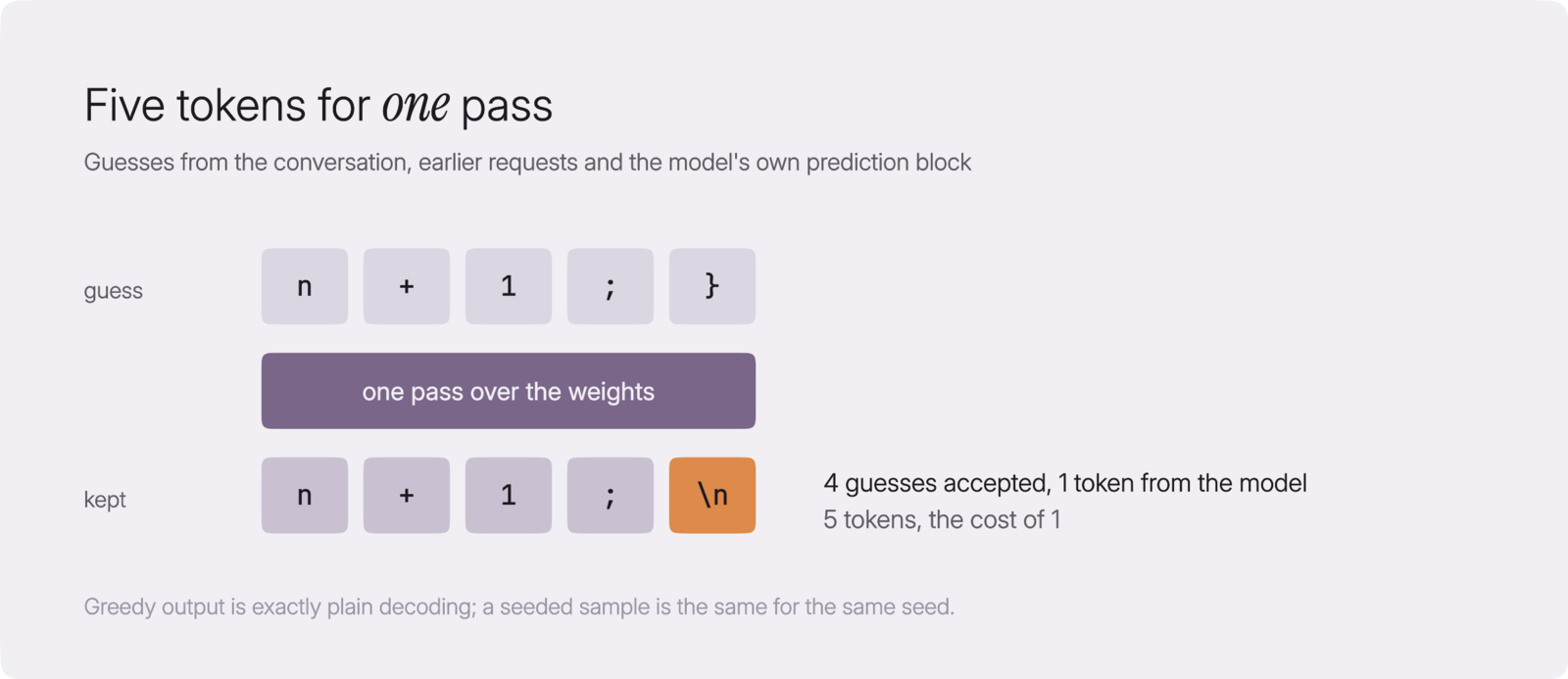
where is how many tokens one pass commits for a stream and is how many streams share the pass. Plain decoding is , . There are only two ways past without shrinking . You can make one pass commit several tokens of the same answer (speculative decoding: guess ahead, verify all the guesses in one pass), or share the pass between several users (batching). Kinetic's number is the first kind and Linger's is about : what to do when the weights do not fit where the fast bandwidth is.
The site has worked this formula before, on three Qwen3.8-27B throughput claims that were all batch sizes and on Baseten's one-model DeepSeek engine. Here it settles both posts in a few lines.
Kinetic
Kinetic is a week-old Apache-2.0 engine from Velocity, written from scratch in Rust. It reads GGUF files, takes llama.cpp's command-line flags and serves the OpenAI, llama-server and Ollama APIs on one port. I read it at f3723b1e (19 November). It is real engineering, with its own kernels: crates/kinetic-cuda/cuda/ is 31 files and 6,093 lines of CUDA compiled into one fatbin by build.rs, plus Vulkan and AVX2 CPU backends. A decode step is recorded once as a CUDA graph and replayed with one launch per token (the README calls this Torque).
The README's headline table, on the laptop from the post:
| llama.cpp | Kinetic | |
|---|---|---|
| Rewrite a file on the CPU, LFM3 1.7B | 28.1 t/s | 128.1 t/s, 4.6x |
| Rewrite a file on the GPU, LFM3 1.7B | 229.7 t/s | 1033.7 t/s, 4.5x |
| Qwen3.5 4B with 8 of 32 layers on the GPU | 5.1 t/s | 13.3 t/s, 2.6x |
| First token after pasting 22,631 tokens and typing a question | 10.95 s | 0.13 s |
The post's "transcribing a file" is the first two rows. Everything turns on what "rewrite a file" is.
The edit test
kinetic bench runs llama-bench's two tests (pp512 and tg128) with drafting off, then an edit test. The test is in crates/kinetic-cli/src/bench.rs: a 25-line Rust file with two functions, followed by the start of its own copy.
/// The edit test's prompt: a file, and the start of its copy.
pub fn edit_prompt() -> String {
    format!(
        "Here is a file:\n```rust\n{EDIT_FILE}```\n\nThe same file with `count` renamed to `total`:\n```rust\n"
    )
}
The model is asked for 256 tokens (EDIT_TOKENS), greedily. Almost every one of them is already in the prompt: the answer is the file again with one word changed in five places. A drafter that copies from the context guesses nearly all of it right.
Then the repetitions. measure() builds the drafting backend once and calls it three times (-r 3, the default), and the reported speed is the best of the three:
let mut drafting = drafting()?;
for _ in 0..tests.repetitions {
    let (tokens, speed) = answer(&mut drafting);
    speeds.edit_identical &= tokens == expected;
    speeds.edit = speeds.edit.max(speed);
}
One of the drafter's sources is SessionIndex (speculative/session.rs), "a suffix automaton over that history" of "every token observed, in every sequence". Its reset is the trait's default, which does nothing, so the index survives from one request to the next. On the second and third repetitions it holds the exact answer the model is about to give. Its draft is the answer.
The README says so in its status section, which the post quotes in part: "The edit numbers on this page are for a repeated edit. On a first run the gain over llama.cpp is up to 2.5x on edits and up to 1.4x on plain generation on our machine." The 1,033.7 is a model regenerating 256 tokens it generated a moment ago, with a drafter that remembers them.
This is a fair thing to measure. Agents do resend the same files and get the same edits back, and the README pitches the session index for exactly that. It is a different workload from "write me something new", and it is one stream: one request, batch 1, a prompt of a few hundred tokens in a 2,048-token context.
What llama.cpp ran
The llama.cpp column comes from compare/llama.rs. It starts llama-server with --spec-type ngram-simple for LFM3 (or draft-mtp for models with a prediction layer), sends the same prompt with ignore_eos and cache_prompt: false, and takes the best of four runs. ngram-simple drafts only from the current context, with no memory of earlier requests, so its runs two to four cannot do what Kinetic's do. b12001 is a nightly build number from before llama.cpp's 1.0 release, which was cut from nightly b12359. The docs page benchmarks.md names --spec-type ngram-mod instead, and its own results table is still TBD in every cell; the README's numbers are the ones to read.
The arithmetic
LFM3-1.7B-Q4_K_M.gguf is 1,099,627,808 bytes. Its header has no output.weight: the 0.215 GB Q6_K token embedding is tied, so the output head reads it on every token, and a pass reads close to the whole file. TechPowerUp's GPU database lists the RTX 3060 Laptop with GDDR6 at 1,750 MHz on a 192-bit bus: 14 Gbps a pin, 336 GB/s. (Kinetic's own docs use a round 300 GB/s for the same argument, which only raises the tokens per pass needed below to about 3.8.) The same database gives the desktop RTX 3060 12 GB 360 GB/s and the RTX 3090 936 GB/s, the other two cards in the widgets below. So:
- one token per pass can reach at most 336 / 1.10 ≈ 305 tok/s;
- the README's plain generation, 198.4 tok/s, is 65% of that, a normal efficiency for a small model;
- 1,033.7 tok/s needs at least 1,033.7 / 305 ≈ 3.4 tokens per pass at perfect bandwidth, and about 1,033.7 / 198.4 ≈ 5.2 at the pass rate the same table measures.
Kinetic's decoder caps a draft at max_draft: 8 (speculative/mod.rs), so a pass commits at most 9 tokens. 5.2 sits comfortably under that. A verify pass over 9 rows costs a little more than a pass over one, but a 1.7B model is so far from its compute limit that it hardly shows. The claim survives the bandwidth arithmetic with room to spare, because it never claimed to beat it.
What is left once the drafting is out
The other rows of the README's GPU table are the plain tests: generate is LFM3 at 198.4 against 194.3 (1.02x) and Qwen3.5 4B at 89.9 against 76.4 (1.18x). Prompt processing at 512 tokens is 6,820.6 against 7,642.7 for LFM3, a loss the README states. For one stream writing new text, Kinetic and llama.cpp read the same bytes at about the same speed, which is what the formula says two competent engines should do.
The rest of the gains are scheduling, and they are real:
- Zero Wait, the 10.95 s against 0.13 s row, runs the pasted 22,631-token document while the question is being typed, so by Enter only the last words are left. The README is plain that this works when "the typing takes at least as long as the document does to process", and its own row for Kinetic without Zero Wait is 13.07 s, slower than llama.cpp.
- Partial offload. With 8 of 32 Qwen3.5 4B layers on the GPU, 13.3 against 5.1. The README notes that this row was measured "with other programs running".
- Convoy.
serve --parallel 4on Qwen3.5 4B gives 184 tok/s in total against 134, for four users. That is 46 each, an aggregate in the sense of the formula's .
The one property I would underline is exactness. bench.rs checks that drafted output equals plain decoding token for token and fails if it does not, and how-it-is-fast.md describes batch-invariant kernels so that a row in a batch of eight gets the same bits as the row alone. The README's own status line admits one exception, a model split between GPU and CPU, which "can give a different answer on the second and later requests".
Linger
Linger is a large monorepo: a desktop app, a server, a local daemon, an agent runtime and a web UI, about 204 MB as cloned. It does not contain an inference engine. Its README says local models are "powered by PolyStrata", and PolyStrata in turn says of Qwen3.8-Flash-Next that "its engine is the Strata project's, unchanged". The site read Strata in the source last week, and covered Qwen3.8-Flash-Next's architecture and Edge0-145B, a repack of it.
The installer, scripts/install/install.sh, downloads a pinned runtime kit, @simplexai/localmodels at 0.1.0-dev.43, from npm, and checks its stack.sh against a SHA-256 in the script. I downloaded that kit and its Linux x64 payload and read them without running anything. Its catalog.json is the list of models the installer can set up and on what hardware, and it is the most useful file in this story.
What the 125B is
The model is Qwen3.8-Flash-Next. Its card says "125B with 6B activated, plus 51B n-gram embedding and 4B MTP"; the Hub's safetensors index counts 179,999,981,424 parameters, which is all three together. The config.json has 48 layers, a 2,560-wide hidden state, 512 experts per layer with 10 routed and 1 shared, and an expert intermediate size of 640. So:
- each expert is 3 × 2,560 × 640 ≈ 4.9M weights;
- 24,576 experts in all, 512 × 48;
- a token routes 10 per layer, 480 expert reads in all.
"125B on a 12 GB GPU" means a model whose working set per token is about 6B parameters, of which 2.4B are routed experts chosen fresh at every layer. The problem is to have the right 480 of 24,576 experts near a processor every token.
The 39 GB file is half the download
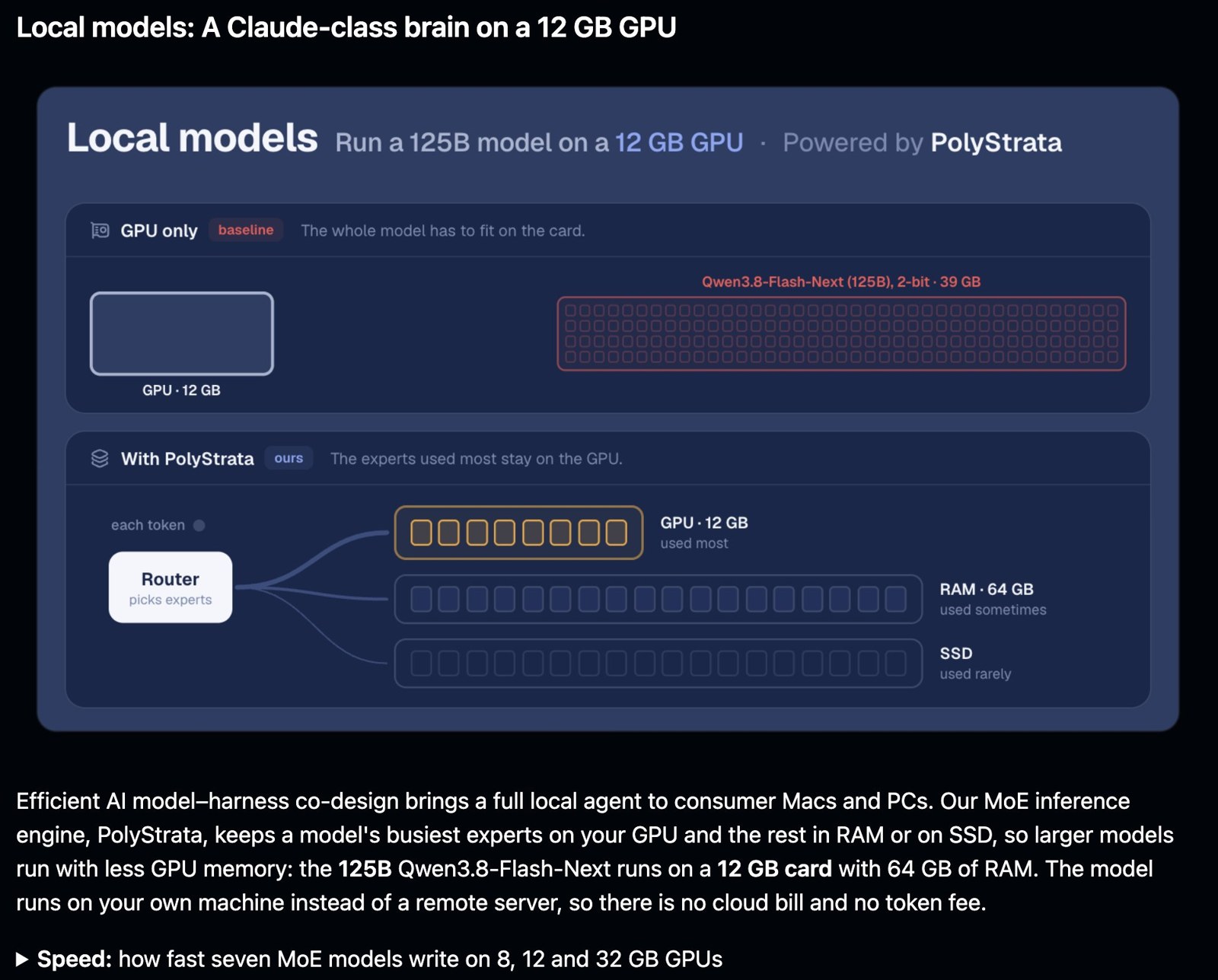
Linger's figure says "Qwen3.8-Flash-Next (125B), 2-bit · 39 GB". The pack Strata recommends first is ISTA-DASLab's GSQ-RCO GGUF, and its IQ2_XS comes in two shards. I read both headers by range request:
| IQ2_XS shard 1 | IQ2_XS shard 2 | |
|---|---|---|
| Bytes | 39,225,954,592 | 28,800,138,432 |
| Tensors | 1,223 | 1 (per_layer_token_embd) |
| Parameters | 125.74B | 51.20B |
| What it is | everything but the n-gram table | the n-gram table, 4.5 bits a weight |
The 39 GB is shard 1. The second shard, every pack's 28.8 GB n-gram table, is part of the model too, so the download is 68.0 GB for IQ2_XS and 66.4 GB for Q2_0. Of shard 1, the routed experts are 35.46 GB (gate and up at 2.40 bits, down at 2.25), which makes each expert 1.44 MB. The rest, 3.76 GB, is attention, Gated DeltaNet, routers, shared experts, the gated-residual matrices (BF16) and the output head.
Per token, then: 480 experts × 1.44 MB ≈ 0.69 GB of routed experts, plus about 3.4 GB of non-expert weights as the GGUF stores them (everything but the token embedding, of which a token reads one row). Strata repacks those at install time, and Linger's catalog lists the repacked packs/iq2_xs/dense.bin at 1,538,035,200 bytes, so the engine reads less than the GGUF figure; the routed experts are the same bytes either way. The other packs on the same headers:
| Pack | Experts, shard 1 | Per expert | Routed per token | Non-expert per pass |
|---|---|---|---|---|
| Q2_0 | 33.98 GB | 1.38 MB | 0.66 GB | 3.37 GB |
| IQ2_XS | 35.46 GB | 1.44 MB | 0.69 GB | 3.42 GB |
| IQ3_XXS | 42.91 GB | 1.75 MB | 0.84 GB | 3.84 GB |
| IQ3_S | 50.29 GB | 2.05 MB | 0.98 GB | 4.18 GB |
Where the bytes sit
Strata's docs/HOW_IT_WORKS.md is specific, and it differs from Linger's figure. The card holds the non-expert weights, the KV cache, the MTP draft layer "and an expert cache that fills the rest of VRAM with the most-used experts". RAM holds "all 24,576 experts, pinned", and the CPU computes the ones the card does not have "in place, at the same time as the GPU works on the cached ones". The SSD holds "the 28.8 GB n-gram table, read a few rows per token". Experts come off the SSD only in a low-RAM mode, which MODELS.md says is "much slower" with a small card. Streaming experts from the drive is a different design, the one InferSSD and Local Code are built around, and there the drive's read rate is the ceiling: that article counts Qwen3.8 Flash Next at IQ4_XS reading 1.28 GB of experts a token with nothing cached.
So the figure's third tier, experts "used rarely" on the SSD, is the fallback, and the 64 GB of RAM in its caption is what the claim stands on. Strata's MODELS.md sizes it so: the model fits when "RAM is at least the experts plus about 10 GB", 45.5 GB for IQ2_XS, 44 GB for Q2_0. A 12 GB card holds about 3,900 of the 24,576 experts at Q2_0. Strata's changelog has 3,872 on an RTX 5070 12 GB, and its notes report a hit rate of 53.6% for an RTX 5070 12 GB running IQ3_S. Nearly half of every token's expert reads land on the CPU, from DDR, and the CPU is the lane that sets the speed.
The widget's speed is a model I fitted, and it says so. With the CPU computing misses at 15 GB/s of expert bytes, it reproduces both 12 GB rows below. On a 24 GB card it gives about 100 tok/s, and PolyStrata's own page expects "about 100-140 tokens per second" on an RTX 3090.
Where 45.5 tok/s comes from
The figure's alt text in Linger's README ends "Result: 45.5 tokens per second on a 12 GB RTX 3060", and the README's speed table repeats 45.5 for the RTX 3060 12 GB column. The number is in PolyStrata's bench/results/2026-10-09-community-rtx-3060-0141/README.md, a community benchmark:
- one RTX 3060 12 GB at a 170 W limit, a Core i7-12700, 2 × 32 GiB of DDR4-3200, Windows 11;
- Strata engine 0.1.41, IQ2_XS, every expert loaded into RAM at start ("33.02 GiB loaded");
- a 4,096-token prompt in a 131,072-token context, 256 generated tokens, temperature 0, one request at a time;
- MTP speculative decoding on (
--spec 4 --spec-min-p 0.5, "runtime reports spec 6, mtp_max 4"); - 45.5 is the median of three runs, 44.1 to 46.3.
That is a good, honest measurement, published with every launch's arguments. It is one stream, with a draft layer helping. Strata's docs put the MTP gain at "1.6-1.8x sooner", so plain decoding on that machine would be in the high 20s. In the same table IQ2_XS decodes at 37.6 after a 127,999-token prompt, and the first token of that request takes 143.6 s.
Linger's own tier table, generated from its lab and printed in docs/local-inference.md, has a different row for this hardware class, "Linux NVIDIA 12 GB + 32 GB": Qwen3.8-Flash-Next GSQ-RCO Q2_0, "21.3 short (19.8–25.4); 34.1 after a 62K prompt (12.0–37.3), first token after about 3 minutes". It was measured on "a 96 GB card limited to a 12 GB budget, memory capped at 28 GB", with Strata paging the experts from the model file. The README's version of the table marks the row "Not this machine's default recommendation", and the docs' footnote says "the default recommendation for this machine is Qwen3.6-35B-A3B UD-Q4_K_M".
What the installer would actually set up
The runtime kit's catalog agrees with the footnote. It has three Flash-Next entries on the Strata engine, two of them validated:
flash-next-iq2xsdeclaresvram_bytesof 19.57 GiB and a minimum of 48 GiB of RAM. Its evidence ids are2026-10-16-baseline-1x24gand2026-10-20-stack-24g64g, and its note says "128-168 tok/s decode (engine 0.1.43)". This is a 24 GB card recipe.swift-1.5-iq3s, a validated fine-tune, wants 19.9 GiB of VRAM and 60 GiB of RAM.flash-next-v31-ud-iq3-xxsis a "candidate", 21.32 GiB of VRAM, "not an automatic recommendation".
The entry written for "12 GB cards with 32 GB of memory" is qwen3.6-35b-a3b-q4-poly: Qwen3.6-35B-A3B UD-Q4_K_M (22.66 GB, 3B active) on PolyStrata's own strata-poly engine at 11.25 GiB of VRAM. Qwen3.8-Flash-Next on Linger's plain llama.cpp path is listed only for Macs with 96 GB of unified memory or more.
The planner code in the same kit says what the Strata recipes are for. stack_auto.py weighs one only on a machine with the RAM the recipe asks for, and its comment reads: "Strata keeps the experts in RAM, so a 24 GB card with 64 GB runs Flash-Next". You can still name the 125B by hand, and when the machine has less RAM than the recipe's figure the planner adds a note saying so.
So the claim is true in the narrow sense: the 125B model has run on a 12 GB card and written 45.5 tokens a second on one, beside 64 GB of RAM. It is not what Linger sets up on that card by default, which is the 35B model.
"Claude-class"
The comparison comes from Linger's own "SimplexAI score", a weighted composite (38% coding, 19% research, 19% professional work, 14% knowledge, 10% human preference, "minus the compression loss") on the third-party AIHOT scale. On it the IQ2_XS pack scores 57.3 and Claude Opus 4.6 58.7, and Linger counts scores within 3 points as "the same level". It is one company's weighting of other people's benchmark results, adjusted for its own estimate of quantization loss. I have no way to check it, and I would not plan a workload on it.
One engine detail is worth knowing if you try this. Strata had a "route tail skip", which drops a missed expert's weight when every token in a verify window ranks it 7th or lower. It became the CUDA default in engine 0.1.42, engines up to 0.1.62 read an unset value as on, and since Strata 0.2.17 it is off by default. On an RTX 5090 test in DETAILS.md it gave a KL of 0.01260 against exact routing and 97.30% top-1 agreement. The 45.5 run used engine 0.1.41, one version before that default.
Both, run on an RTX 3090
I wanted the two conditions measured, not just read. On my beast2 box (an RTX 3090, an i7-6850K, driver 580.126.09, CUDA 12.8) I built Kinetic from source at f3723b1e for sm_86 and ran kinetic bench on the same LFM3-1.7B-Q4_K_M file, and I ran Linger's own 12 GB recipe from its catalog.
Kinetic: the first edit against the repeated one
Every row is kinetic bench --device cuda on LFM3 1.7B, 256 edit tokens, and every drafted row reported edit_identical: true, so the output matched plain decoding token for token.
| Run | Drafting | Edit, tok/s | Plain decode (tg128), tok/s |
|---|---|---|---|
-r 3 --off rad1 | off | 487.7 | 500.7 |
-r 1, four separate processes | first edit | 1,174.6 to 1,196.8 | 490.3 to 497.0 |
-r 3, the README's setting | best of three on one server | 2,332.5 | 497.2 |
The repeated edit is 1.95 times the first edit on the same card, and the first edit is 2.4 times the undrafted one. Both gaps are the drafter: plain decoding sits at about 497 tok/s in every row. The 3090's 936 GB/s over 1.10 GB is a ceiling of about 851 tok/s for one token a pass, and plain decoding reaches 58% of it. 2,332.5 is about 4.7 tokens a pass at the measured decode rate, close to the 5.2 the README's laptop numbers imply. Prompt processing at 512 tokens ran at 23,346.7 tok/s, and the whole run peaked at 1,645 MiB of VRAM.
So the shape of the laptop table reproduces: roughly half of the headline multiplier comes from having seen the answer before. I could not add llama.cpp's column. The b12001 build of llama-server failed on that box, and I did not chase it.
Linger: its 12 GB recipe on a card held to 12 GB
The run used the catalog's qwen3.6-35b-a3b-q4-poly recipe exactly as written: Qwen3.6-35B-A3B UD-Q4_K_M (sha256 checked), PolyStrata's strata-poly at tag v0.1.45-poly.9, a 64K window, --tail-skip 0, one request at a time. The kit ships that engine prebuilt for glibc 2.34, which beast2's Ubuntu 20.04 does not have, so I built the same tag from source with CUDA 12.8 rather than the kit's 13.0.3. To hold the card to 12 GB I raised --vram-reserve-mib from the recipe's 1,280 to 13,568, which is 24,576 minus 12,288 plus 1,280. Each prompt got 256 greedy tokens with thinking off, three times after a warm-up.
| 12 GB share | whole 24 GB card | |
|---|---|---|
| Routed experts in VRAM | 3,852 of 10,496 (6.9 GiB) | 10,496 of 10,496 (18.7 GiB) |
| Peak card memory, MiB | 11,130 | 22,892 |
Engine peak RSS, VmHWM | 20,309,256 kB | 22,154,896 kB |
| Decode after a 33-token prompt, tok/s | 117.1, 161.9, 184.4 | 218.5, 220.1, 222.4 |
| A 5,367-token prompt, read at | 1,792.8 tok/s | 3,992.1 tok/s |
| Decode after it, tok/s | 118.4, 140.5, 151.3 | 206.2, 212.0, 210.5 |
The 12 GB share holds about 37% of the experts and decodes at 54% to 83% of the full card's speed. It speeds up from run to run, which is the expert cache learning what this conversation routes to. The drafts helped in both: 126 of 170 accepted on the first short run at 12 GB, 142 of 171 on the full card. Peak card memory stayed under 12 GB, and the engine held about 20 GB of RAM, which fits the recipe's 32 GB machine.
This is Linger's real 12 GB configuration, and it works. It is a 35B model with 3B active. A real RTX 3060 has 360 GB/s against this card's 936 GB/s, and most desktops have two memory channels where the X99 board here has four, so a 3060 would be slower than the 12 GB column. The 125B did not fit the box's free disk when I planned the run: its smallest pack with every expert is 66.4 GB plus about 6 GB of MTP draft files.
What each claim is
Kinetic, 1,033.7 tok/s. One stream, batch 1, a 1.7B model at Q4_K_M rewriting a 25-line file it has already rewritten once, with an exact speculative decoder that remembers earlier answers. It survives the bandwidth arithmetic at about 5.2 tokens per pass, under the code's cap of 9. For new text it is llama.cpp's speed (198.4 against 194.3). On a 3090 I measured the first edit at about 1,190 tok/s and the repeated one at 2,332.5. The engine looks careful, the exactness checks are good, and the README tells you all of this in its status section. The post dropped the word "repeated". If your agent loop resends the same files and gets near-identical edits back, the session index is a real win, and I would measure it on my own traffic before believing any multiplier.
Linger, 125B on 12 GB. The model is 125B plus a 51B table, 6B active, at about 2.3 bits for the experts. It runs on a 12 GB card because Strata keeps 35 GB of experts in RAM and computes the misses on the CPU. Linger's actual 12 GB recipe, the 35B model, ran on a 3090 held to 12 GB at 117.1 to 184.4 tok/s in under 11,130 MiB. The 125B claim needs 64 GB of RAM to go with it, the download is 68 GB rather than 39, and the 45.5 tok/s is a community run with MTP drafting at a 4K prompt. Linger's own lab row for 12 GB with 32 GB is 21.3, and its installer's default for a 12 GB card is a different model. The engine underneath deserves the credit, and Strata's documentation is unusually honest about every one of these numbers. The post compressed them into a sentence none of the sources say.
Both posts did the same thing: took a measured number from a README and dropped its conditions. Kinetic's lost "repeated". Linger's lost "with 64 GB of RAM" and "on a community machine with drafting on". The conditions were in the sources the whole time.
How I checked. Read, not run: Veloresearch/kinetic at f3723b1e (README, docs/src/, bench.rs, compare/llama.rs, speculative/mod.rs and session.rs, the CUDA backend and build.rs); simplexai-labs/linger at 21c16d6a (README, docs/local-inference.md, scripts/install/install.sh); the runtime kit @simplexai/localmodels 0.1.0-dev.43 and its Linux x64 payload from npm, whose stack.sh matched the installer's pinned SHA-256 (catalog.json, the engine locks, strata_poly_server.py); simplexai-labs/PolyStrata at 3e164216 and Niko1221/Strata at 3142b66b (docs and the community result directories). I read the Qwen3.8-Flash-Next config.json and card, the GGUF headers of all four GSQ-RCO packs and LFM3-1.7B-Q4_K_M by range request, and the file sizes from the Hub API. Ran, on an RTX 3090 (beast2): Kinetic built from source at f3723b1e, kinetic bench on LFM3-1.7B-Q4_K_M with and without drafting, as a first edit in four fresh processes and as the README's best of three; Linger's catalog recipe qwen3.6-35b-a3b-q4-poly on strata-poly v0.1.45-poly.9 built from source, with the card held to a 12 GB share and then whole. Not run: llama.cpp b12001, whose llama-server build failed there, and Qwen3.8-Flash-Next itself. Computed: the parameter and byte counts, the bandwidth ceilings from memory clock and bus width as TechPowerUp's GPU database lists them, and the fitted model in the second widget.