2026-11-16 · 23 min · llama-cpp · gguf · inference · quantization · on-device
A 2:40 narrated explainer, drawn in code. Every number and picture in it is this article's own; the sources are below.
› transcript
Runs on the hardware you already have. Runs every model. And now, for the first time, a major version. So what does the one in front of the dot actually promise? Hi, I'm Wexley. I diffed the last zero release against one point oh. Here is where the promise starts and stops. For years, llama.cpp had no versions, only build numbers. This release was cut from nightly twelve thousand three hundred and fifty-nine. Semantic versions started in August. Eleven more tags in three months. Under zero point x, any of them was allowed to break anything. One point oh changes the rule. A breaking change to the headers in include now bumps the major, and the library's soname follows it. Callers pass this struct by value, so its layout is compiled into every program. Here it is from byte eighty on. One point oh deletes a deprecated float. But a pointer has to start on a multiple of eight, so the gap becomes padding and nothing moves. The new field is what breaks it. A float at byte one hundred and twenty, and every field after it slides eight bytes. A binary built against the old header would hand its callback to the wrong field, silently. That is what the soname bump catches. Now the file. A GGUF starts with a magic word, a version, and two counts. Then metadata, then one record per tensor with its type and an offset. The data is stored exactly as the kernels read it, so loading is a memory map. I parsed one real file by range request: a hundred and forty-seven tensors. Sorted by type, Q4_K_M turns out to be a mix. The embedding and half the down projections stay at six bits. Here is a file from 2024 in the same repository. As a container, it is perfectly valid version three. But most of its tensors use a type that was removed, and the reader stops at the first one. One point oh promises nothing about GGUF. I built both releases on a three-oh-ninety and ran the same files. Decode speed did not move: every gap is inside the noise. The quant matters more than the release. Smaller files decode faster, until the codebook formats: the smallest file here is slower than Q4_0. One point oh binds the C headers and the soname. Your GGUF files are on their own: keep the source checkpoint. The headers are promised, the struct moved for a new field, and GGUF has no promise. Thanks for watching! Every source is in the full article. I'm Wexley. Bye!
Why read this
Notabletop 60%Diffs v0.9.0 against v1.0.0 to say what 1.0 binds (the C headers, the soname) and what it leaves out (GGUF, the server, experimental headers), on real files.
- Original analysis
- Runs on a consumer GPU
- Widely used
Inference & servingMITPractitioner tool
How this was scored
- Is it new?
- 1 of 3: An incremental tweak
- Can I trust it?
- 2 of 3: Measures key facts from files, code or configs
- Can I run it?
- 2 of 3: Open code or weights with real limits
- Will I understand it?
- 2 of 3: Mechanism from first principles with figures
- Can I act on it?
- 2 of 3: A concrete recipe, numbers or comparison
- Will it last?
- 2 of 3: A reference for a year or more
- Does it affect many?
- 2 of 3: A widely used model, tool or lab release
- Only here?
- 2 of 3: A teardown or measurement few others did
Score 66 of 100, ranked 282 of 773 rated articles. Each question is answered 0–3 by hand, and a 3 is rare. How articles are scored
Georgi Gerganov posted it in one line on 13 November: "llama.cpp v1.0.0 is now available", with a link to the announcement on the Hugging Face blog. A second post four minutes later called it "the first major version of llama.cpp and ggml" and carried a 33-second launch film.
The film is about reach. The release itself is about something narrower and more useful to anyone who links against the library: from now on, a breaking change to the public C API bumps the major version. That is the whole promise, and it is worth knowing exactly where its edges are, because the thing most people actually depend on, the GGUF file sitting in their model directory, is outside it.
LLM inference in C/C++
- license
- MIT
- branch
- master
- forks
- 25.9K
- open issues
- 2.6K
- tests
- 255 files
- source
- 46.1 MB
- commit date
- 2026-11-23
Read at tag v1.0.0 (commit b1b770d, nightly b12359) and diffed against v0.9.0 and v0.1.0. Release notes from the GitHub release objects of llama.cpp and ggml.
GitHub REST API, 2026-11-23 — branch, commit, commitDate, createdAt, description, forks, homepage, languages, license, openIssues, pushedAt, stars, topics
local clone, 2026-10-06 at 212c547 — fileCount, hasTests, licenseFile, shallow, testFileCount
shallow clone: counts describe the pinned tree, not the history
Twelve thousand builds and no version
For most of its life llama.cpp did not have versions. It had build numbers. Every commit on master produced a nightly
tagged b plus the commit count, and downstream projects pinned whatever number worked for them. The nightly this
release was cut from is b12359. One reply under the announcement put the old situation well: binding maintainers can
now "read a bump as 'the C API broke', not 'it's Thursday'".
Semantic versions arrived in August. A ggml discussion opened on 7 August, "releases and versioning of ggml-org projects", lays out the scheme that 1.0 now completes:
- Nightlies keep their
b[NUM]tags and build with-DLLAMA_BUILD_IS_DEV=ON, which appends-devto the version string. - Releases are tagged
vX.Y.Zand built with-DLLAMA_BUILD_IS_DEV=OFF. - llama.cpp vendors its own copy of ggml, and "the release tags are created on the condition that the internal
ggmlcopy is identical to the releasedggmlcopy". That rule is what lets Homebrew and Debian build llama.cpp against a system-wide ggml package and know the two match.
The first tag under that scheme, v0.1.0, is dated 17 August 2026. Eleven more tags followed in three months, through
v0.8.0 on 28 October and v0.9.0 on 4 November. Then the ggml 1.0.0 release went up at 08:34 UTC on 13 November and
llama.cpp's at 10:20 UTC. The v0.9.0 to v1.0.0 changelog lists 249 commits; the tree diff between the two tags touches 1,092
files.
So 1.0 is not the first versioned release. It is the first release that says the version means something about
compatibility. During 0.x, semver's own rules let any minor bump break anything, and the project used that freedom: the
deprecated functions that 1.0 deletes were sitting in llama.h at v0.1.0 too, 39 lines of DEPRECATED( markers then and
at v0.9.0.
What the major version binds
The announcement's rule table is three rows long. MAJOR is a "breaking change to the public C API in ./include". MINOR is
a "backward-compatible feature, backend updates, model support, or API addition". PATCH is a "bug fix with no API
change". It applies to two libraries: libllama with its headers in include/, and libggml with its headers in
ggml/include/.
The build system turns that into something a dynamic linker enforces. At both tags, src/CMakeLists.txt sets the shared
library's SOVERSION to LLAMA_VERSION_MAJOR, and ggml does the same with its own major. So the file a program records
as its dependency changes name when the major does: libllama.so.0 for everything built against 0.x, libllama.so.1
from now on. A distribution can ship both side by side, and a program built against 0.x will refuse to start against the
new library instead of crashing halfway into a call.
That matters because 1.0 breaks the ABI on purpose. Two kinds of change land in llama.h.
Deletions. At v0.9.0, llama.h contains 39 occurrences of DEPRECATED(. At v1.0.0 it contains three, and all
three are the macro's own definitions. The 36 removed declarations are the old names that had replacements for a long
time: llama_load_model_from_file, llama_free_model, llama_new_context_with_model, the per-model getters like
llama_n_embd, the five old state and session functions, twenty vocabulary helpers (llama_token_bos and its
siblings, llama_add_bos_token, llama_add_eos_token) plus llama_vocab_cls, the trigger-word form of llama_sampler_init_grammar_lazy, and llama_set_warmup. That squares with
the release notes, which list llama_set_warmup and "35 deprecated functions". Counting LLAMA_API lines, the header
went from 260 to 242, and that is a net figure: the same release moved the NextN speculative-decoding API into llama.h
from an internal header, 18 new declarations, so 260 minus 36 plus 18. On the ggml side, ggml.h lost its deprecated entry points
(ggml_add1, ggml_rope_custom, ggml_upscale_ext and others) and the ggml_diag_mask_* ops, and its GGML_API count
went from 383 to 371.
A struct that changed shape. This is the one that would bite a binary that never called a deprecated function.
// include/llama.h, struct llama_context_params, v0.9.0
    uint32_t yarn_orig_ctx;    // YaRN original context size
    float    defrag_thold;     // [DEPRECATED] defragment the KV cache if holes/size > thold, <= 0 disabled (default)

    ggml_backend_sched_eval_callback cb_eval;
At v1.0.0 the defrag_thold line is gone, and further down a new float moe_cache_cpu_share sits after
moe_cache_size. The C API passes this struct by value: you call llama_context_default_params(), change a few fields,
and hand the whole struct to llama_init_from_model(). The caller compiles in the struct's layout.
Work the offsets out on a 64-bit Linux target and the two edits behave differently. Nine 32-bit counts, five enums and
six floats put yarn_orig_ctx at byte 80. At v0.9.0, defrag_thold fills bytes 84 to 87 and the cb_eval pointer
starts at 88. At v1.0.0 those four bytes become padding, because a pointer has to start on a multiple of 8, so cb_eval
is still at 88. The deletion that the release notes lead with moves nothing. The addition does: moe_cache_size ends at
byte 120, the new float takes 120 to 123, padding takes it to 128, and abort_callback, the booleans, the sampler
configuration and ctx_other all move 8 bytes later. A program built against the 0.9 header and run against a 1.0
library would put its abort callback where the library reads moe_cache_cpu_share, its callback's user-data pointer
where the library looks for the callback itself, and its booleans inside what the library takes for the user-data
pointer, with no compiler or linker saying a word. The source still compiles against the new header
unless it touched defrag_thold; the binary does not survive. That is the case a soname bump exists for.
I checked the arithmetic instead of trusting it. On the 3090 box I compiled a ten-line C file against each tag's headers
and printed sizeof and offsetof:
| field | v0.9.0 | v1.0.0 |
|---|---|---|
cb_eval | 88 | 88 |
type_k | 104 | 104 |
moe_cache_size | 112 | 112 |
abort_callback | 120 | 128 |
embeddings (first boolean) | 136 | 144 |
ctx_other | 160 | 168 |
sizeof(llama_context_params) | 168 | 176 |
The two builds' shared libraries came out as libllama.so.0 and libllama.so.1, and libggml-base.so.0 and
libggml-base.so.1, so the soname half of the promise is real too. llama_model_params is 80 bytes at both tags.
What it does not bind
Reading the rule literally, everything outside those two include directories is outside the promise. Some of it is obvious, some less so.
mtmd.his the odd case. The multimodal library that vision, audio and the new TTS models go through lives intools/mtmd/, not ininclude/, so the announcement's table does not name it. But in the August discussion Gerganov wrote that "we can have a single semantic version that tracks bothlibllamaandlibmtmd", and the build does exactly that:tools/mtmd/CMakeLists.txtsets itsSOVERSIONtoLLAMA_VERSION_MAJORtoo. The intent covers it; the published rule does not say so. Meanwhile this release still listsmtmd.hchanges under "API changes" and deletesclip.h, so it is the part of the API moving fastest.llama-ext.h, the internal header the NextN API came from, is out on purpose. Gerganov in the same thread: it exists "to be able to experiment with some API changes without affecting the official API of the library", and "is not public so we can change it without announcing this with a version bumps".- The server.
llama-server's HTTP endpoints and flags are not a C header (I took one of its newer endpoints apart in decision models in llama.cpp). This release removes--defrag-thold, adds--allow-unauthenticated-toolsand--media-allow-private-urlsas opt-ins for things that used to just work, and adds a/v1/audio/speechendpoint. A script that drives the server sees those changes with no major bump to warn it. - Parameters marked experimental.
llama.hatv1.0.0still marks nine fields and APIs[EXPERIMENTAL], including the KV-cache typestype_kandtype_v, both MoE cache fields and the backend sampling API, under a comment that says changing their defaults "may cause crashes or incorrect results in certain configurations". The announcement does not say whether experimental parts of the public header are exempt from the major-version rule. I would not assume they are covered. - The RPC protocol. Pruning ggml bumped the RPC protocol so that a 1.0 node rejects an older peer. That is the right call, and it is also a wire format that changed without a separate version story.
docs/release.mdhas not caught up either: its table still names onlyinclude/llama.hfor MAJOR, and it says releases are not published as GitHub releases, which v1.0.0 now is.
None of this is a complaint. It is a C library promising C compatibility, which is what a major version can honestly promise. It is just narrower than "llama.cpp is stable now".
GGUF is still version 3
The question one reply asked under the announcement is the one I care about most: "does the 1.0 promise cover the GGUF
format too, or just the C API? that's the part downstream tools break on". I read 190 of the replies and none answers it.
Neither do the 69 comments on the versioning discussion, where GGUF comes up only as the Python gguf package getting
its own tags. The sources answer by omission. The announcement and the release notes promise nothing about the file format. GGUF_VERSION is 3 in
ggml/include/gguf.h at both v0.9.0 and v1.0.0, and the diff of gguf.h and gguf.cpp between the two tags is
empty. The gguf.h C API (gguf_init_from_file and friends) is in ggml/include/, so the functions that read a file are
covered. What a file is allowed to contain is not.
To see why that distinction is real, start with what a GGUF file is. The format spec
describes it, and the comment at the top of gguf.h lists it in seven lines: a 4-byte magic GGUF, a uint32 version, an
int64 tensor count, an int64 key-value count, the key-value pairs, one record per tensor (name, number of dimensions, the
dimensions, a type id, an offset), and then the tensor data, aligned. Version 2 widened the counts from 32 to 64 bits;
version 3 added big-endian files. Nothing else about the container has changed since.
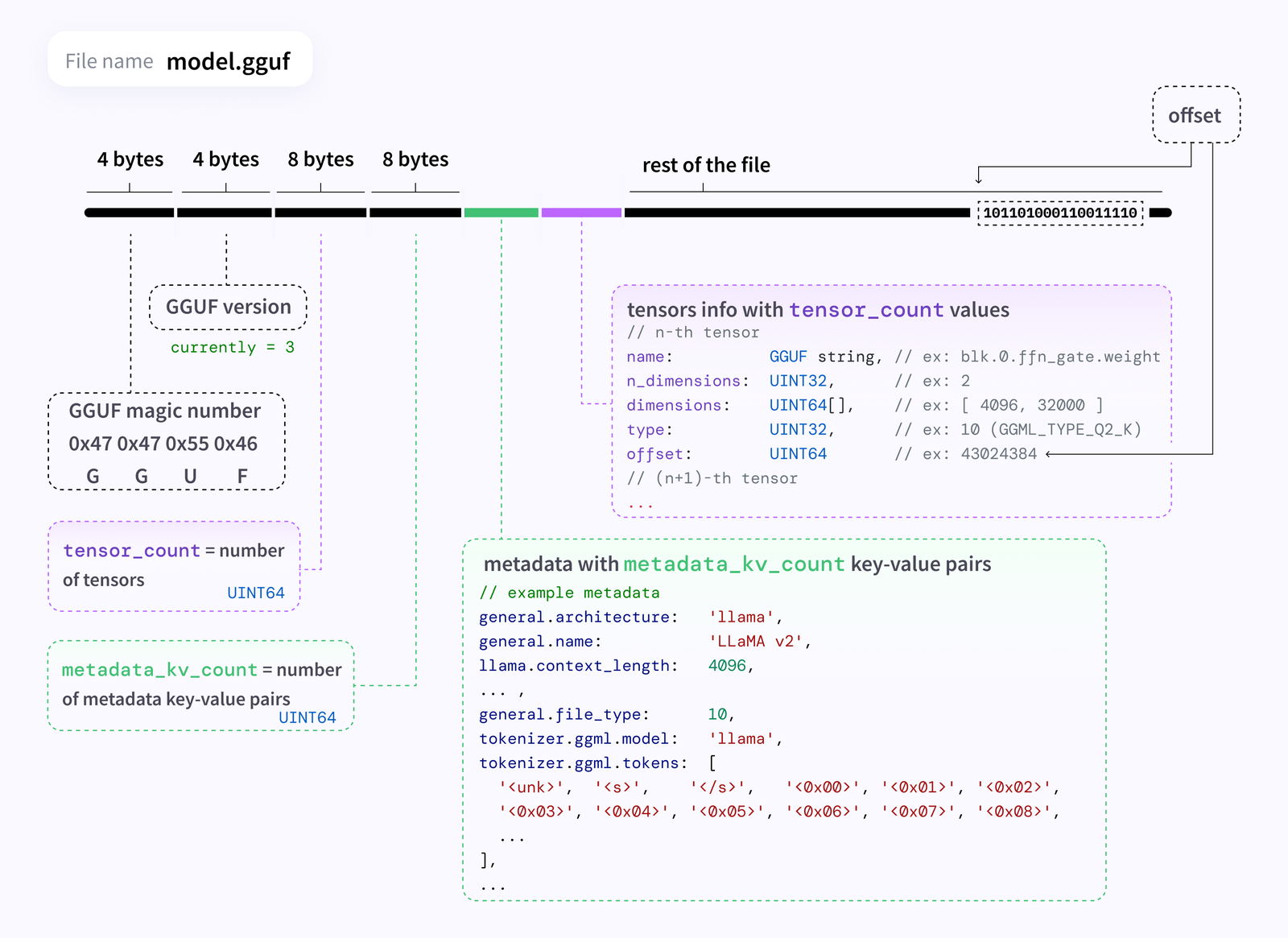
The design decision that makes llama.cpp start fast is the last part. The tensor data is stored in ggml's own block
formats, at offsets aligned to 32 bytes from the start of the data section, so loading does not parse or convert weights.
The loader maps the whole file read-only (mmap with PROT_READ in src/llama-mmap.cpp, the default load mode). For a
tensor served from the mapping, src/llama-model-loader.cpp sets the data pointer to the mapping's base address plus the
tensor's file offset, and the bytes come in from the page cache when a kernel first touches them. For a tensor offloaded
to a GPU, the loader reads the same bytes through the mapping and copies them into a device buffer once.
There is a large exception on the CPU. On a chip with AVX2, or Arm with dot-product or int8 matmul instructions, the CPU
backend by default repacks the weights of matrix multiplies into interleaved layouts its kernels prefer:
ggml/src/ggml-cpu/repack.cpp has paths for Q4_0, Q4_K, Q5_K, Q6_K, Q8_0, Q2_K, IQ4_NL and MXFP4. Those copies live in
anonymous memory, not in the mapping, so on most desktop CPUs the bulk of a Q4_K_M model is not served zero-copy from the
file. --no-repack turns that off. The mapping still saves the parse, and the file layout still lets each tensor be read
with one seek. The loader even refuses to map a GGUF embedded in a larger file if its data section is not aligned
to what the CPU buffer needs, because the pointer arithmetic would then be wrong.
I wanted real numbers for that picture, so I parsed one file: Llama-3.2-1B-Instruct-Q4_K_M.gguf from
bartowski/Llama-3.2-1B-Instruct-GGUF, uploaded in
September 2024, 807,694,464 bytes. A GGUF header is self-describing, so the first 16 MiB fetched with an HTTP range
request gave me every key and every tensor record without downloading the weights, the same method I used to count the
bytes of llama-modchip's 284B checkpoint. The file has 35 keys and 147 tensors.
The header runs to byte 7,831,525 and the data starts at 7,831,552 after 27 bytes of padding. Two thirds of that header is
the tokenizer's 280,147 BPE merges, stored as strings. Click around:
Three things fall out of the map. The header is under 1% of the file, and almost all of it is tokenizer. The type
column is mixed: "Q4_K_M" is a recipe, not a type, and this file holds 96 tensors of Q4_K, 17 of Q6_K and 34 small F32
vectors. And there is no output.weight at all: Llama 3.2 1B ties its output projection to the token embedding, so the
largest tensor in the file, token_embd at 215,470,080 bytes of Q6_K, does double duty.
A version-3 file that will not load
The type column is where the format's stability ends. A tensor record stores a type id, an index into ggml's
ggml_type enum. At v1.0.0 that enum has gaps with comments in them: ids 4 and 5 (Q4_2, Q4_3) say "support has been
removed", and ids 31 to 33 say GGML_TYPE_Q4_0_4_4 = 31, support has been removed from gguf files, with 36 to 38 (the
IQ4_NL_4_4 family) commented out beside them. Those were ARM-specific interleaved layouts of Q4_0, written into files
in 2024 and later replaced by repacking Q4_0 at load time on the CPU.
The same bartowski repository still carries Llama-3.2-1B-Instruct-Q4_0_4_4.gguf. I parsed its header too. It is a
perfectly valid version-3 file: magic GGUF, version 3, 147 tensors, 35 keys, data at the same 7,831,552. Of its 147
tensors, 112 have type id 31. In ggml/src/ggml.c at v1.0.0, the type-traits entry for id 31 is named
"TYPE_Q4_0_4_4 REMOVED, use Q4_0 with runtime repacking" with a block size of 0, and gguf.cpp rejects any tensor whose
row length is not a multiple of its type's block size. A row length is never a multiple of zero, so the reader stops at
the first such tensor with an error that names the type.
Both builds on the 3090 box agree. Pointed at that file, llama-bench from v1.0.0 and from v0.9.0 stop with the same
line:
gguf_init_from_reader: tensor 'blk.0.ffn_down.weight' of type 31 (TYPE_Q4_0_4_4 REMOVED, use Q4_0 with runtime repacking) has 8192 elements per row, not a multiple of block size (0)This did not happen in 1.0. The enum already carried that comment at v0.1.0, the first semver tag. The point is what "version 3" means:
the container parses, and nothing promises that every type id ever written into one will still have a kernel. The
practical rule is the same one it has always been. Keep the source checkpoint, or at least know where it is, and expect
to re-quantize now and then. A major version on the C API does not change that, and nothing in the announcement says it
does.
What a quant type is, byte for byte
Since the type id is the part of a GGUF that can go stale, it is worth knowing what one is. A ggml quant type is a fixed
block struct in ggml/src/ggml-common.h, and every one of them is pinned by a static_assert on its size. Q4_0 is the
simplest: 32 weights share one fp16 scale d, and each weight is a 4-bit integer q, so
The K-quants group 256 weights into a super-block of smaller groups. Q4_K has eight groups of 32, each with its own 6-bit scale and 6-bit minimum, so a weight is , and two fp16 numbers scale all the scales: 4 + 12 + 128 = 144 bytes for 256 weights, also exactly 4.5 bits. Q6_K spends 210 bytes on 256 weights, 6.5625 bits. The IQ types replace the uniform integer grid with lookups into fixed codebooks, which is how IQ2_XXS gets to 2.0625 bits and IQ1_S to 1.5625. The newest entries are floats: MXFP4 stores each weight as a 4-bit E2M1 float with one shared power-of-two exponent per 32, and NVFP4 uses an FP8 scale for every 16.
The table under the blocks is the reason "4-bit" is a loose word. This 1B model has 1,235,814,432 weights. Divide the
published Q4_K_M file's bytes by that and you get 5.23 bits per weight, not 4.5. About a fifth of the weights (21%) are in the
128,256-row embedding table, which quantizers keep at higher precision because the tied output head reads it, and Q4_K_M
lifts half the layers' ffn_down and attn_v to Q6_K. Even the plain Q4_0 file comes to 5.00 bits for the same reason.
What else is in the release
The versioning is the headline, but 249 commits carry a lot of ordinary progress, and some of it matters more day to day than the soname.
- FP8 KV caches.
-ctk f8_e4m3 -ctv f8_e4m3stores keys and values in OCP FP8 with optional static per-tensor scales (#28392), backed by new FP8 CUDA support in ggml. One byte per element halves the cache against F16, and it joins the integer cache types and the rotation tricks I covered in TurboQuant. - The MoE expert cache grew a CPU share. Experts kept in host memory were already cached on the GPU; now a configurable share of cache misses runs on the CPU instead of being uploaded (#30966), with a tuning script. The PR's own example run on a Qwen3.8-Flash-Next IQ4_NL build went from 24.2 tok/s at share 0 to 47.6 at share 0.95 with a 6,464 MiB cache. That is the same RAM-and-VRAM split as the 200 GB MoE on one RTX 3090, now inside llama.cpp.
- The NextN speculative API is public. Functions the multi-token-prediction and drafter paths use moved into
llama.h, including a query for the DFlash 2 selector head from the DFlash 2 paper. Being in the header means they are now under the major-version rule. - Server hardening. Fixes for
--cors-origins, DNS rebinding and SSRF through the CORS proxy and media URLs, theHF_TOKENrestricted to huggingface.co hosts, MCP tool calls cancelled when the client disconnects. Two of these change defaults: tools on a non-loopback address and private media URLs now need explicit opt-in flags. - Models. Three new text architectures (Kimi-K3.1-Pro, Ripple and xing4_0), Fish Audio's
Drama 3 TTS, MageVL-Cowork and Kimi-K3.1 vision. The
llm_archenum insrc/llama-arch.hnow has 172 named architectures; the announcement's "more than 150 architecture variants" is conservative. - A redesigned web UI: chat groups, a sidebar footer, a phone layout, and a chat box that is a live-preview markdown editor.
No new backend arrived with 1.0. The list of headers in ggml/include/ is identical at v0.1.0, v0.9.0 and
v1.0.0, and ggml/src/ has eighteen backend directories (CUDA, HIP, Metal, Vulkan, SYCL, OpenCL, WebGPU, CANN, Hexagon,
OpenVINO, zDNN and the rest). The backend work in this release is kernels: few-row quantized matmuls for batch sizes 2 to
24 on CUDA, an Intel FlashAttention prefill path on Vulkan, a device-side MoE scheduler on SYCL, decomposed FlashAttention
for Adreno in OpenCL.
v1.0.0 against v0.9.0 on a 3090
A version number does not make code faster, but 249 commits of kernel work might, so I measured. On beast2, an RTX 3090
(24 GB) with driver 580.126.09 and CUDA 12.8, I built both tags from source for sm_86 and ran llama-bench with every
layer on the GPU and FlashAttention on (-ngl 99 -fa on -p 512,2048 -n 128 -r 5). The models are the bartowski Llama
3.2 1B Instruct files in seven quantizations plus the 3B at Q4_K_M, the same files the widgets above describe. v1.0.0 ran
first, then v0.9.0, then one interleaved repeat of the 1B Q4_K_M with the order reversed. Each number is the mean of
five runs; tok/s is tokens per second.
| model | prefill pp2048, v0.9.0 | v1.0.0 | decode tg128, v0.9.0 | v1.0.0 |
|---|---|---|---|---|
| 1B f16 | 26,180 | 27,036 | 269.56 | 269.90 |
| 1B Q8_0 | 24,824 | 25,872 | 440.09 | 441.58 |
| 1B Q6_K | 22,155 | 22,692 | 516.03 | 518.00 |
| 1B Q4_K_M | 23,336 | 24,626 | 584.93 | 589.02 |
| 1B Q4_0 | 26,004 | 27,470 | 611.90 | 622.29 |
| 1B IQ4_XS | 25,738 | 26,204 | 575.14 | 581.31 |
| 1B IQ3_M | 23,723 | 25,332 | 565.55 | 577.26 |
| 3B Q4_K_M | 9,457 | 9,747 | 254.32 | 255.34 |
Decode did not change. On the headline file, 1B Q4_K_M, v0.9.0 decodes at 584.93 tok/s and v1.0.0 at 589.02. The largest gap is IQ3_M at 2.1%, and every run's standard deviation is 1.5 to 3.2% of its mean, so all eight rows are inside the noise. That is what I expected: the CUDA work in this release (few-row MMQ for batch sizes 2 to 24, BF16 few-row matmuls, MoE layouts) targets batched and MoE paths, and a single stream of a dense model uses neither.
Prefill at 2,048 tokens is 1.8 to 6.8% faster on v1.0.0 in every row, with standard deviations of 0.5 to 4.5%. I would not bank that. v1.0.0 ran every model before v0.9.0 did, on a GPU that read 34 °C at 210 MHz just before the first run, so order and temperature may favour it. The interleaved repeat put v0.9.0 first: 22,165 against 23,021 tok/s at pp512, with standard deviations of 1,263 and 1,686. Same direction, inside the noise. Prefill on a 1B model on this card runs above 20,000 tok/s either way; a 2,048-token prompt takes under a tenth of a second.
The quant column says more than the version column. If decode only read weights, tokens per second would scale with file size: f16 to Q4_0 is a 3.2x cut in bytes. The measured speedup is 2.3x, and IQ3_M, the smallest file, decodes slower than Q4_0. Fit a straight line through the two simplest formats (time per token = fixed cost + bytes ÷ bandwidth) and f16 and Q8_0 give a fixed cost of 0.63 ms and an effective bandwidth of 804 GB/s. That line predicts 632 tok/s for Q4_0, close to the measured 622. It predicts 615 for Q4_K_M (measured 589), 647 for IQ4_XS (581) and 695 for IQ3_M (577). The K-quants pay a little for unpacking their sub-block scales; the IQ formats, whose weights are codebook lookups, pay a lot. On a model this small, about 0.6 ms of every token is fixed overhead that no quantization touches, which is why the 3B at Q4_K_M, with 2.5 times the bytes, decodes at 255 tok/s and not at a third of the 1B's 589.
None of this is a reason to choose a release. It is a reason to choose a quant: on a 3090, below Q4_0 a small dense model stops getting faster and only gets smaller.
Who should change anything
If you link libllama or libggml directly, from a binding, an app or a distribution package, 1.0 is worth acting on.
Pin a major instead of a build number, rebuild once against the new headers, and fix the renamed calls; the replacements
all exist, and the compiler has been warning about the old names for as long as they carried DEPRECATED. If you go through llama-server or a CLI, nothing in the versioning
protects you, and this release changes server defaults in ways a script will notice. If you mostly care about GGUF files,
nothing changed. Version 3 still parses everywhere, old type ids can still disappear, and a converter or quantizer from
one release can write metadata an older reader does not understand.
My view: this is a good release, and the right size of promise. A C library can guarantee C compatibility, and llama.cpp now does, with a soname that makes the guarantee mechanical instead of social. I would have liked one sentence in the announcement about GGUF, even if the sentence were "no promise". Until that exists, treat a GGUF file the way you treat a compiled artifact: reproducible from its source checkpoint, and not something to archive as the only copy.
For the browser end of that hardware row, see wllama v4.0.0: llama.cpp compiled to WebAssembly,
pinned to a commit after this release, working around ggml's 32-bit size_t sums from its own side instead of patching it.