2026-10-30 · 21 min · diffusion-lm · mixture-of-experts · speculative-decoding · gated-deltanet · inference · qwen
Why read this
Hightop 30%Reads the shapes, sampler and both serving PRs, measures real expert routing over 29 of 40 layers, and re-prices the speed claim with it.
- Interactive explanations
- Original analysis
- Widely used
Inference & servingNeeds datacenter GPUsApache-2.0Practitioner model
How this was scored
- Is it new?
- 2 of 3: A real new idea, method or capability
- Can I trust it?
- 2 of 3: Measures key facts from files, code or configs
- Can I run it?
- 2 of 3: Open code or weights with real limits
- Will I understand it?
- 3 of 3: Mechanism carried by interactives built from real code or data
- Can I act on it?
- 2 of 3: A concrete recipe, numbers or comparison
- Will it last?
- 1 of 3: Relevant for months
- Does it affect many?
- 2 of 3: A widely used model, tool or lab release
- Only here?
- 2 of 3: A teardown or measurement few others did
Score 71 of 100, ranked 140 of 773 rated articles. Each question is answered 0–3 by hand, and a 3 is rare. How articles are scored
@DiffuSpace_Labs announced Clover-35B-A3B-Preview on 28 October as "the first open-weight production diffusion language model (dLLM) with 35B total parameters capable of 680 tps on a single card at BF16." The weights are on the Hub under Apache-2.0. The number comes from the launch blog, which says where it was measured: one NVIDIA GB300, BF16, batch size 1, on the team's "internal Agent scenario data".
When I first wrote this up I could not run anything, so I read: the 813 tensor shapes in the safetensors headers, the config, the sampler and the SGLang pull request. For this update I went further, on the CPU of a workstation that also holds an RTX 3090. I fetched the official weights, ran the model's own Transformers code, and measured something the files cannot tell you: how many distinct experts a block of 32 tokens actually routes to. Two limits shaped that run. The box's shared disk filled up before the last six shards arrived, so I ran the first 29 of the 40 layers; routing at a layer depends only on the layers before it, so those numbers are the full model's at those layers. And SGLang's Clover path rejects any GPU older than Hopper at startup, so nothing here is a Clover timing. The speeds below are DiffuSpace's.
Clover, a 35B diffusion large language model.
- branch
- main
- forks
- 12
- open issues
- 7
- tests
- none found
- source
- 154.5 kB
- commit date
- 2026-11-19
GitHub REST API, 2026-11-23 — branch, createdAt, description, forks, openIssues, pushedAt, stars, topics
local clone, 2026-10-30 at 685744f — fileCount, hasTests, shallow
shallow clone: counts describe the pinned tree, not the history
- architecture
- CloverMoeModelLM
- task
- text-generation
- library
- transformers
- license
- apache-2.0
- safetensors
- 28 shards
- largest file
- 3.96 GB
- files
- 41
- downloads
- 6.2K
- likes
- 278
repo last modified 2026-10-28
What Clover is
The model card says Clover is "derived from" Qwen3.6-35B-A3B, and the
config agrees: 40 layers, of which 30 are Gated DeltaNet layers and 10 are full attention, in the repeating pattern of
three recurrent layers and then one attention layer. Every layer has 256 routed experts, routes each token to 8 of them,
and adds one shared expert that is always on. The hidden size is 2,048, the vocabulary is 248,320, and the context limit
is 131,072 tokens. What is new is in four config keys: block_size is 32, mask_token_id is 151669, the
denoising_config is low_confidence with a threshold of 0.95, and moe_block_coreset_enabled is true with a top_p of
0.9.
The licence file preserves the upstream Apache-2.0 text with Alibaba Cloud's 2026 copyright, and the card's header says
apache-2.0. The weights need trust_remote_code=True, because the model class, the sampler and the config class are
Python files in the repository. The modeling file is plain PyTorch with no custom kernels, which is why it ran on CPU
without complaint.
Summing the shapes gives 34,661,350,848 parameters, exactly the Hub's own count. Routed experts are 32,212,254,720 of them, 92.93%. One expert is three matrices, gate and up at 2,048 by 512 and down at 512 by 2,048, which is 3,145,728 parameters or 6.29 MB in BF16. A token uses the 8 experts its router picks in each of 40 layers, plus everything that is not a routed expert: that is 1,006,632,960 expert parameters plus 1,940,536,768 others, 2,947,169,728 in all. That is the "3B active" in the name, and in BF16 it is 5.89 GB that a plain decode step must read for every token it produces. Keep that figure, because the speed claim is a claim about beating it.
Two details are worth the space. The output head (508,559,360 parameters) is untied from the embedding and is read in
full at every step, so it is 1.47% of the weights but 17% of the 3B a token touches. And the parts DiffuSpace says it
added for diffusion are tiny: the bd_ softmax controls and the right-hand convolution weights total 740,160 parameters,
0.002%. The blog, which now has an English version, describes them. Each Gated DeltaNet layer keeps its recurrent state
for the history and lets the tokens inside the current block attend to each other with a bidirectional softmax, with the
history's read-out entered as one more "information unit" in that same softmax, so the model learns when to lean on the
past and when on the block. A learnable block-size calibration compensates for the history's weight diluting as the block
grows, and a separate, zero-initialized convolution branch handles right-hand context. There is still no paper and no
training code: the GitHub repository's sft/ folder says "Coming soon".
How it writes
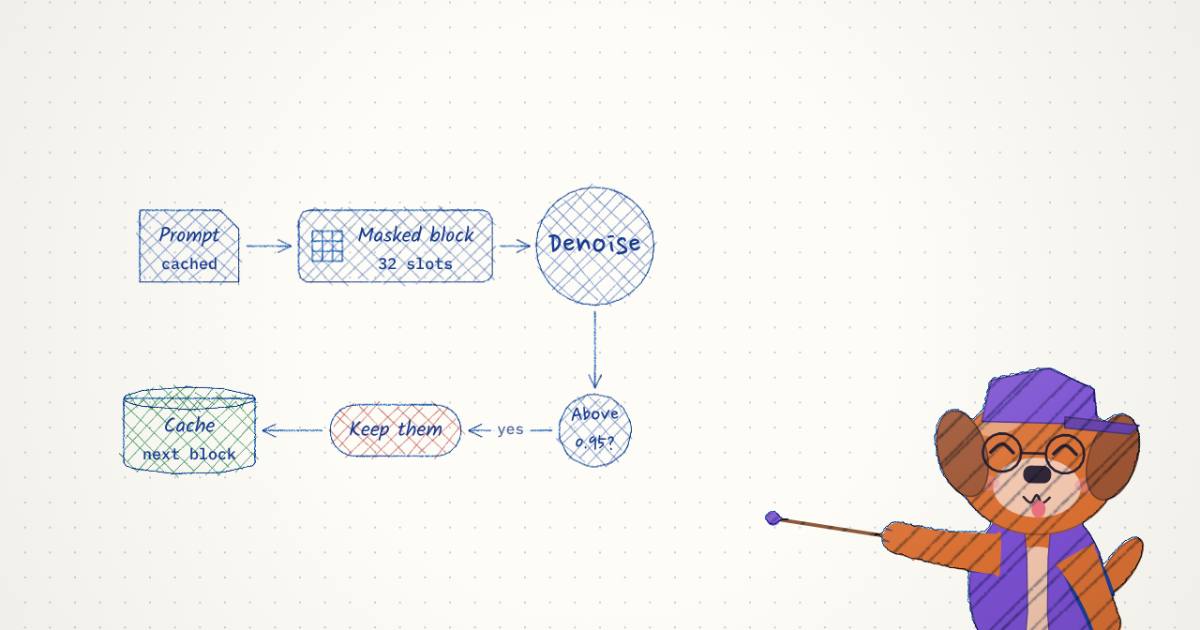
An autoregressive model writes one token per forward pass. Clover writes a block of 32. The loop is in
modeling_clover_moe.py, and it is short:
- Fill a block of 32 slots with the mask token and run the model over it, with the prompt and everything already written in the cache.
- For every slot, take the most likely token and its probability. The mask token's logit is set to minus infinity first, so a slot can never "predict" a mask.
- Commit every still-masked slot whose probability is above 0.95. If none clears it, commit the single most confident one, so every step makes progress.
- Repeat from step 1 until no slot is masked. That takes at most 32 steps and, if the model is sure of everything, one.
- Run the finished block through the model again as ordinary causal text to update the cache, and start the next block.
The two numbers that matter are how many slots clear 0.95 on a typical step, and what a step costs. The first is a property of the trained model and the text, and it needs the output head, which sat in one of the shards that never made it to disk. So the widget below still shows the rule on a model that is not Clover.
I ran the same rule on distilroberta-base, a masked language model with 82 million parameters, on CPU: 48 tokens of
prefix taken from paragraphs of this site, then a block of 16 masked slots with nothing to their right. The model was not
trained to fill a block this way, and the point of the toy is the rule, not the quality.
At the 0.95 threshold the model commits 1.16 slots per step on average and needs 13.8 of the 16 possible steps; with a block of 32 it commits 1.41 per step and needs 22.7 of 32. Lowering the bar to 0.4 gets it to 2.09 per step in 7.7 steps, and the cost shows: the share of neighbouring tokens that are the same token goes from 19% to 43%. The first step commits exactly one slot at every threshold, including 0.4: before a neighbour is filled in, at most one slot clears the bar. What gets written is mostly page furniture, "ARTICLE CONTINUES BELOW" and runs of equals signs or hash marks, and in 10 of the 24 blocks at 0.95 a single token fills at least half the slots. None of this is a result about Clover. It is the reason Clover is trained for the job: a model never taught to be sure about slots it cannot yet see commits one slot at a time and fills the rest with noise, and the number the blog's speed rests on is how much better the trained model does.
How many experts a block really touches
The fourth config key is the one that makes a block step affordable. In an ordinary MoE forward pass each token picks its own 8 experts, and a block of 32 tokens reads the union of 32 such sets. If routing were independent that union would be about 163 of the 256 experts in every layer (the closed form is , and a simulation agrees with it at 163.4), which is 41 GB of expert weights for one step, nearly two thirds of the 64 GB of experts in the model.
Clover's coreset_torch limits that. For a block, it adds up each token's top-8 routing probabilities per expert, sorts
the experts by that total, keeps the smallest set whose share of the total reaches top_p (0.9, and always at least the
top expert), and forbids every token in the block from routing outside it.
In October I could only run that selector on invented routing, and the answer swung from 8.6 to 126.7 experts depending
on how much I assumed a block's tokens agree. This time I measured it. I loaded the official model class truncated to
layers 0 to 28 and ran it on CPU over four texts: an agent transcript I generated (ten get_weather tool calls and their
JSON results), TileLang's FlashAttention example in Python, English prose from this site, and the Chinese text of Clover's own blog. For each text I prefilled 192
tokens and then ran four blocks of 32, three ways: the causal pass over the 32 real next tokens (what a verify pass reads
when every draft is right), a preview of one real token plus 31 masks (the start of a self-speculative round), and a
preview with half the slots masked (mid-denoising). A hook on each MoE router recorded the distinct experts per layer,
before and after the coreset. That is 16 blocks over 29 layers, 464 measurements per pass type.
| Pass over a 32-token block | Experts per layer, before coreset | After coreset (top_p 0.9) | Slots of 8 re-routed |
|---|---|---|---|
| Independent routing (simulated) | 163.4 | 126.7 | 1.1 |
| Causal, 32 real tokens | 83.9 | not applied | |
| Preview, 1 token + 31 masks | 44.9 | 23.8 | 1.04 |
| Preview, half masked | 80.2 | 48.0 | 1.19 |
Real routing is strongly correlated: 32 real tokens touch 83.9 experts per layer on average, about half the independent figure, with a range of 34 to 146 across layers and blocks. The text seems to matter. In this small sample, four blocks per text, my generated agent trace touched the most, 104.6 per layer, against 75.9 for Python and 77.7 for English prose. I expected repetitive JSON to reuse experts; instead the mix of keys, numbers, city names and punctuation in one block spread wider than code did. Four blocks of one synthetic trace is not real agent traffic, so treat that ordering as a hint. The union also falls with depth: about 120 at layers 0 and 1, between about 60 and 90 from layer 5 on. Masks route alike, so a preview that is mostly masks touches only 44.9 experts, and the coreset halves that to 23.8 while moving about one of each token's eight experts.
Two ways to run it, and which one gets the coreset
The README lists the backends: the Transformers path does block diffusion denoising only, SGLang does both denoising and "self-speculative decoding", and llama.cpp does self-speculative decoding only. The team's reply to the launch thread says the self-speculative mode is what reaches "600+ tps". The code is in two pull requests, SGLang #46927 and llama.cpp #31306.
Both have moved since October, and the llama.cpp one contradicts the README, which I re-read on 13 November and which
still lists llama.cpp as "Self-speculative decoding". The PR was merged on 2 November, and its description says it adds
Clover "in AR mode only" and that "self-speculative generation for Clover is split into a separate PR." The follow-up,
#31732, is open, adds a generic draft-self mode, and was validated
on NVIDIA's Nemotron-Labs-Diffusion checkpoints. Its description says Clover's self-speculative decoding "requires
substantial changes to Clover's implementation, so it will go to a separate PR" of its own. Its own table, on an H200 with the 14B Nemotron model, runs from 1.9% slower than autoregressive decoding on
writing prompts to 26.8% faster on structured output. The SGLang PR is still open; its head is now a1eee6c, and the
files I quote are from that commit.
In self-speculative decoding one model plays both roles, and the worker's docstring says how: "Preview B slots, verify causally, then commit only the accepted prefix."
A round previews a block with the diffusion pass, takes each slot's argmax as a candidate, runs the same model causally over those candidates, and keeps the longest prefix the causal pass accepts, plus one new token sampled at the boundary. If drafts are accepted the round produces tokens. The block can be 32 or any divisor of it.
In October I could not say whether the verify pass uses the coreset. It does not. In clover_moe.py the coreset lives in
a CloverRouterGate that only acts while CloverSparseMoeBlock.forward has set a preview block size, and the block only
sets it when forward_batch.forward_mode.is_dllm_extend(); the code comment reads "The coreset restricts routed experts
only, before top-k, and only in preview." The worker builds the preview batch with forward_mode=ForwardMode.DLLM_EXTEND.
The verify batch comes from CloverVerifyInput, which inherits prepare_for_verify from DFlash's verify input, and that
runs the target with ForwardMode.TARGET_VERIFY. So the preview pass reads the small coreset union, and the verify pass
reads every expert its 32 candidates pick: about 84 per layer on real text, by the table above. The Transformers path is
consistent with this: coreset_torch runs only when preview is true, never in the causal replay that commits a block.
The Triton coreset kernel in the PR supports block sizes of 4, 8, 16 and 32.
A setting, speculative_clover_accept_rule, picks the acceptance test: exact keeps a candidate only if it is the causal
pass's argmax, and threshold, the default, keeps it if the causal pass gives it probability at least
where is the entropy of the causal distribution at that position. The function in clover_utils.py defaults to a
ratio of 0.9 and the server flag to 1.0; is 0.6 in both, "the value used by the reference Clover serving
implementation", in the docs' words. With the ratio never binds, because cannot exceed 0.6.
The working threshold asks for probability 0.6 when the model is certain and only 0.22 when its entropy is one nat. The
PR's documentation names the source, the typical-acceptance rule from
Medusa, and states the consequence in a warning: "Neither rule is
distribution-preserving stochastic speculative sampling." It also turns on response penalties by default (presence 0.9,
repetition 1.05).
To see what the rule does, I paired a 70-million-parameter drafter with a 160-million-parameter verifier (both Pythia), generated 32 tokens for each of 8 paragraphs of this site in rounds of 8 draft tokens (so at most 9 tokens a round), and counted what each rule keeps. These are stand-in models, not Clover's own preview pass.
Exact matching keeps 3.55 tokens per round and reproduces the verifier's own greedy text in 90.6% of positions; the gap from 100% is most likely floating-point noise between a cached generate and a full forward pass, not the rule. The threshold rule with Clover's default delta of 0.6 keeps 8.69 per round, almost the maximum of 9, and the text agrees with the verifier's in 12.5% of positions: nearly everything the drafter proposes passes, so the output is closer to the drafter's than to the verifier's. Raising delta to 3 gives 5.40 tokens per round and 9.8% agreement, and delta 10 gives 2.33 and 22.3%. Agreement is a harsh measure, because one early difference changes everything after it, so read it as "did the text diverge from the verifier alone". The stand-in drafter is weaker than its verifier, where Clover's drafter and verifier are the same weights, so these numbers show the shape of the trade, that a lenient rule turns verification into a rubber stamp, and not Clover's acceptance rate.
What 680 tokens a second has to be
The blog gives three speed claims: 680 tokens a second on one GB300 at BF16 and batch size 1, on internal agent-scenario data; 515 on one H200 on agent tasks, against 365 for Qwen with a speculative-decoding method it calls DFlash2; and 101.8 on a 16 GB RTX 5070 Ti at INT4 on MATH-500, against 48.5 for comparable models. Its speed chart adds the conditions: SGLang, 32K context, 4K maximum output, "Agentic Replay data", with Mercury 2.5's speed taken from Artificial Analysis and LLaDA's from its own report.
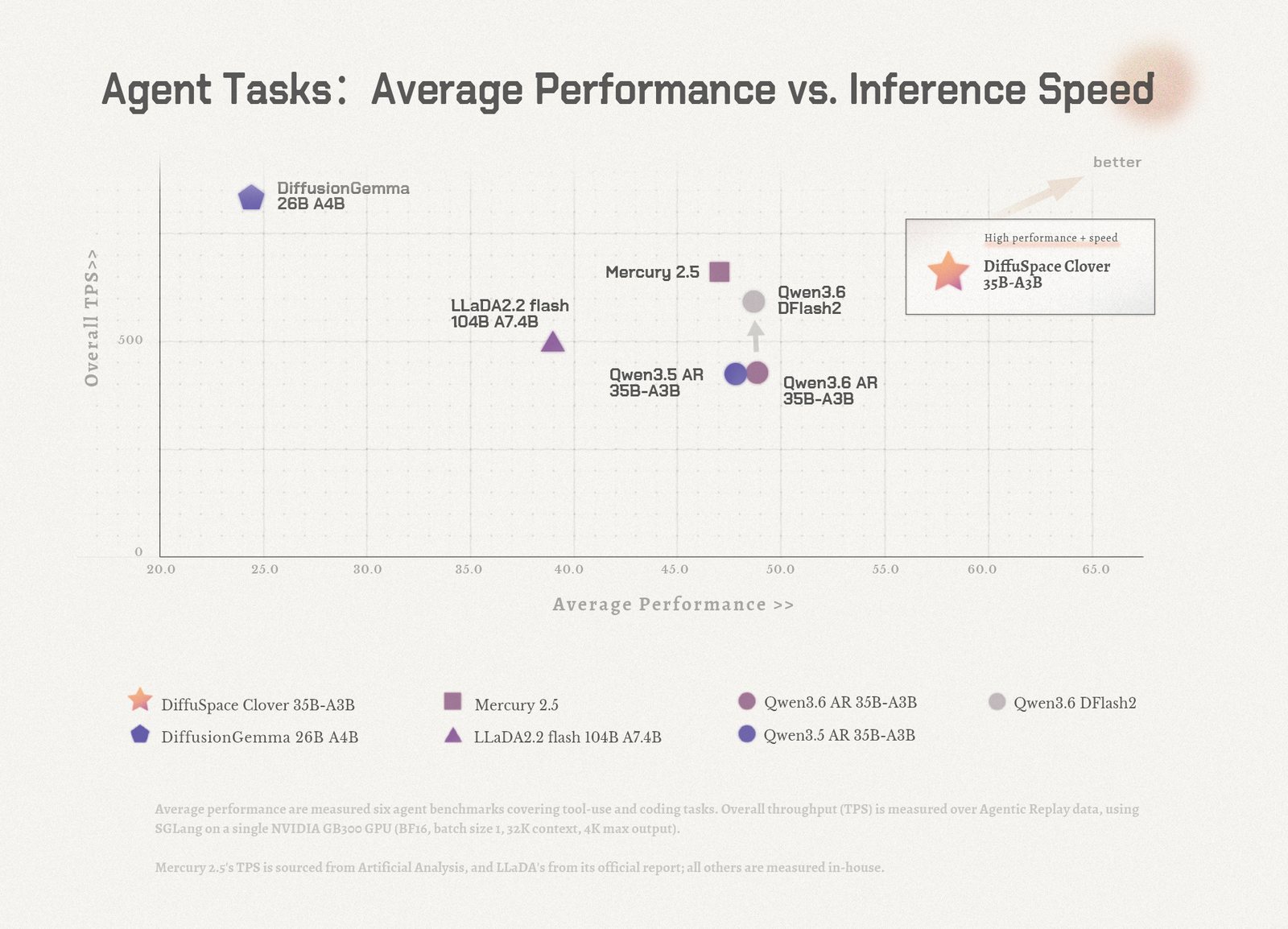
Read the chart for what it plots. Clover is not a point on it; it is a star in a box in the top right corner. The other points can be placed against the axis. I located each marker's centroid in the image and scaled it between the 0 line and the 500 gridline, which is good to about five tokens a second: Qwen3.6 autoregressive sits near 425 tokens a second, Qwen3.6 with DFlash2 near 590, Mercury 2.5 near 660 and DiffusionGemma 26B A4B near 830, faster than Clover's 680 at a much lower score. So on the vendor's own GB300, Clover's 680 is about 1.6x plain autoregressive decoding of the model it came from and about 15% faster than that model with a trained drafter. The blog's H200 pair, 515 against 365, is a wider 1.41x over the same drafter.
The scores come from a second chart, which I did not re-run:
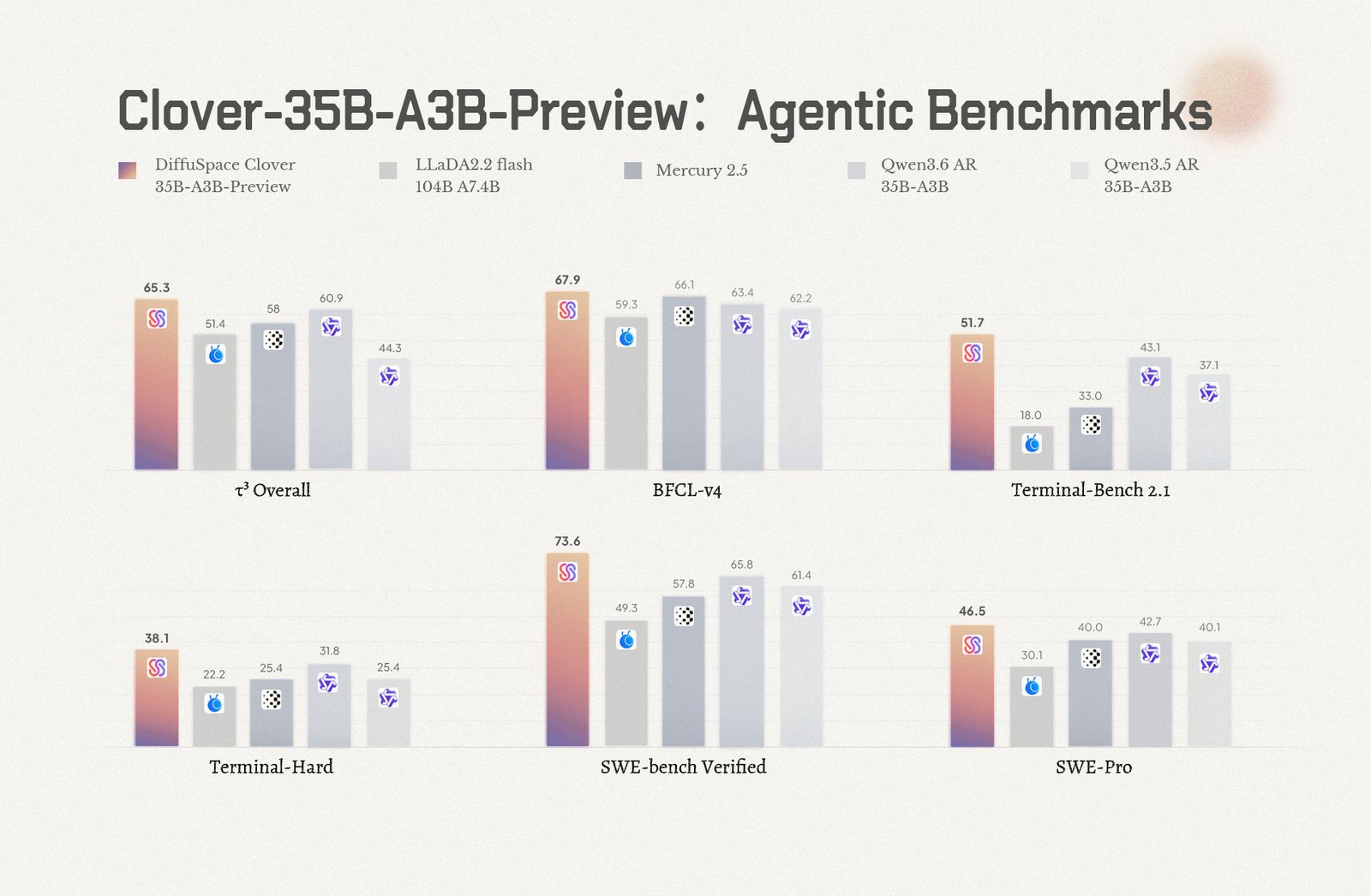
Clover tops all six, and its lead over its own base model is large for a model that started from it: 7.8 points on SWE-bench Verified and 8.6 on Terminal-Bench 2.1. With no paper and no training code there is no way to say what post-training produced that. The blog also gives 83.8 on GPQA Diamond, 95.8 on ZebraLogic and 72.0 on AA-LCR. The demo videos are the other evidence it offers, and they are demos. In this one the model parses a compound air-traffic instruction into five drone tasks:
Now the arithmetic, with routing measured instead of assumed. At batch size 1 a pass is limited by the bytes it must read. One token at a time the weights cost 5.89 GB a token, so a perfectly efficient decode of this model on an H200 (4.8 TB/s, NVIDIA's published figure) tops out near 814 tokens a second, and on a GB300 (about 8 TB/s) near 1,357. At 60% of the H200's bandwidth, plain decoding would give 489. The reported 515 and 680 are not impossible for a plain model, so the claim is not that Clover beats physics. It is that a round reads the weights once for several tokens.
A round is two passes. The preview reads the dense part (3.88 GB in BF16, the head included) plus the coreset union; the verify reads the dense part again plus the full union of its 32 candidates. With the measured unions, 23.8 experts per layer for a fresh preview and 83.9 for the verify, and assuming the 29 layers I measured stand for all 40, a round reads 34.9 GB: 9.9 for the preview and 25.0 for the verify. The verify pass is more than two thirds of the bytes, and the coreset does not touch it.
On an H200 at 60% of its bandwidth that round takes 12.1 ms, so 515 tokens a second needs 6.2 tokens kept per round; at 80% it needs 4.7. On a GB300 the 680 needs 4.9 at 60% and 3.7 at 80%. If the preview is mid-denoising (48.0 experts) or the text looks like the agent trace (104.6 for the verify), the H200 figure rises to about 7.2 or 7.3 tokens per round. In October, with routing assumed, the same budget spanned 4.3 to 13.2. Measured routing removes the pessimistic end: the claim needs a model that keeps roughly five to seven tokens of every 32 it drafts on agent traffic, not ten or more.
That is a plausible number, not a confirmed one. Kept tokens per round is the one quantity I could not measure without the output head, and it depends on the text: agent traffic is full of stretches the model can call with near certainty, such as JSON keys and repeated tool names, and the blog itself says the figure is an average over internal agent data. A free-form essay will keep fewer.
The RTX 5070 Ti line fits no public code path I can find. At 4 bits the 34.66 billion parameters are 17.3 GB before any overhead, more than the card's 16 GB, so some of the weights must sit elsewhere, and the blog does not say how. SGLang's Clover documentation says it "requires CUDA compute capability 9.x or 10.x (Hopper or Blackwell) and BF16; other GPUs are rejected at startup", and that it does "not support quantized checkpoints". The 5070 Ti is compute capability 12.0, and INT4 is quantized. The merged llama.cpp support runs Clover autoregressively. So the 101.8 came from an engine that is not public yet, or from a mode the blog does not name.
Where this leaves the claim
Read as a systems result, the speed is a product of three terms. A round reads the dense weights twice plus whatever experts the block touches; the coreset keeps the preview's share small, and on real text the verify pass reads about a third of each layer's experts without it; and the acceptance rule decides how many tokens a round keeps. The checkpoint fixed the first term. My run fixed most of the second. The third is still DiffuSpace's word, and it is the one that matters most: the default rule is lenient by design, so "tokens kept" is partly a property of the threshold rather than of the model's agreement with itself.
If you want to check it, you now need less guesswork. You need a Hopper or Blackwell card with 80 GB or more for the BF16
weights and the SGLang build from the pull request, pinned to a revision, since the loader runs the repository's Python.
Log kept tokens per round on your own traffic, under both the exact and the default threshold rule, because the gap
between those two numbers is the part of the speed that comes from leniency. I would not plan capacity around 680 until
someone outside DiffuSpace has published that pair.
Measured here, read here, still open
- Ran: the official
modeling_clover_moe.py(Hub revision of 28 October), truncated to layers 0 to 28, on the CPU of the 3090 workstation, with hooks on the 29 MoE routers; 16 blocks of 32 tokens from four texts, three pass types. For the October version, on CPU: thedistilroberta-basedenoising toy and the Pythia drafter-verifier toy. - Read: the safetensors headers, config and sampler; SGLang PR 46927 at
a1eee6c(clover_moe.py,clover_worker.py,clover_info.py,clover_utils.py, the docs) and DFlash's verify input it inherits from; llama.cpp PRs 31306 and 31732; the blog in Chinese and English. - Not checked: any speed; kept tokens per round on Clover itself (the run needed the output head); routing in layers 29 to 39; the benchmark scores; the community GGUF files the team's account mentions.
Sources
- Launch post, blog (Chinese and English), model card and files at the Hub revision of 28 October 2026, repository.
- SGLang pull request 46927 (head
a1eee6c; first read at 2243dc6e), llama.cpp pull request 31306 (merged, autoregressive only) and 31732 (self-speculative, open). - Qwen3.6-35B-A3B, the base model, and Medusa for the typical-acceptance rule.
- Related here: DFlash 2, the trained drafter the blog compares against, and iLLaDA on how far masked diffusion scales.