2026-11-16 · 29 min · threejs · three-js · webgpu · computer-graphics · rendering
A 2:26 narrated explainer, drawn in code. Every number and picture in it is this article's own; the sources are below.
› transcript
Left of the line, three.js. Right of it, the same scene file, path traced. The engine is called ThreeRT. Hi, I'm Albedo. ThreeRT runs three.js style code and traces its light on ray tracing hardware. Here is how, and what its sixty frames cost. Scene code never imports three. It imports a lookalike in physical units. Every change becomes a call on a small engine interface. In the native app, the script runs in QuickJS, and a Rust engine owns the scene and the frame. In a browser, the same calls drive plain three.js. The game works. The traced light stays behind. A live frame starts with one sample per pixel. The camera ray finds the floor. There, the kernel samples the lamp directly, with a shadow ray. Then the path bounces once and stops, reading the light from a cache voxel that other samples trained. Every pixel, every frame, while one tile in eight trains the cache. Less noise, some bias. The raw trace is noisy and small. It is blended with its reprojected history. Up to five wavelet passes smooth what is still noisy. An upscaler takes it to full size. On Bistro, the trace runs near half resolution. Then Unreal's bloom and tone map. Every glowing object is a light. Knock them over, and the light moves with them. The repository's numbers, on an Apple M five. Live, fifteen and a half milliseconds at render scale point five five. Full resolution, forty. Against its own offline reference, the live frame is close, far closer than three.js. Three.js wins on cost. Small scenes take it about a millisecond. Tokyo, from Japan's open city model. Seventeen million triangles near the tower. Afternoon into night, no rebuild, again through the upscaler. On a Steam Deck, the game's own counter reads thirty-four frames a second. Windows is an unsigned preview, and the clients are closed. The engine is MIT. Sixty frames here means one sample, one bounce, a cache and an upscaler. It works. Three.js shaped code, a path tracer underneath, sixty frames bought with a cache. Every source is in the full article. I'm Albedo. Bye!
Why read this
Notabletop 60%Reads the engine against its launch: how three.js code reaches a Rust path tracer, what a live frame traces, and which numbers hold at which render scale.
- Original analysis
- Runs on a consumer GPU
- A lasting reference
GPUs, kernels & systemsMITPractitioner tool
How this was scored
- Is it new?
- 2 of 3: A real new idea, method or capability
- Can I trust it?
- 2 of 3: Measures key facts from files, code or configs
- Can I run it?
- 2 of 3: Open code or weights with real limits
- Will I understand it?
- 2 of 3: Mechanism from first principles with figures
- Can I act on it?
- 2 of 3: A concrete recipe, numbers or comparison
- Will it last?
- 2 of 3: A reference for a year or more
- Does it affect many?
- 1 of 3: A specialist community
- Only here?
- 2 of 3: A teardown or measurement few others did
Score 67 of 100, ranked 245 of 773 rated articles. Each question is answered 0–3 by hand, and a 3 is rare. How articles are scored
On 13 November an account called @ThreeRT3D, "a research project from @MeshyAI", posted
"What if three.js could render beyond the limits of the browser?" Its thread promised a
native JS runtime and a hardware-accelerated real-time path tracer for three.js scenes on
macOS, Windows, iOS, Android and Steam Deck, with plain three.js as the fallback in a
browser. The repository is meshy-dev/ThreeRT, MIT.
I cloned it at 65a4eb9 (16 November) and read the engine, the scene package, the docs and
the roadmap. I did not run it on this laptop; a run on an RTX 3090 is further down.
The pitch is easy to misread. It is not three.js with a new renderer bolted on. Scene code
never imports three. It imports @threert/scene, a TypeScript package that looks like
three.js, and that package talks to whatever engine it is bound to: a Rust path tracer in a
native app, or real three.js in a browser tab. Most of what is interesting about ThreeRT
sits in that split, so I'll go through it layer by layer and then check the launch numbers
against the repository's own tables.
Hardware ray-traced three.js: a real-time path tracer behind a three.js-style API. Rust + wgpu engine, TypeScript scene and gameplay packages.
- license
- MIT
- branch
- main
- forks
- 54
- open issues
- 50
- source
- 6.5 MB
- commit date
- 2026-11-23
GitHub REST API, 2026-11-23 — branch, createdAt, description, forks, homepage, license, openIssues, pushedAt, stars, topics
A three.js lookalike with a 35-call back end
This is the README's hello world, trimmed. It would compile against three.js with three
changes (the import, SkyAtmosphere and setSunAngles):
import { Scene, PerspectiveCamera, Mesh, BoxGeometry, MeshStandardMaterial, DirectionalLight, SkyAtmosphere } from "@threert/scene";

export default function build() {
  const scene = new Scene();
  const sun = new DirectionalLight(0xffffff, 90000).setSunAngles(28, 100); // lux
  scene.add(sun);
  scene.environment = new SkyAtmosphere({ sun });
  const plaster = new MeshStandardMaterial({ color: 0xd9d4cc, roughness: 0.92 });
  const wall = new Mesh(new BoxGeometry(6.6, 3, 0.3), plaster);
  wall.position.set(0, 1.5, -3.15);
  scene.add(wall);
  // ...
}
packages/scene reimplements the parts of three.js that scene code touches: Object3D,
Mesh, BufferGeometry, the geometry generators, the math classes, Raycaster, the
materials and the lights. It is pure TypeScript with no DOM, so it runs in Node, in a
Cloudflare Worker or inside the engine. A SceneBinding watches the objects (each one
reports its own changes) and turns them into calls on an Engine interface. That interface
is the real API. It has 35 functions natively (script.rs installs them as
globalThis.__engine): geometry(id, positions, normals, uvs, indices), material(id, desc), object, transform(id, trs), light, camera, instances, environment,
physics(op, args), plus calls that take WGSL source, which three.js has no equivalent
for. There is no scene file in between. Scene code drives the engine directly.
Light is in physical units, and that is the first place a three.js habit breaks. The sun in that snippet is 90,000 lux. A three.js tutorial sun is an intensity of 3.
How much existing three.js code survives? The repository answers that with a test set,
tests/three-compat: 34 snippets of scene code, some from three.js's official examples and
some written by LLMs, run unchanged against @threert/scene. A snippet passes if it runs,
its own check of the three.js behaviour it relies on holds (a raycast hit, a transform), the
package logged nothing as unsupported, and the renderer draws something that is neither
black nor flat. The roadmap records the pass rate as 1 of 34 at the start (27 snippets died
on AmbientLight), 32 of 34 after the gaps were filled, and 33 of 34 once vertex colours
landed. The one still failing needs Shape and ExtrudeGeometry.
Passing is not the same as looking the same, and the differences are deliberate. Shadows are
always on, from every light. MeshPhongMaterial becomes a standard material with roughness
√(2 / (shininess + 2)). AmbientLight becomes a uniform sky. decay is always 2. The
WebGLRenderer you construct is a stub whose render() does nothing. Click through the
names below; each one says what the engine does with it and what the same code gets in a
browser.
Two absences matter more than the rest. There is no ShaderMaterial: a custom surface is a
MaterialFunction, a WGSL body the path tracer calls at every hit (docs/COMPARE.md counts
179 of Kabukichō's materials as material functions: wet asphalt, signage, windows). And there is no OrthographicCamera, which rules out the
isometric and CAD-style viewers a lot of three.js work is. Loaders are replaced rather than
mapped: GLTFModel(uri) hands the file to the engine's Rust glTF loader, so code that walks
a GLTFLoader result's scene graph needs rewriting.
Where the JavaScript runs
"A React Native-like JS runtime" is how the thread describes it, and the analogy holds in
one respect: a native shell owns the window, the GPU and the frame loop, and the
JavaScript is a guest that tells it what to do. The guest is
QuickJS, embedded through the rquickjs crate
(0.12.2, QuickJS-ng 0.15.1 in the runtime probe). Not V8, not JavaScriptCore, and no JIT.
renderer/src/script.rs sets the sandbox. The engine has no file system, network, timers or
module loader. The host adds a log sink, a monotonic clock, the 35 engine functions and a
message queue to the app around it; memory is capped and every call into the script runs
under a time budget that an interrupt handler enforces. QuickJS has no event loop, so each
entry ends by draining the promise jobs it queued, as a browser does when a script returns.
The boundary between script and Rust is four channels, and docs/RUNTIME.md says it is the
contract that survives a change of script engine:
| channel | direction | for |
|---|---|---|
| commands | script → Rust, once per return | scene.add, impulses, joints: many small writes in order |
| poses | Rust → script, one table a tick | 7 floats a body; a body nobody reads costs the script nothing |
| events | Rust → script, once a frame | contacts, bodies that left the world |
| queries | both ways, at once | rays, overlaps, sweeps |
Rust owns the scene, the Rapier physics world, the voxels and the fixed 1/60 s tick. A rigid body's pose goes from the physics to the GPU's instance records without passing through JavaScript.
Why QuickJS is acceptable is in the probe the team ran on 10 November (Apple M5 Pro, with Node's V8 standing in for a browser). A call across the boundary costs 18 ns in native QuickJS against about 1 ns from V8 into wasm. Reading 10,000 bodies' poses from one table takes 0.94 ms. That is fine for orchestration in a 16.67 ms frame. Number crunching is another matter: greedy-meshing 64³ voxels takes 1.25 ms in Rust, 4.05 ms in warmed-up V8 and 135 ms in QuickJS, 108 times the Rust figure. On the Kabukichō level's setup code the docs measure QuickJS at about 8× slower than V8, a different workload with a smaller gap. Either way the design answer is the same: heavy work leaves the script, either as one call into the engine's Rust (voxel edits, meshing, physics queries) or as a WGSL program the engine runs on the GPU. A game's script time is in the frame log, so an author sees when their TypeScript is the cost.
What one frame traces
The kernel is renderer/shaders/pathtrace.wgsl (4,016 lines) plus five companion files,
compiled per device and per scene with WESL's conditional translation: a feature the scene
does not use (glass, fog, cutouts, vertex colours) is not in its kernel at all. The shading
model copies UE5's DefaultLit, Lambert diffuse and GGX specular with UE's
multiple-scattering compensation, because the team's ground truth for most of the project
was Unreal's own path tracer.
Finding the hit. When the adapter exposes wgpu::Features::EXPERIMENTAL_RAY_QUERY,
gpu.rs turns it on and the kernel calls rayQueryInitialize / rayQueryProceed against a
hardware acceleration structure (trace_hw.wgsl). That is the "hardware ray-traced" part,
and it is honest: it uses the RT cores on Metal and Vulkan. Without the feature (or with
THREERT_HWRT=0) the kernel walks its own BVH, built on the CPU by bvh.rs with a binned
surface-area heuristic: 16 bins, at most 4 triangles a leaf, a node packed as two vec3
bounds and two u32s. A second level of "units" lets a browser or a GPU without ray queries
move instances without rebuilding the whole tree.
The comments around the hardware path read like a debugging diary. Alpha-tested foliage was first handled with the ray query's own candidate loop, and on Metal about 0.1 % of rays near cutout leaves missed the ground behind them, differently on every run: two offline renders of Kabukichō differed in 75 % of their pixels. The fix forces every triangle opaque and steps through cutout hits one query at a time, up to 16 for a closest hit and 64 for a shadow ray.
Sampling. Offline, every dimension is Owen-scrambled Sobol (Burley 2020, as Cycles does). At each vertex the kernel samples lights directly. Up to eight local lights are evaluated exhaustively; more are resampled from eight candidates (RIS) with one shadow ray. Emissive triangles go into a light tree after Conty Estevez and Kulla 2018: each node bounds its emitters with a sphere and sums their power, and a shading point descends it choosing children by importance, so the lamp beside the camera gets the samples rather than the whole city. Bistro has 20,638 emitter triangles. BSDF samples that hit a light are weighted against light samples with the power heuristic.
The live frame is where the 60 fps comes from, and it is a different estimator from the
offline one, by design (docs/RUNTIME.md, "How live differs from offline"):
- One camera ray a pixel, at a single sub-pixel jitter for the whole frame that the
upscaler later resolves. (A rasterised visibility pass exists too, behind
THREERT_RASTER=1; it is off by default.) - The camera hit gets its direct light: light samples and shadow rays, as offline.
- The path bounces, and at its first vertex that is not through glass it ends in a
radiance cache: a hashed grid of world-space voxels whose size grows with distance from
the camera, each holding the light leaving surfaces in it. A voxel is trusted after 4
samples. One tile in 8 (8×4 pixels, one SIMD group) traces deeper paths each frame to
train it, and pixels that hit a cold voxel trace a fresh estimate. Those few scattered
pixels are deferred to a second pass,
finish, because tracing them inline held whole SIMD groups idle (Bistro's trace went from 8.06 to 6.54 ms without them). - At most 4 bounces, a clamp on the cache term, and a hash instead of Sobol past the camera vertex.
Then live.wgsl cleans it up: diffuse irradiance, demodulated from albedo, is accumulated
over its reprojected history and filtered by up to five edge-avoiding à-trous passes with
steps of 1, 2, 4, 8 and 16 pixels. Each pass is gated (atrous_gated): it runs only where
the accumulated mean is still noisier than a threshold, so a converged still frame gets
little filtering and a disocclusion gets all of it. Specular
gets its own temporal pass and roughness-aware filter; the frame is composed, and a temporal
upscaler takes it from the render scale to the output resolution, as UE's TSR does after
Lumen. Then UE's bloom, exposure, filmic tone map and vignette, ported exactly. The offline
render uses Intel's Open Image Denoise when the binary is built with the oidn feature, and
a CPU à-trous filter (Dammertz et al. 2010, with SVGF's filtered variance) when it is not.
The cache is the trade that makes 1 sample a pixel usable, and the docs list its costs
plainly. Light in a gap narrower than a voxel reads 14 % bright. The cache stores no
direction, so a mirror is treated as a diffuse reflector of what falls on it, and the ground
in front of a sunlit mirror wall reads 5 % bright. Five more approximations are switchable
bits (A_GLASS_SHADOWS, A_FAR_EMITTERS, ...), each with its measured bias and the cost of
turning it off. Light under tinted glass is 4.3× too bright with the glass shortcut on, and
the exact version costs a glass scene 34 % more trace.
Here is the same choice in a room small enough to draw every ray. It is a flatland path tracer: a 2D room, a one-row image, a lamp in the ceiling and a block that casts a shadow. "Offline" traces full paths with a shadow ray at each vertex. "Live (cache)" does what the kernel does: direct light at the camera hit, one bounce, then the value of a grid cell that other samples have trained (shaded in the room as it learns). Step one sample at a time and watch a pixel's path; run it and watch the error against a 1,024-sample reference fall.
In my runs of this flatland (the same code run in Node, with the widget's defaults: 3 bounces, the same seed, the 1,024-sample reference), the cache is a modest win and not a large one. At 1 sample a pixel the error is 28.2 % with the cache against 32.4 % for full paths; at 4 samples they tie (14.1 % and 14.0 %); at 16 the cache leads, 7.6 % against 8.9 %. At 256 both sit near 5 %, the floor that cutting paths at 3 bounces leaves against an 8-bounce reference. The cache's own bias is where you can see it in the room: a cell that straddles the block's shadow edge gives both sides the average. ThreeRT's real cache is finer near the camera, trains on the GPU every frame and is followed by a temporal filter, so the numbers do not transfer. The shape of the trade does.
The numbers, checked
The launch makes four claims with numbers in them. Here is each against the repository.
"Path tracing at 60 fps." True on the scenes and hardware the repo names, at a reduced
render scale. docs/COMPARE.md's milestone table for Bistro at night, 1280×720 on an Apple
M5: ThreeRT live costs 15.52 ms of GPU time at a render scale of 0.55 (the internal image is
about 704×396 before the upscaler), mean ΔE 3.4 and SSIM 0.826. At full resolution the same
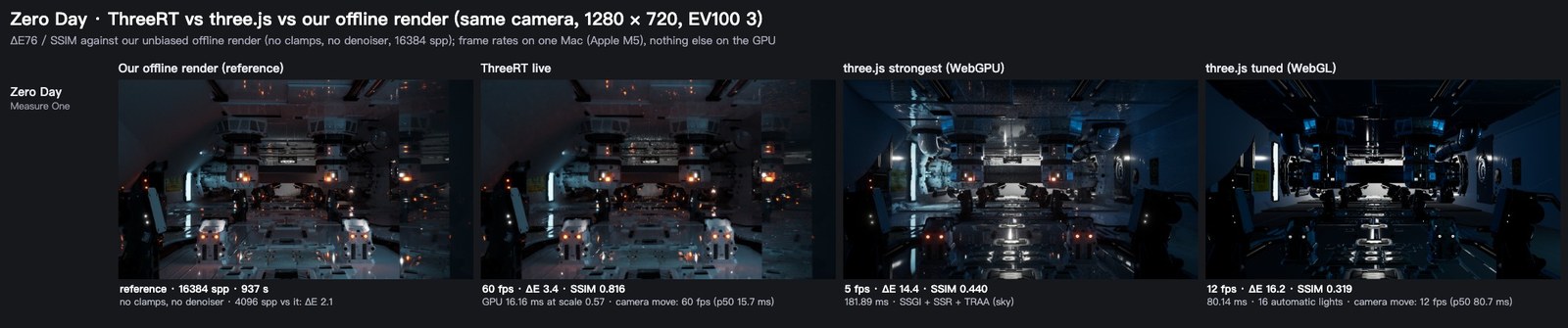
frame costs 40.28 ms, 25 fps. Zero-Day is the same story: 16.16 ms at scale 0.57, 39.2 ms at
scale 1. Along a 6-second camera move the GPU p50/p95 is 16.32/16.72 ms. The README is clear
that the live view "holds 60 fps by lowering its render scale". The tweet is not.
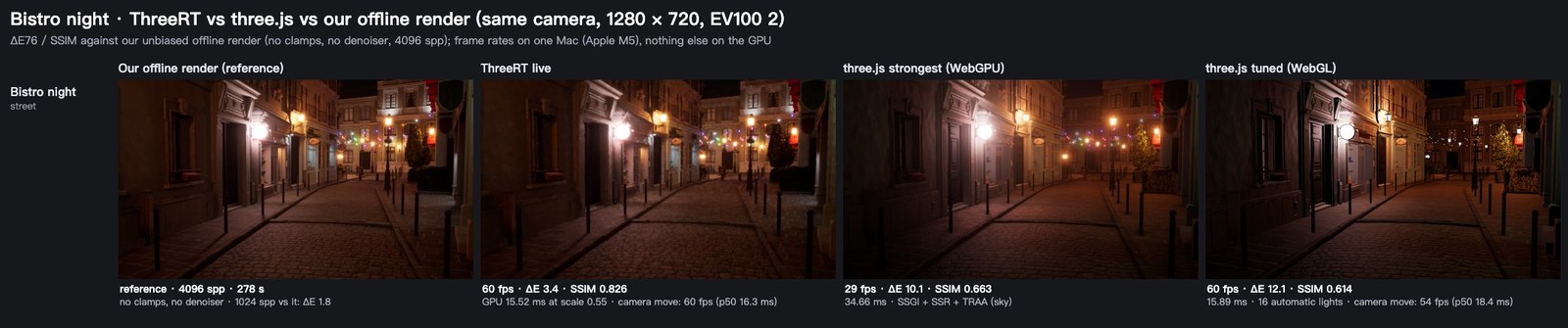
"Lifelike lighting, closer than three.js." The comparison is fair in method and the
numbers support it. Both engines run the same scene file (tools/three/engine.ts implements
the Engine API on three.js r187), the same camera and the same exposure. Three.js "at its
strongest" is WebGPURenderer with its own SSGI at the documented High preset, SSR and TRAA.
On Bistro it costs 34.66 ms with ΔE 10.1; tuned WebGL with shadow maps costs 15.89 ms with
ΔE 12.1. The reference matters, though. The milestone tables measure everything against
ThreeRT's own unbiased offline render, which favours the renderer that shares its BRDF,
light units and sky. The hello-world and Part 1 tables use Unreal 5.8's path tracer instead,
and there ThreeRT's lead holds: on the sun-room scene, ΔE 3.6 against 18.8 for tuned
three.js and 20.6 for the strongest setup.
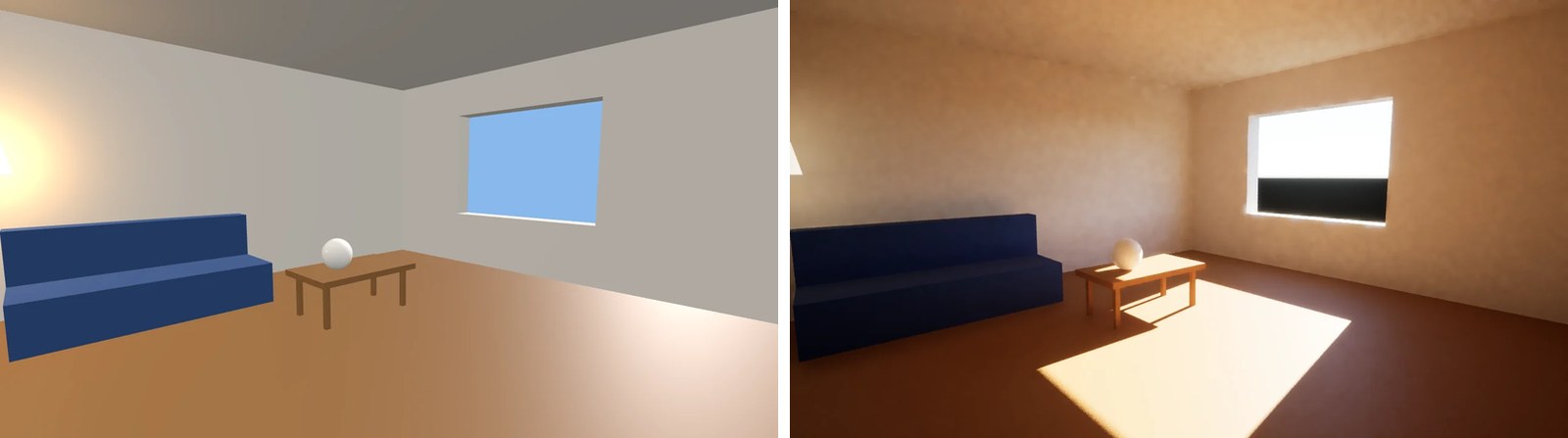
The repo is also honest about where three.js wins. Tuned three.js draws the small scenes in
about 1 ms; ThreeRT spends 15 to 20 ms on them because it fills the 60 fps budget by design.
On a weaker GPU that floor is the risk, and three.js has ten times the headroom. ThreeRT's own
target in docs/ROADMAP.md is ΔE ≤ 3 and SSIM ≥ 0.9 against the offline render; live Bistro
is at 3.4 and 0.826, so by its own bar it is close, not there.
"10M triangles and 1M lights in real time, on a MacBook." The Tokyo scene is Project
PLATEAU's open city model compiled through jeantimex's tokyo
pipeline. The roadmap's own counts are larger than the tweet's: the Shiba area within 1.3 km
of Tokyo Tower is 17.4 M triangles, and Tokyo's scenes carry 1.4 M emitters. Those "lights"
are emissive triangles, mostly lit windows, sampled through the light tree, and the live
view's A_FAR_EMITTERS approximation proposes none beyond 120 m for direct sampling (far
windows still light the scene through the cache and are seen by camera rays). Measured with
the clock running from 15:30 to 17:45: 61 fps after the first second, frame interval p95
17.7 ms, GPU p50 15.6 ms, at a render scale of 0.62 and with no rebuild. That is real
time by the repo's definition, again through the upscaler.
The hardware is worth stating per number, because the repo uses three Macs. The README's reel
is on an M3 Max, the milestone and compare tables on an M5 (10-core GPU), and the runtime
and browser probes on an M5 Pro. None of the tables I read has a frame time from an NVIDIA or
AMD card. docs/REPORT.md prices screenshots on an RTX 4090 and an L4, but with the M5's
frame times "used as an upper bound for discrete RT GPUs", not with a run on those cards.
On an RTX 3090
The repository's numbers are all from Apple GPUs, so I had the engine built and run on
Satyajit's Linux box: an RTX 3090 (driver 580.126.09) through Vulkan, where wgpu reports
"hwrt": true. The script cloned the repository fresh, which by then was at 0778f4d
(20 November), four days newer than the 65a4eb9 the rest of this article reads. It built
threert-render in release without OIDN and ran three reference scenes that need no
downloaded assets: the Cornell box, the material grid and the sun room. Each ran twice, with
hardware ray queries and with THREERT_HWRT=0, which falls back to the software BVH on the
same GPU.
First, offline renders at 1280×720 and 256 samples a pixel. The trace time is the kernel's own; the wall time includes start-up, the sky bake, the CPU à-trous denoiser (about 0.4 s, since there is no OIDN in this build) and writing the PNG:
| scene | triangles | trace, ray queries | trace, software BVH | ratio | wall, ray queries / software |
|---|---|---|---|---|---|
| Cornell box | 86 | 447.4 ms | 709.9 ms | 1.6× | 5.37 s / 5.18 s |
| material grid | 217,730 | 515.1 ms | 1,455.5 ms | 2.8× | 5.69 s / 6.22 s |
| sun room | 6,400 | 947.4 ms | 3,029.1 ms | 3.2× | 5.99 s / 7.84 s |
The Cornell box at 256 spp traces in under half a second with ray queries, about 527 million
samples a second by the renderer's own count. The material grid shows a second difference
between the two paths. With ray queries its spheres stay 19 instances over 12,098 pooled
triangles; the software path flattens them into 217,730 triangles and spends 171.6 ms
building a BVH of 132,193 nodes first, as docs/RUNTIME.md says an offline render under
software traversal does. On scenes this small the fixed costs swamp the trace: about 4.9 of
the Cornell box's 5.37 seconds are something other than tracing. The renderer's own timings
name about 1.1 s of it (GPU start-up 534.1 ms, the denoiser 356.2 ms, the upload 152.9 ms,
readback and post); I assume most of the rest is compiling the kernel for the scene, which
the timings do not list.
Then the live view, headless, at 1280×720 and render scale 1 (no upscaler), 600 frames each, statistics from frame 100 on:
| scene | GPU ms a frame, p50 / p95, ray queries | software BVH | trace of one sample, ray queries | software BVH |
|---|---|---|---|---|
| Cornell box | 11.54 / 12.02 | 12.09 / 13.18 | 0.50 ms | 1.19 ms |
| material grid | 11.73 / 12.79 | 6.42 / 14.61 | 0.69 ms | 3.29 ms |
| sun room | 11.33 / 12.56 | 7.31 / 9.92 | 1.56 ms | 4.39 ms |
The GPU-time column is the misleading one. With hardware ray queries every scene lands near
11.5 ms, and with the software BVH two of them come in cheaper, which reads as if the
software path were faster. It is not. In the live runner I read, a session at render scale 1
raises its samples per frame while the GPU has headroom under the 60 fps budget (next_spp
in live/session.rs), and the frame timer covers all of them. A frame's GPU time is
therefore close to a budget the runner fills, not a cost. The column that compares like with
like is the trace of one sample: ray queries are 2.4× faster on the Cornell box, 4.8× on the
material grid and 2.8× on the sun room. The software path's wider p95 on the material grid
(14.61 ms against a 6.42 ms median) is the same mechanism with less headroom to work with.
I did not log samples per frame, so this explanation is my reading of the code, not
something the run printed.
So on a three-generation-old desktop card, these hello-world scenes trace one sample at full 720p in 0.5 to 1.6 ms, and the engine has room to put several samples in each frame before it needs the upscaler at all. That says nothing about Bistro or Tokyo, which need their downloaded assets and were not run. It does say the NVIDIA path builds from the public source and works on Linux, which nothing in the repository showed.
Five platforms, and what ships for each
The README badge still says "clients: macOS · iOS", and the README's own instructions are
"macOS (14 or later, Apple silicon) or iPhone and iPad (iOS 17 or later)". The release
manifest the download page reads (threert.dev/releases/latest.json, fetched on 16
November) lists all five: macOS 0.5.0 (signed and notarized), iOS 0.4.3 on TestFlight, a
Linux x86_64 tarball 0.4.4 for the Steam Deck that "needs SteamOS 3 or a Linux with Vulkan
ray queries", an Android 0.4.3 APK, and Windows 0.4.3 as an unsigned preview that "needs
DirectX 12 GPU with ray queries". Every entry is dated 14 November or later, the day after
the post. The Windows card's fine print says "physical GPU validation is still pending", and
under the post, when someone asked how to run it on Windows, @ThreeRT3D replied that they had
"tested ThreeRT on a ThinkPad with RTX5070" and would release the installer once code signing
was sorted. So Windows asks for hardware ray queries on DirectX 12; how well that path works
is what the pending validation is about.
The device list on the landing page is the useful part: Desktop "RTX 20 · RX 6000 and later", Mac "M3 and later", Steam Deck "all models", iPhone "15 Pro and later". Every one of those is the first generation of its line with ray-tracing hardware. The software BVH exists, but the product is aimed at RT cores.
Android is the platform with the most scar tissue. docs/RUNTIME.md has a long section on
an Adreno 740 (Snapdragon 8 Gen 2, an AYN Thor handheld), where the renderer as written drew
textures from the wrong tables and lit nothing. The fixes are switches that are off
everywhere else: four read-only tables copied into uniform buffers (which caps a scene at
4,096 object entries and 409 instance records on that path), and a strict mode that refuses
non-finite rays because the odd one "faulted the GPU's MMU thousands of times a second and
doubled the trace". For the Steam Deck I found no frame-time measurement in the repository.
The only number is in the launch video: the frame counter in the corner of OpenStrike on the
Deck reads 34 fps.
Then there is "fully open source". The engine, the scene and gameplay packages, the tools and
the tests are MIT. The README's last section says "the clients for macOS and iOS are free to
use and closed source". So the app that most people will install, and that ships the
threert command line, is not in the repository. You can build threert-render yourself
with Rust and bun renderer/build.ts, and it has a window, a headless live mode and an
offline renderer. You cannot build the iPhone app.
What the browser actually gets
"Where ThreeRT isn't installed, the same code falls back to three.js" is accurate, and it is worth knowing which of three things the repo calls a browser path:
- The three.js page.
threert devserves "the three.js page" alongside the native clients. The CLI ships inside the closed Mac client, so I can't read that page's code; what the repository has istools/three/view.tsontools/three/engine.ts, the Engine API implemented on three.js r187'sWebGLRenderer, which plays games in a browser and is the same mapping the comparisons use. I assume the CLI's page is that one or close to it. It maps physical units mapped 1:1, shadow maps, PMREM image lighting from the sky, ACES. What three.js cannot express is dropped and counted: material functions, wetness and puddles, rect-light shadows, volumetric fog, the UE post chain, and all global illumination. Emission lights nothing in three.js, so the adapter places up to 16 point lights at the brightest emissive clusters. Physics is the engine's own Rapier compiled to wasm, so a game plays the same. - The engine itself in wasm (
renderer/web). The Rust engine builds forwasm32-unknown-unknownand runs in Chrome on WebGPU. WebGPU has no ray queries, so it uses the software BVH, the loop guard (every traversal loop counts and bails at 65,536, after two runaway dispatches took a Mac's display down) and a merged binding layout that fits eight storage buffers a stage. It has run the physics hello world, number for number with the native run. Larger scenes are not measured. - Rays off.
docs/PORTS.mdlists a raster mode of the native engine for GPUs without ray tracing. Same engine, same scene, rays switched off past the camera hit.
The first is what a shared URL shows today, and it is ordinary three.js. That is the right fallback: the game works, and the reader sees a plain version rather than an install prompt. The second is where this goes if WebGPU ever gets ray queries.
What Meshy gets out of it
None of the repository says why Meshy funds this, so this section is my reading of what is in it.
docs/ARCHITECTURE.md is titled "ThreeRT: serverless 3D gameplay & rendering runtime for AI
agents". The engine was extracted on 10 November from a repository called
taichi-dev/serverless-agent-test, and the evaluation report's production deployment is a
Cloudflare Worker named agent3d-gateway. The design in that document is an LLM that writes
a game.ts, a gateway that stores it, rooms that hold game state with optimistic
transactions and deterministic replay, and a pool of GPU render nodes that run the scene code
in QuickJS and return a screenshot. The compatibility set mixes official three.js examples
with "the code LLMs usually write". threert create drops an AGENTS.md and a CLAUDE.md
into every new game, and the repository ships a scene-authoring skill for coding agents. The
roadmap, planning street furniture for the Tokyo scene, notes that for generated assets
"Meshy is the natural source".
Put together: Meshy sells generated 3D models. Generated models are only as good as the place
they end up, and three.js is where LLM-written 3D code ends up, because LLMs write three.js
fluently. A runtime that takes that code unchanged, makes it look like an Unreal render,
publishes it at name.threert.app and lets an agent iterate on a screenshot from a render
node is a destination for Meshy's assets that Meshy controls. The thread also says ThreeRT
grew out of Pocket3D, "static three.js compilation for console rasterizers", and thanks
Yuanming Hu, Taichi's author and Meshy's founder. Picking QuickJS over V8 fits that history:
the same runtime has to fit on a phone and a handheld.
Where I land
The engine is serious work. The kernel is one source compiled into per-device variants, the live estimator's every shortcut is a named bit with a measured bias, and the comparison with three.js is set up the way I would want it set up: the same scene file through both engines, three.js given its best stack, and the cases where three.js wins written down. I have not read a more careful README for a graphics launch this year.
The launch copy is looser than the repository. "Path tracing at 60 fps" is 60 fps at a render scale near 0.55 plus a temporal upscaler and a radiance cache that ends most paths after one bounce. That is the same deal Lumen and every vendor upscaler make, and nothing to apologise for, but a reader comparing it with an offline path tracer should know. "macOS, Windows, iOS, Android and Steam Deck" is true of the release manifest a day later, with Windows an unsigned preview whose GPU validation is pending. "Fully open source" excludes the clients.
Should you port a three.js project to it? If your scene is a room, a product, a city or a
game where light carries the picture, and your users have RT hardware, yes: it is the
shortest path I know from three.js-shaped code to images that look like a path tracer drew
them, and the three.js fallback means you lose nothing on the web. If you depend on
ShaderMaterial, orthographic views, post-processing passes of your own or the three.js
ecosystem's addons, the port is a rewrite, and the coverage map above is roughly where it
starts. For real-time three.js on the web itself, the work in
three.js's meshlet pipeline and
three-nanite is still where the action is, and
Shaders' WebGPU engine is a good look at what effects a browser
already gets from WebGPU without any ray tracing.