2026-07-10 · 2 min · mixture-of-experts
Why read this
Nichelast 15%A clear walk through top-1 routing, the capacity buffer and dropped tokens, the balancing loss and fp32 router, with the 7x and 1.6T read precisely.
- Genuinely new idea
- Evergreen reference
- Widely used
LLM architectureNeeds datacenter GPUsPractitioner paper
How this was scored
- Is it new?
- 3 of 3: Changes how the field does something
- Can I trust it?
- 0 of 3: Restates claims
- Can I run it?
- 1 of 3: API-only, gated or restrictive licence
- Will I understand it?
- 2 of 3: Mechanism from first principles with figures
- Can I act on it?
- 1 of 3: General advice
- Will it last?
- 3 of 3: Evergreen fundamentals
- Does it affect many?
- 2 of 3: A widely used model, tool or lab release
- Only here?
- 0 of 3: Same as the press release
Score 49 of 100, ranked 664 of 773 rated articles. Each question is answered 0–3 by hand, and a 3 is rare. How articles are scored
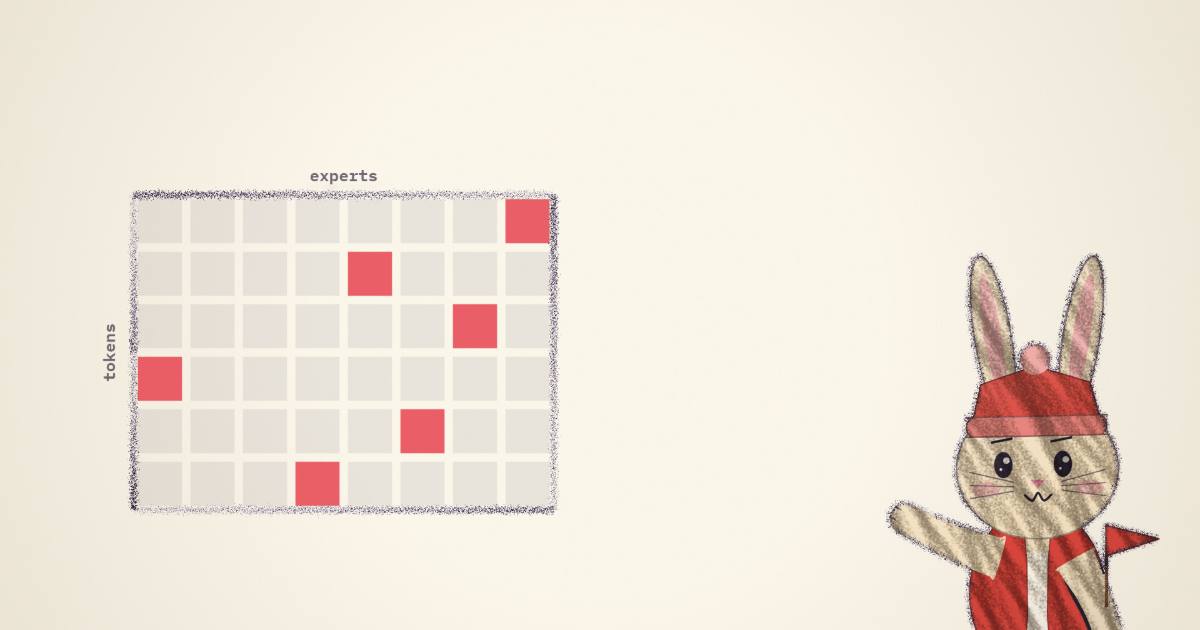
Switch Transformers (Fedus, Zoph and Shazeer, 2021) made mixture-of-experts simple enough to scale with one blunt move: send each token to exactly one expert. The 2017 recipe argued for at least two, so the router could learn by comparing them. Switch keeps only the argmax.
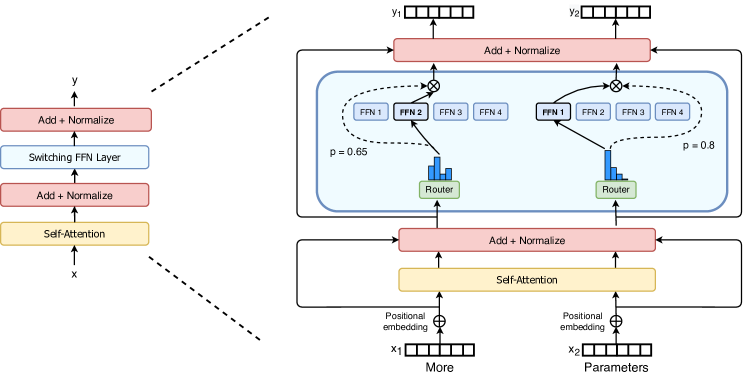
This page used to carry the whole paper. It is now a summary, and the mechanism lives in Mixture of Experts, from scratch, next to GShard before it and DeepSeek's loss-free balancing after it, with a capacity-factor widget and drop rates measured on Qwen3-30B-A3B. The points worth keeping:
- Top-1 halves the traffic. Each routed copy of a token is an activation shipped to another device. One copy instead of two roughly halves the router's work and the all-to-all volume. In the paper's Table 1, Switch-Base at capacity factor 1.0 trains at 1,000 examples a second against 860 for the top-2 MoE-Base.
- A fixed buffer, and the tokens that fall off it. Each expert gets (tokens per batch / number of experts) × capacity factor slots, so tensor shapes stay fixed. The paper tests 1.0, 1.25 and 2.0. A token that finds its expert full is dropped: it skips the layer and rides the residual connection. With the balancing loss, drops were typically under 1%.
- Two guardrails. A balancing loss, with , which equals under perfectly even routing. And a router computed in float32 inside an otherwise bfloat16 model, since that softmax is where small errors flip the argmax.
- Read the 7× precisely. At equal FLOPs per token, Switch-Base reaches T5-Base's quality in about a seventh of the steps, and Switch-XXL reaches T5-XXL's about 4× faster. That is sample efficiency bought with memory and communication, not a wall-clock promise. Switch-C stores about 1.6 trillion parameters in 2,048 experts per layer, and a token still runs one expert's FFN.
- Distillation keeps a slice. Distilling the sparse teacher into a dense student compressed it by up to 99% while keeping about 30% of the sparse model's gain.
Newer models moved on from most of this: top-8 of many small experts instead of top-1, a per-expert bias instead of the loss, and no dropped tokens at all. They all start from this layer. The guide's Switch section has the derivations and the measurements.