2026-09-22 · 56 min · 3d · gaussian-splatting · performance · cuda · mesh · bim
A 4:26 narrated explainer, drawn in code. Every number and picture in it is this article's own; the sources are below.
› transcript
A three sixty camera films the whole room at once. So why does a good pipeline cut every frame into ten small pictures? Hi, I'm Saffi! Spirula Studio takes raw video all the way to Gaussian splats in one program. Today, how it handles a three sixty camera. Chapter one. Rewritten, not wrapped. Most all in one splat tools are a launcher around other people's programs. Here, each one was written again. COLMAP became a structure from motion module on Vulkan, porting its algorithms and defaults, not its code. PyTorch became a small inference runtime written in Slang. The video decoders are its own, running on the graphics card. And the segmentation model that masks out the operator runs as compute shaders. This is the desktop app. The same trainer drives it and the command line, so a cloud box runs exactly what your laptop runs. Chapter two. A sphere into views. The easy route hands structure from motion the stitched panorama. Both lenses become one camera, downsampled to four point four pixels per degree. Spirula cuts views that each read one lens. A face holds sixteen point seven pixels per degree, and a rig ties the views of a frame together. Here is the whole sphere, unrolled. A GoPro MAX does not stitch its two lenses. They meet down this dashed line, with real parallax across it. So Spirula cuts per lens. The front lens gets the face on its axis, plus the near half of its four neighbours. The back lens gets the same five. Every view reads one lens, so each is a true pinhole camera. Only five point nine percent of the sphere is seen twice. The views of one frame share almost no features, so matches across time hold them together. A MAX 2 is already stitched, so it gets six faces on a tilted cube. Kept level, my check finds about two percent of the sphere in no view. Every camera model is a rule for where a ray lands. A pinhole puts a ray at the focal length times the tangent of its angle. At ninety degrees that is infinite. An equidistant fisheye grows with the angle itself, so a lens of about two hundred degrees still fits on the sensor. A dual fisheye file is different again. It holds two fisheye tracks, one per lens. Each track is already one central camera, so each gets a fisheye model of its own. No cutting. Structure from motion is told the two lenses are a rig, back to back, and solves one pose for the whole frame. Training renders the fisheye directly by default. It splits each lens into five faces only when you ask. In the project's own reel: a fisheye frame of a room, masked, then the cameras solved. The timings on screen are the project's claims. Chapter three. From splats to a building. A building model needs metres and gravity. Spirula has four ways to get them. The camera's own telemetry, read from the video file. Printed markers, new in October and still marked experimental. A distance you measured on site, between two points you pick in the editor. Or a laser scan, which is metres by definition and already level. The mesh starts from the trained Gaussians. Each one gives seven points: its centre, and two along each of its axes. Those points are joined into tetrahedra, and each corner is called inside only if every camera's line of sight to it is blocked. The surface is cut where that occupancy crosses one half, then cleaned and textured. Reading the code also showed what nobody has measured. Nobody, the project included, has said how many millimetres off a wall the mesh lands. The finished reconstructions are not yet scored against COLMAP on a public dataset. And I read the code without running the binary. So cut the sphere per lens, and tell the solver the rig. Then model from the dense points, and show people the splat. To recap. Rewritten, not wrapped. Views per lens, held together by a rig. Points for the modeller, splats for everyone else. Every source is in the full article. I'm Saffi. Bye!
Why read this
Notabletop 60%Checks whether a one-binary splat pipeline wraps or rewrites COLMAP, PyTorch and ffmpeg (it rewrites), why BA stays fp64, and how the new LiDAR path works.
- Original analysis
- Runs on a consumer GPU
- A new technique
3D & spatialGPL-3.0Practitioner tool
How this was scored
- Is it new?
- 2 of 3: A real new idea, method or capability
- Can I trust it?
- 2 of 3: Measures key facts from files, code or configs
- Can I run it?
- 2 of 3: Open code or weights with real limits
- Will I understand it?
- 2 of 3: Mechanism from first principles with figures
- Can I act on it?
- 2 of 3: A concrete recipe, numbers or comparison
- Will it last?
- 1 of 3: Relevant for months
- Does it affect many?
- 1 of 3: A specialist community
- Only here?
- 2 of 3: A teardown or measurement few others did
Score 65 of 100, ranked 319 of 773 rated articles. Each question is answered 0–3 by hand, and a 3 is rare. How articles are scored
When a project describes itself as "one self-contained binary" covering camera
alignment through to 3D Gaussian Splatting training, my first move is to open
the CMake and count the FetchContent_Declare calls. That is where the seams
usually are: a launcher, a config schema, and six other people's repositories
doing the work.
Spirula Studio has two.
glfw and imgui. That is the entire external fetch list.
This matters beyond tidiness. Every Gaussian-splatting pipeline I have had to
put into production died at the same place: not at the training, but at the
seams. A COLMAP that has to be built with the right CUDA arch. A PyTorch wheel
that fights the driver. A masking script that pulls a second CUDA stack in
beside the first. An ffmpeg that is on the machine but wrong. The model was
never the hard part; the bill of materials was.
So the interesting question about Spirula Studio is not whether it trains good splats. It is whether "no Python, no PyTorch, no separate COLMAP install" is a packaging claim or a rewrite.
It is a rewrite
| dependency removed | what replaced it | lines |
|---|---|---|
| colmap (subprocess) | src/sfm/ still borrowed: COLMAP's behaviour and parameter defaults, as the reference | 44,310 |
| PyTorch + CUDA (inference) | src/nn/ still borrowed: nothing — Vulkan + Slang, its own tensor and op set | 10,886 |
| lang-segment-anything | src/sam/ still borrowed: Meta's SAM 2.1 / SAM 3 checkpoints, fetched on first use | 7,962 |
| ffmpeg (frame extraction) | src/video/ still borrowed: nothing — VK_KHR_video_decode plus its own demuxers | 9,145 |
| onnxruntime (features) | src/aliked/ + src/loma/ still borrowed: COLMAP's and LoMa's own ONNX exports, parsed in process | 5,712 |
| torch.hub + mmcv (depth) | src/moge/ + src/metric3d/ still borrowed: onnx-community and Ruicheng ONNX exports of MoGe-2 / Metric3D v2 | 4,059 |
What is left of Python in the repository is 39 files under reference/, kept as the behavioural reference the ports were checked against, plus the build's own codegen. Nothing in the shipped binary runs them.
Read the module READMEs and the same sentence appears six times in slightly different words: "with no onnxruntime, no PyTorch and no converter." Each module says what it replaced and why:
src/sfm/— "A standalone SfM pipeline — images in, a COLMAPsparse/model out — with a GPU compute backend (Vulkan + Slang) and no heavy dependencies… It exists to replace thecolmapsubprocess." The rule it sets for itself is the one that makes this defensible: "Port algorithms, not code. COLMAP is the reference for behaviour and parameter defaults; the implementation is ours, against our own data structures." COLMAP's on-disk formats stay the interchange format precisely so any one stage can be swapped back for COLMAP's to bisect a failure.src/nn/— a general inference layer: its own Vulkan runtime, a device tensor, an op set, host image I/O. "It knows nothing about any model." No computation graph, deliberately: "a module's forward pass reads as straight-line C++ next to its PyTorch reference, and the arena's scoping is the whole memory strategy."src/sam/— SAM 2 / 2.1 / 3 on that layer, a Vulkan + Slang port of sam3.cpp, itself a ggml port of Meta's SAM 3. It exists "to replace the Python/PyTorch subprocess the GUI used to shell out to for masking."src/video/— frame extraction without ffmpeg, onVK_KHR_video_decode_*, with the containers, bitstream parsing and reference-picture management written here because "a hardware decoder does entropy decoding, motion compensation and filtering. It does not track reference-picture state, and Vulkan makes that the application's job."
The checkpoints are the honest exception and the project is precise about it.
ALIKED's weights are "COLMAP's, fetched from COLMAP's release URL and parsed
in process. We host nothing and convert nothing." The ONNX reader is
nn/io/Onnx.cpp, a ~400-line varint walk of protobuf that reads initializers
only — the graph structure is hard-coded in C++, so nothing has to understand
an operator or a shape rule. The point of that is stated plainly: parity.
Both sides run the same bytes, so a difference against
colmap feature_extractor --FeatureExtraction.type ALIKED_N16ROT is yours and
can be bisected, "which is exactly how the two bugs below were found."
That is the tell of a real port rather than a reimplementation-by-vibes. The modules report their parity as a number: MoGe-2's forward pass matches onnxruntime on the same checkpoint to a relative L2 of 3.8e-6, Metric3D v2's to 1.5e-3, and LoMa's three networks each match on the same bytes.
The -DSS_ENABLE_PATENTED=ON line
Buried in the build instructions is the most grown-up licensing decision I have seen in a hobby-scale repository:
Nine thousand lines of decoder, written, tested, and fenced behind a flag that defaults to off, with the fallback wired and the user told why. The upside of turning it on is stated too — roughly 15× faster frame extraction, a 127-second 1080p30 clip in ten seconds, masking that rides along on the same device pass, and no ffmpeg to install.
Where the numbers are
The feature list is the marketing surface: cross-vendor via Vulkan, one strategy combining MCMC/IGS+/MRNF, 10 million SH3 Gaussians in 8 GB of VRAM under quantized training, native 360 and equirectangular support, a modified bilateral grid and PPISP for exposure and white balance. I have not run the binary and have no measurement of my own to put against any of it.
What I can read is the engineering documentation, and there the numbers have the shape of things someone actually measured and then had to live with. My favourite is the one that argues against a speedup.
The mapping stage spends most of its time in bundle adjustment, and most of those solves are provisional — a growth-phase refinement followed by more growth, a merge-tree level followed by another level. Running them in fp32 is worth 25–35% of the stage, and the README does the arithmetic for why: "on solves large enough to be arithmetic-bound, halving the bytes every kernel moves is worth ~2×, and below a few dozen images the scalar makes no difference at all because those solves are bounded by dispatch count instead."
It is fp64 anyway. The reason is the one that only shows up if you run the same job three times:
The README reports three identical runs of a 379-image capture: 96.1 AUC@10
every time in fp64, and 96.5 / 92.3 / 91.5 in fp32. Noisier and 2.7
points worse on average. The flag to take the speed anyway exists, --ba-real-coarse float,
and the default does not use it.
This is a familiar bruise. Non-determinism from atomic ordering is the thing that makes a CUDA pipeline impossible to debug — you fix a bug, the number moves, and you cannot tell whether you fixed it. Paying 30% to keep a pipeline bit-reproducible is the right trade, and almost nobody makes it, because the 30% is visible in a benchmark and the reproducibility is not.
The second measurement in that family is about an abandoned design rather than a scalar. An earlier "manage" loop repaired a model by growing it without a bound: "on a 5356-image capture it spent 65 minutes to merge three models and recover 119 images, and ended with three near-copies of one reconstruction." That is in the README, describing code that has since been replaced, under the switch that still turns it off.
The 360 path
The claim I most wanted to check is the one about 360 cameras, because it is
where most pipelines cheat. The cheap version is: undistort the panorama into
six or ten pinhole faces, hand those to COLMAP, and call it support. For a
dual-fisheye file, Spirula does not do that. (Correction, 12 November: a GoPro
.360 is cut into ten pinhole views, and the trainer splits panoramas into
cube faces. The per-container answer is below.)
- container
ISO-BMFF picked by content, not extension; the file's two video tracks are enumerated, never merged — a 360 camera's two fisheye lenses.
one output folder per track
- decode
VK_KHR_video_decode on the same device as everything else; the H.264/H.265/AV1 bitstream parsing and reference-picture state are Spirula's own.
127 s of 1080p30 in 10 s · ~15× vs shelling out to ffmpeg
- rig
kind: dual-fisheye — the second lens is the first turned 180° about the image vertical, and the baseline between them is its only translation (refined as axial).
Insta360 X, Osmo 360 and a PortalCam all calibrate within 0.8–1.4° of that rotation; the Osmo's baseline lands within a millimetre of the axis
- matching
--rig-pairs extends every verified frame pair to the other lens: cam0–cam0 brings cam1–cam1, cam0–cam1 brings cam1–cam0. A second, smaller verification pass over what the first confirmed.
72–95% of rig-mates verify on the dual fisheyes measured; 6% on a .360's narrow views, which is why it stops there
- registration
Once a member is calibrated the FRAME is what PnP estimates: every calibrated lens's 2D–3D correspondences go into one pool, one LO-RANSAC over all of it.
a hypothesis explaining one lens and contradicting the other nine loses to one that explains the frame
- gauge
The file's own sensors fix scale and up. The Osmo 360 carries an attitude stream but no raw gyro, so pre-integration runs from the attitude instead; the IMU-to-lens rotation is calibrated from the reconstruction itself.
gravity solves to 9.82 m/s² within 0.3° of up on a 118 s walk; the whole sensor fit takes 0.3 s
- record
sparse/N/gauge.txt states oriented and metric and which source settled each. A gauge a sensor settled is never overwritten by the guess it replaced.
scale and orientation uncertainties are printed and never gated on — measured against GPS they under-state the real error 3.9–4.5×
The whole thing hangs on treating the two lenses as a rig with known
geometry rather than as two unrelated cameras. kind: dual-fisheye says the
first two members are back-to-back lenses of one camera: the second turned 180°
about the image vertical, the baseline between them its only translation. The
repository reports how well that nominal geometry holds — Insta360 X, DJI Osmo
360 and a PortalCam's two fisheyes "all calibrate within 0.8–1.4 degrees of
that rotation, so it is refined; the Osmo and the PortalCam, measured against
something metric, put the baseline within a millimetre of the axis" — and then
uses it from the seed pair on, instead of waiting for each lens to register
independently.
Once a member is calibrated, registration changes shape: "a candidate whose frame has no lens placed yet brings the whole frame, and the frame — not a lens — is what the PnP estimates: every calibrated member's 2D–3D correspondences go into one pool, and one LO-RANSAC over that pool solves for the frame's pose… scored against all the members, so a hypothesis that explains one lens and contradicts the other nine loses to one that explains the frame."
The rig-mate extension is the part with the most useful negative result.
Extending a verified pair to the other lens verifies 72–95% of the time on
dual fisheyes and 6% on a .360's ten narrow views — so it is enabled for
the first and stopped for the second, with the measurement printed rather than
a heuristic asserted.
And the metric gauge is where the Osmo 360 gets special-cased by its own deficiency rather than by name. Scale and up normally come from the accelerometer through pre-integration and from the GPS log. What is missing is refused by its own uncertainty rather than by a rule: "a camera that only pans gets up and no scale, a stale phone fix gets no GPS, a file with an attitude stream but no raw gyro (the Osmo 360) pre-integrates from the attitude instead." The check that it worked is gravity: 9.82 m/s² within 0.3° of up on a 118-second walk, and the whole fit takes 0.3 s.
Then the uncertainties get printed and not enforced, for a reason worth quoting at every team that has ever shipped a quality gate:
What I would want before putting it in a pipeline
The gap is comparison. The SfM README's own unstarted list names it twice: "what is left is a scored comparison of the three frontends on a public dataset — nothing here says which to reach for", and, separately, "parity benchmarking on ETH3D / IMC." So the port is verified against onnxruntime and COLMAP for agreement, which is the harder and more useful check, but nothing says whether the finished reconstruction is as good as COLMAP's on a dataset both have seen.
The support surface is also one person's. The README says so — "developed and
maintained almost entirely by one person" — and the git history says the same:
50 commits in the public tree, the most recent three on the day before I wrote
this, all titled "render: misc UI/UX fixes". Against that, 471,999 lines of
C++, Slang and CUDA across src/, of which roughly 286,000 is hand-written once
the generated kernel instantiations and the translation catalogues are taken
out.
Cross-vendor 3D Gaussian Splatting trainer - video to splat to mesh, Vulkan or CUDA.
- license
- GPL-3.0
- branch
- master
- forks
- 246
- open issues
- 118
- tests
- 164 files
- source
- 27.2 MB
- commit date
- 2026-11-22
GitHub REST API, 2026-11-23 — branch, createdAt, description, forks, license, openIssues, pushedAt, stars, topics
local clone, 2026-10-11 at a132532 — fileCount, hasTests, licenseFile, shallow, testFileCount
shallow clone: counts describe the pinned tree, not the history
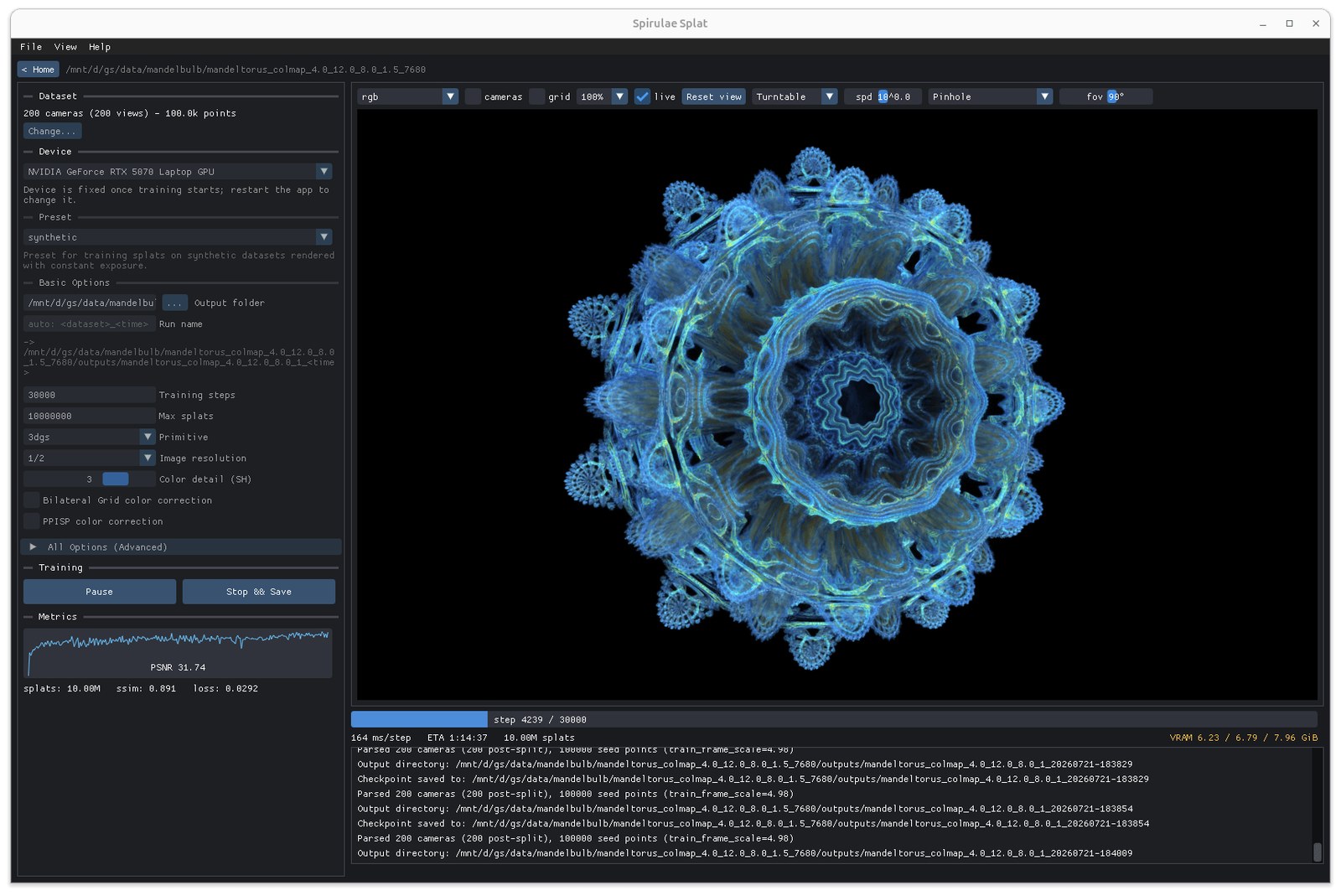
The other thing I would want is a licence read before adopting. Spirula Studio
is GPLv3, not Apache or MIT, which is a different conversation from most of
the splatting ecosystem — gsplat is Apache-2.0, nerfstudio is Apache-2.0. If
you are shipping a product, that binary is a subprocess boundary you have to
think about, and -DSS_ENABLE_PATENTED=ON is a second one.
None of which changes the thing I keep coming back to. The reason a splat pipeline is painful in production is that it is six stacks pretending to be one. This is one stack. Somebody sat down and wrote the SfM, the inference runtime, the video decoders and the segmentation model as compute shaders, checked each against the thing it replaced to six decimal places, and then refused the 30% speedup that would have made the result irreproducible.
Update: v2026.10.6
Two weeks after I wrote this, release v2026.10.6 shipped. Its changelog leads
with three things: a region of interest for training, faster depth and normal
maps for 360 cameras, and LiDAR scans as an input. I cloned the tag (commit
b9c8042) and diffed it against v2026.9.20, the last tag before this
article. That is 86 commits and 776 files changed, +143,316 / −8,341 lines
(measured, git diff --shortstat). Two details from the log matter for the
"one person" caveat above. Harry Chen wrote 72 of the 86 commits, and eight
other people wrote the other 14 (measured). The LiDAR feature, the largest
single commit at +10,604 lines over 54 files, came from an outside contributor
(PR #101), with Harry Chen as co-author.
The release notes call LiDAR support "experimental, tested on limited public datasets". I still have not run the binary. Everything below comes from reading the code and the notes committed with it.
LiDAR: what it accepts
On the dataset screen, a laser scan is an input like photos and videos, and a dataset can take several. The formats are:
- E57, read by
data/E57Reader.cpp, 481 lines with "no libE57Format and no Xerces behind it". It walks the file's 1020-of-1024-byte pages and the bit-packed point streams by hand. A file that names any codec exceptbitPackCodec, the only one the standard defines, is refused. - LAS 1.0–1.4, point formats 0–10, uncompressed. LAZ is refused with a message. That is the dependency-deletion habit again: decompressing LAZ would mean taking on LASzip.
- PLY, ASCII or binary, streamed. A
cameraelement (PCL, ETH3D, NavVis) gives the scanner's position. - XGRIDS LCC Studio exports. Their
raw/folder is already a COLMAP dataset in the LAS file's frame, so it is kept as it is (--mode keep).
The committed note draws the whole path as one diagram:
scan.e57 ──► photographs + their scan poses ─┐   (anchors.json)
scan.las ──► views rendered from where the   ├─► SfM ─► spirula lidar ─► sparse/0 in the scan frame
             scanner stood (no photographs)  │          (fit, merge,        + depths/ normals/
photos / videos ─────────────────────────────┘           seeds, tracks)
(Spirula Studio, docs/notes/lidar-alignment.md, "The pipeline".)
LiDAR: how it gets into the reconstruction
The scan does not replace structure from motion. It re-frames what SfM produces. Four steps do the work.
- Anchors. An anchor is an image whose pose in the scan's frame is
already known. Anchors come from the scanner's own photographs, or, for a
scan with none, from views of the cloud rendered where the scanner stood:
E57 station poses, a PLY
camera, or one position every 2 m along a.trajectory.las. - SfM runs as usual over everything. The exception is a dataset whose only images are the scanner's own photographs. Then the scanner's poses are used directly and no SfM runs.
- A similarity fit per model. For each SfM model with anchors, the fit finds a rotation, a translation and a scale. Rotation is the chordal mean of the anchors' relative rotations. Scale and translation come from RANSAC over pairs of anchors, then least squares. Then a point-to-plane ICP pulls the model's points onto the scan, thinned to 2M points, with a 7-parameter Gauss–Newton step. ICP is refused if it moves the anchors more than 5% of their spread. The note records a design that was tried and dropped: fitting anchor centres alone (Umeyama) left the rotation 1.9° off on a capture that walked nearly in a line, because the rotation about that line is free. Fitting rotations first got 0.16° (reported).
- Seeds, depth and normals from the scan. The scan is voxel-thinned to
500k points by default. For every image, the scan is rendered into a
1600 px depth map through that image's real lens, distortion included. A
seed counts as seen by an image when it lies on that depth to within 3% +
5 cm. Each seed keeps 12 of the images that see it as its COLMAP track, so
the trainer's initial cloud is the laser's points, not SfM's. SfM's own
points survive only where the scan has nothing, such as sky or anything
past the scanner's range. The same renders are written to
depths/(16-bit millimetres) andnormals/, in place of the monocular MoGe or Metric3D step.
The geometry the scan contributes is metric: the output model's
gauge.txt says metric 1. The release notes put it as "recover metric
scale and compute depth and normal maps".
LiDAR: how training uses it
This part is easy to over-read, so here is what the trainer actually does with the scan's three products.
- The seeds are used by default. They are the initial Gaussians.
- The normal maps are used by default.
normal_supervision_weightis 0.01 inconfig/TrainConfig.h. - The depth maps are not used unless you ask.
depth_supervision_weightdefaults to 0, no preset in the tree sets it, andTrainerCoreloads depths only when that weight is above zero. When it is on, the loss inshaders/per_pixel_losses.slangis a Pearson correlation between the rendered depth and the reference. A correlation ignores scale and offset. So inside the loss, a laser's millimetres count for no more than a monocular network's relative depth. The metric part of LiDAR reaches the splats through the frame and the seeds, not through the depth loss (reasoned, from the code).
The note's own training check agrees that this is no quality jump yet. On its FJD capture, 7k steps with every 8th image held out, the scan's seeds, normals and depth gave held-out PSNR 17.27 and SSIM 0.533. The same images on the unaligned SfM model and its own points gave 17.37 and 0.526. That is "within this capture's run-to-run noise (about 1 dB)" (reported). The alignment numbers are stronger. On ETH3D courtyard, a merged FARO scan with no photographs, the aligned model lands 3.0 cm / 0.11° from ground truth (reported). What LiDAR buys today is a metric, gravity-aligned frame and a dense seed cloud. It does not yet buy better pixels.
The note is just as frank about what is missing. A model with no anchor is lost. On a NavVis capture, the largest SfM model (1,046 images) had no anchor and was dropped (reported). Using the scanner's poses as priors inside bundle adjustment, which the note calls "the popular request", is listed as not done yet.
Region of interest
The trainer could already keep a run to a region of space (--roi-region),
but the region had to come from a partition or a hand-written JSON. What is
new is an editor, app/gui/RoiEditor.cpp at 2,271 lines (measured). In it you
build a region from boxes, ellipsoids, cylinders and extruded outlines. Each
shape is added, cut or intersected, applied in order from top to
bottom, so "everything except the crowd in the corner" takes one shape. The
editor has starting points ("cylinder around the subject" finds where the
cameras' optical axes come closest). The file it saves, <dataset>/roi/<name>.json,
is picked up by the trainer automatically.
The region does not hard-crop the scene. Splats outside it count for
roi_outside_weight (default 1e-4) when densification picks where to add
or move splats, and roi_mask_pixels (default on) masks each training image
to what it shows of the region. Coordinates are written at full double
precision, because a geo-referenced model sits millions of units from its
origin, where %.9g would round them to centimetres.
"Faster depth and normal maps for 360"
This one is a change of sizing, not a faster kernel (commit a82d926). A 360
frame is too distorted for a depth network, so it is split into overlapping
pinhole faces: a front face plus a ring of seven or eight, depending on
the lens. Before this
release each face was sized at the source frame's pixel density, so a
high-resolution fisheye ran roughly as many pixels as it was shot with, in
pieces. Now each face is sized to the written map's density, capped at
--max-size (default 1064), and raised to at least 1,200 patches (MoGe's
lowest token budget) where the frame has the pixels. In the README's words, a
high-resolution 360 capture "costs what its map does, not what its sensor
does". The old sizing is still available as --face-res source.
How much faster depends on the camera, and the release gives no number. The README points to a "Face size" section for the measurement, and no section by that name exists at this tag. The README's own vit-large timing shows why the lever is large: 260 ms at 616 px, 810 ms at 1064 px and 2,200 ms at 1600 px (reported). Cost grows faster than pixel count, so shrinking faces cuts time by more than it cuts pixels (reasoned). The same commit also blanks any pixel that any face called sky (MoGe's mask), so a wrong normal never reaches the loss.
No screenshots ship with this release: the GitHub release has binaries and a changelog only, and the tag adds no images to the repository. The figure earlier in this article is still the current GUI apart from the redesigned home screen.
October 11: the first scans from outside
Four days after the release, the Japanese account Duckbill Studio posted the first third-party LiDAR results I have seen. Translated, the post says they merged terrestrial-laser-scan E57 files with video and photos in Spirula Studio, got "scale and position constraints", and generated normal and depth maps. They used two rigs: a FARO Focus scan with DJI Osmo 360 video, and a Leica BLK360 scan with Sony A1 stills.
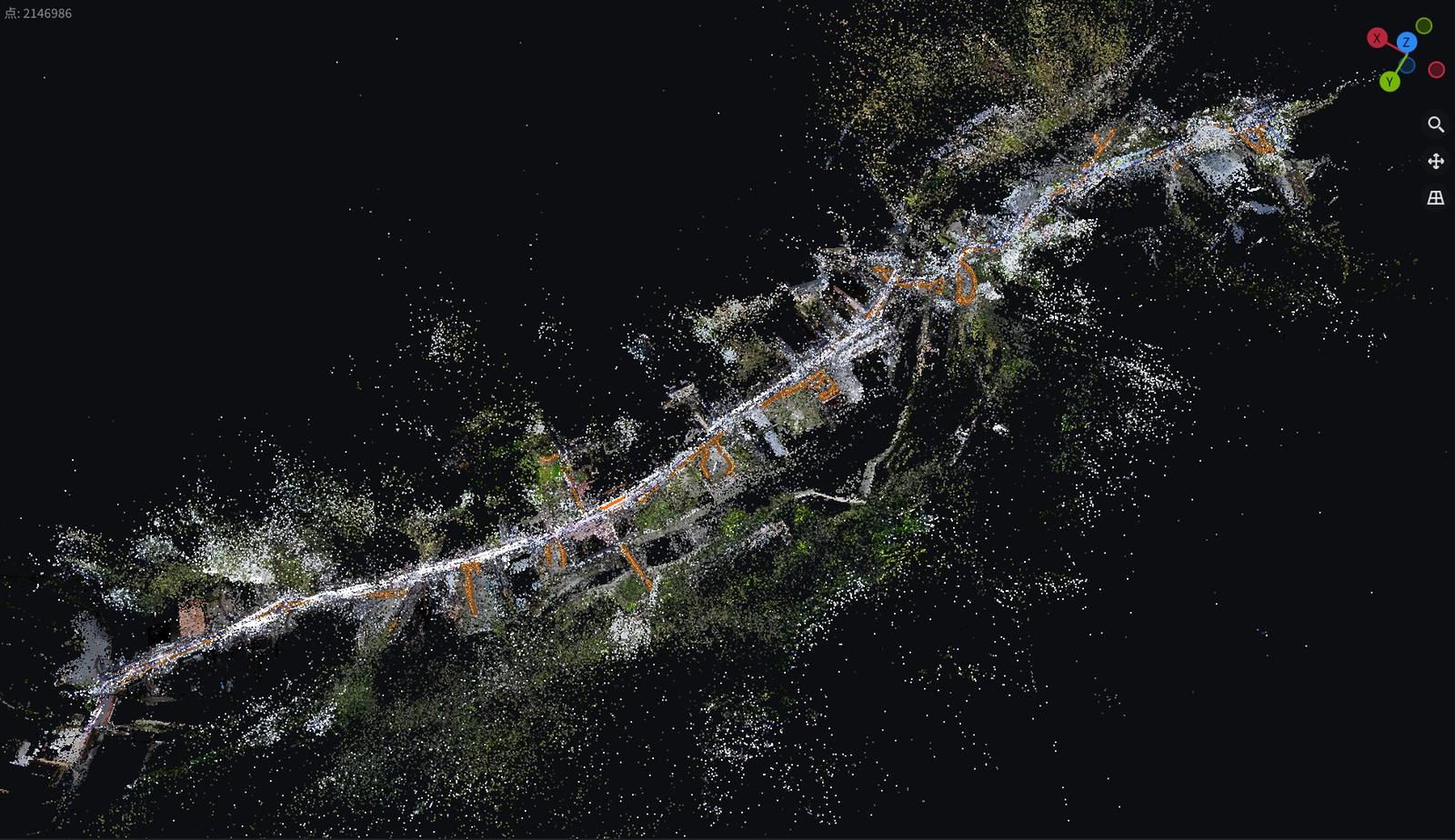
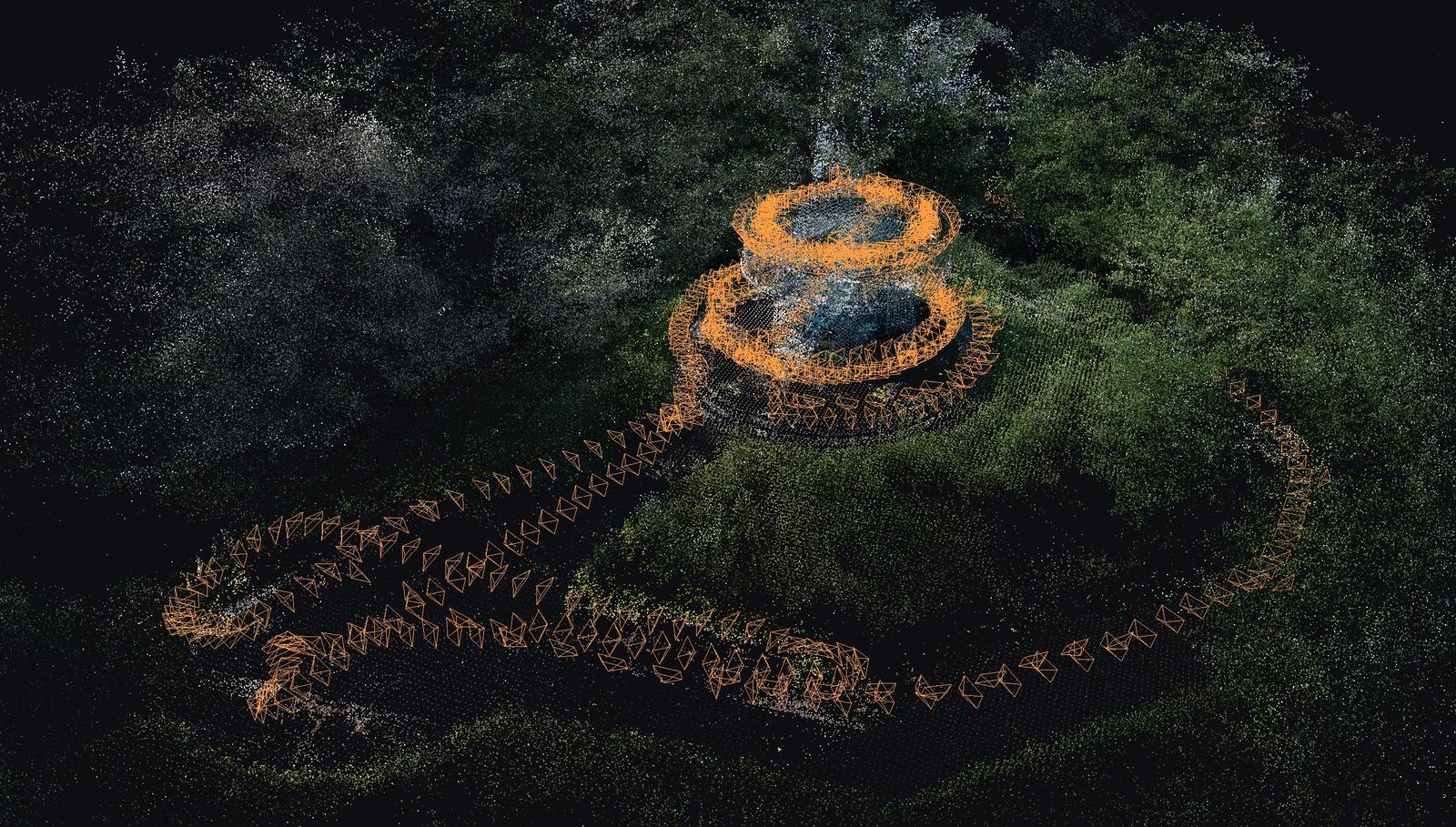
Neither pairing appears in the project's own measurements. In
docs/notes/lidar-alignment.md, the FARO data is ETH3D's merged scan with no
photographs, the BLK360 is tested alone, and the 360 video is an Insta360 X5
.insv, not an Osmo .OSV. So this is new evidence that the path works on
other hardware. It comes as screenshots only, with no residuals or held-out
scores, so it shows the alignment succeeded and not how well it did.
"Scale and position constraints" should be read the way the code does it. The
reconstruction is still pure structure from motion. Afterwards, the whole model
is moved onto the scan by the similarity fit and the point-to-plane ICP
described above, and given metric scale. Nothing constrains the camera poses
while bundle adjustment runs. Using the scanner's poses as priors inside BA is
still under "Not done yet" in the note at af0de16, the tip of the public tree
on October 11.
The follow-up post is the useful part. Translated: the initial point cloud for the splats is generated from the E57, things go wrong when the photos and the scan don't cover the same area, and the initial points for the distant background, outside the scan's range, disappear too.
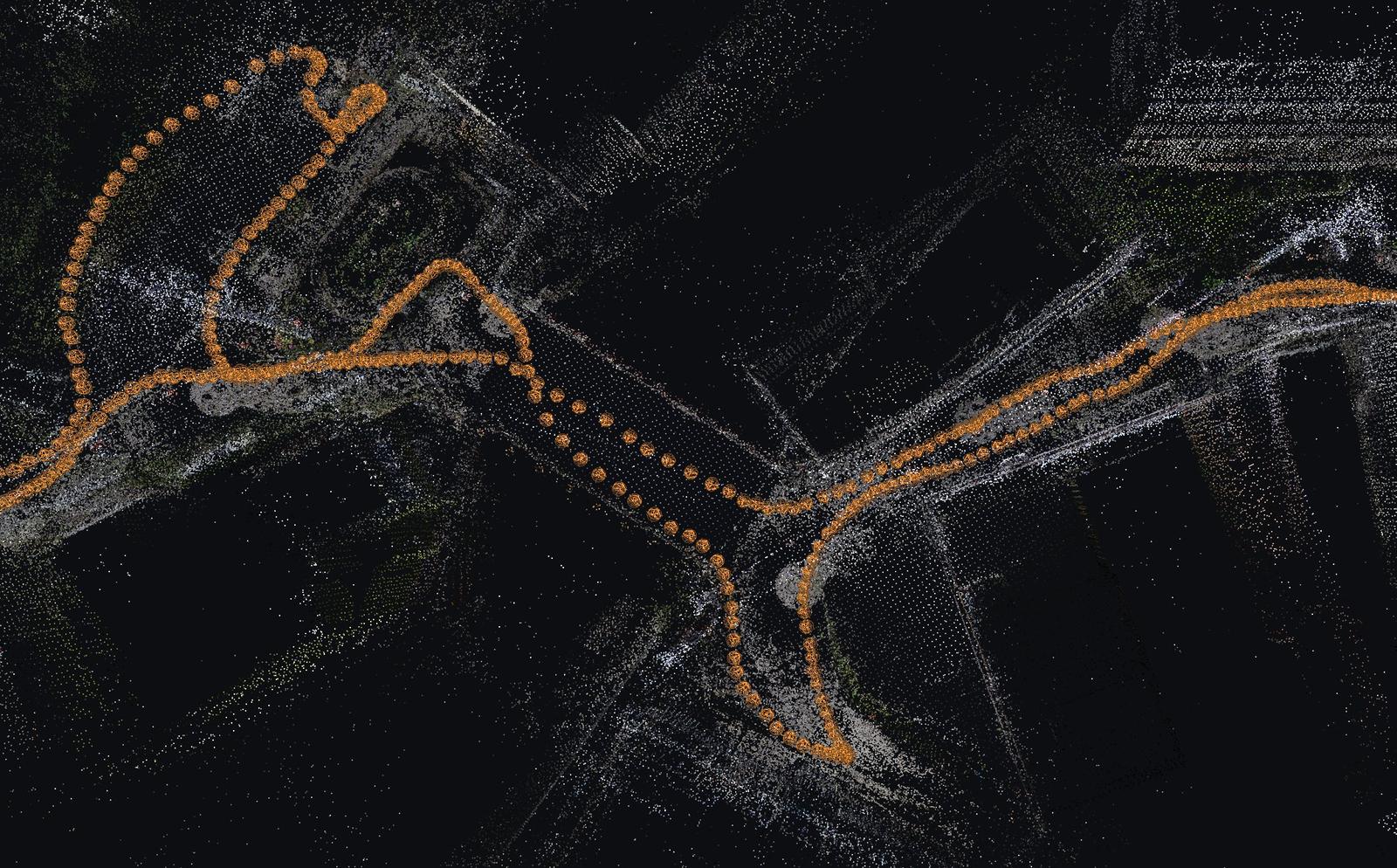
The code explains why. In LidarDataset.cpp, an SfM point survives the merge
only if most of the images that observe it see no scan depth at all at that
pixel. Each image's depth map is rendered from a draw of up to 40M scan points
(kDrawCap). The vote asks whether the map has any depth there (d > 0), not
whether that depth agrees with the SfM point's. A terrestrial scanner reaches
far but thinly. Its sparse distant returns still put some depth into many
background pixels, so the background's SfM points can lose the vote. Meanwhile
the seeds that replace them are thinned to 500k by default, and only a few of
those land far out. That combination is what removes a distant tree line. I am reading
this from the code and the post, not from their data. The CLI has two knobs
for it: --points all keeps every scan point as a seed, and --no-gap-points
goes the other way and drops the SfM points entirely.
The code has hardly moved since the release. Through af0de16 there are 31
more commits, and the only ones that touch the LiDAR path are small. The
XGRIDS importer now finds LCC Studio's nCore_data/ layout as well as
developer_data/, the seed cloud's double-precision PLY write moved to an
enum, and a header gained an include. The others cover GPS in SfM, RoMa v2
dense point clouds, a per-input colour LUT for video, AMD subgroup tuning, and
held-out evaluation after GUI training. I read both posts through the fxtwitter mirror
(the translations are mine), took the images from it, and diffed
v2026.10.6 against af0de16; I still have not run the binary.
Update: training on a PS5
On October 13, Gradeeterna
posted a 51-second
video of Spirula Studio "training Gaussian splats on a PS5… running natively
on the console's AMD GPU via the new PS5 Vulkan port", on a capture of Impasse
Saint Claude in Paris shot with an Insta360.
A reply links the two
repositories. Neither names the other: at d6d0d85, Spirula's tip on October
14, no file mentions the PS5, and the driver never mentions Spirula (measured,
git grep). The controller-driven front end in the video is in neither
public tree.
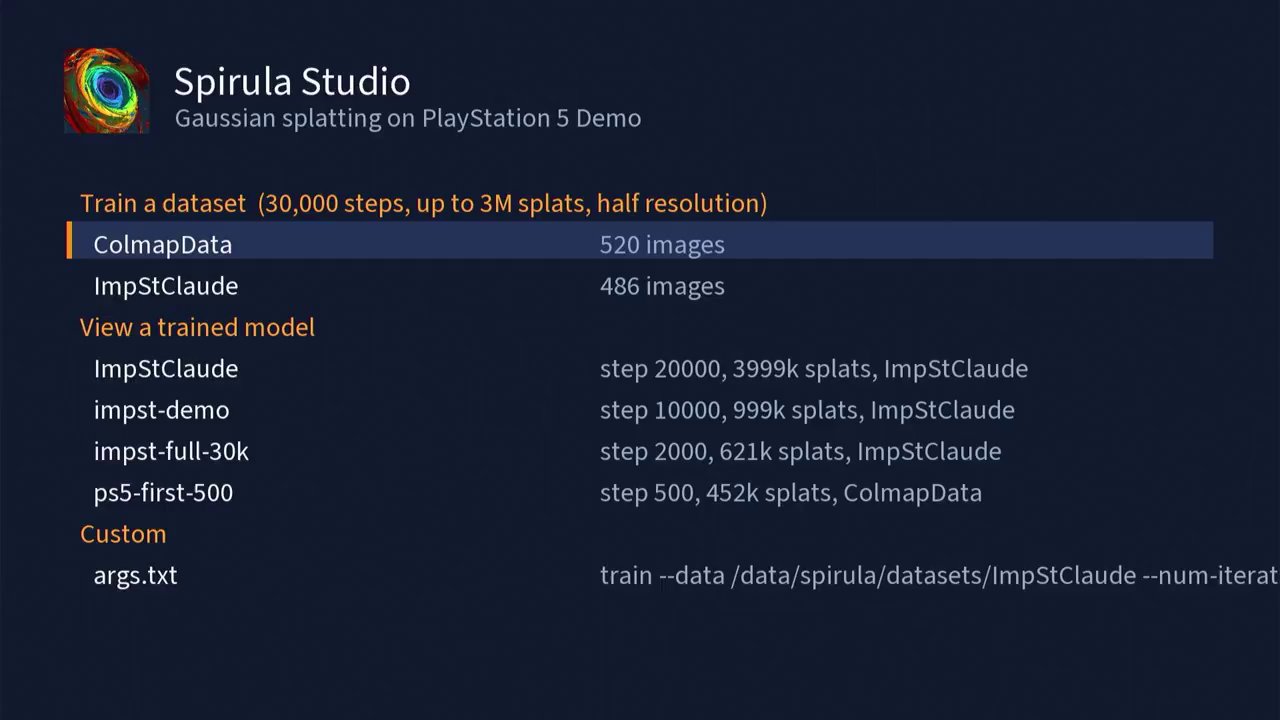
What the port is
PS5_Vulkan, by Mihawk-99 under
GPL-3.0-or-later, holds two Vulkan drivers. The first, ps5vk, is the author's
own Mesa-derived driver: 23 C files, 20,677 lines (measured), reporting Vulkan
1.1. The one that matters here is the second, Mesa's RADV, the stock Linux
driver for AMD GPUs, built from the author's Mesa 26.2.0 fork with a new
window-system layer for the console. RADV, its NIR passes and the ACO shader
compiler stay as upstream ships them except where the console differs. The
PS5 winsys takes GPU memory from the console's direct-memory pool. It copies
each command stream into the graphics ring through sceAgcDriverSubmitDcb,
the same call AnyPS5 reimplements in the other direction,
and the CPU waits on a sequence number each submission writes.
The repository's findings describe the GPU as a hybrid. Its fixed-function blocks behave like GC 10.1.3, the family of AMD's BC-250 board, while shaders ACO compiles for GFX10.3 (RDNA 2) run. The winsys presents a Navi21 and switches off what this chip lacks: variable-rate shading, per-primitive mesh outputs, hardware task-shader dispatch. Mesh and task shaders are rebuilt as compute passes. Compute and transfer queue families exist, but they are served from the graphics ring, so there is no real async compute yet.
RADV reports Vulkan 1.4. The run log records the second full run of the
pinned Khronos CTS (vulkan-cts-1.4.6.2) ending on September 29 with 2,919,757
cases: 1,569,390 pass, 0 fail, 1,350,306 not supported, 60 quality
warnings, and one crash the author caused by closing the test title mid-batch
(reported, docs/RADV_PHASE.md). Not supported is 46% of the run (measured
from those figures), and docs/CTS_GAPS.md gives every gap the port caused an
owner. The README is careful about the word: conformanceVersion stays
0.0.0.0, the project is not a Khronos Adopter, and a clean run on one console
is not conformance.
Running any of it requires a modified console. That is all this article will say about it.
Why Spirula fits
Spirula's trainer has two interchangeable backends, CUDA and Vulkan + Slang,
and the SfM, inference and video modules in the ledger above
are Vulkan only. On an AMD console only Vulkan applies, and what it asks of a
device is short. VulkanContext.cpp refuses a GPU without Vulkan 1.2,
bufferDeviceAddress and timeline semaphores, or with compute subgroups wider
than 64 lanes; everything else is a shader variant picked at load time (read
from the code at d6d0d85). That rules out
ps5vk at 1.1 and admits RADV at 1.4, so the video ran on RADV (reasoned).
One variant matters. Spirula's own comment says native fp32 buffer atomic add
starts at RDNA 3, and that RADV trains correctly on older GPUs through
compare-and-swap loops. On this RDNA 2 shader core the trainer should be
running that emulation, not the .atomicadd blobs (reasoned).
Memory is not the constraint. The port measured a 12 GiB direct-memory pool (reported), and the demo caps training at 3M splats. A Gaussian at SH degree 3 is 59 fp32 parameters, 236 bytes. With a gradient and two Adam moments it is about 944 bytes, so 3M splats is about 2.8 GB before images and sort buffers (reasoned), with no need for the quantized training behind the feature list's 10M in 8 GB. The GPU has 36 compute units, the public figure the port's notes keep. Where the console should hurt is the CAS-loop atomics, and fp64 if anyone runs the bundle adjustment there, since RDNA 2 runs fp64 at a small fraction of its fp32 rate (reasoned). The video does not show SfM; the menu starts from datasets that already exist.
What the video shows
The post's text carries no numbers. The on-screen HUD does, and everything in this section is read off its frames (reported).
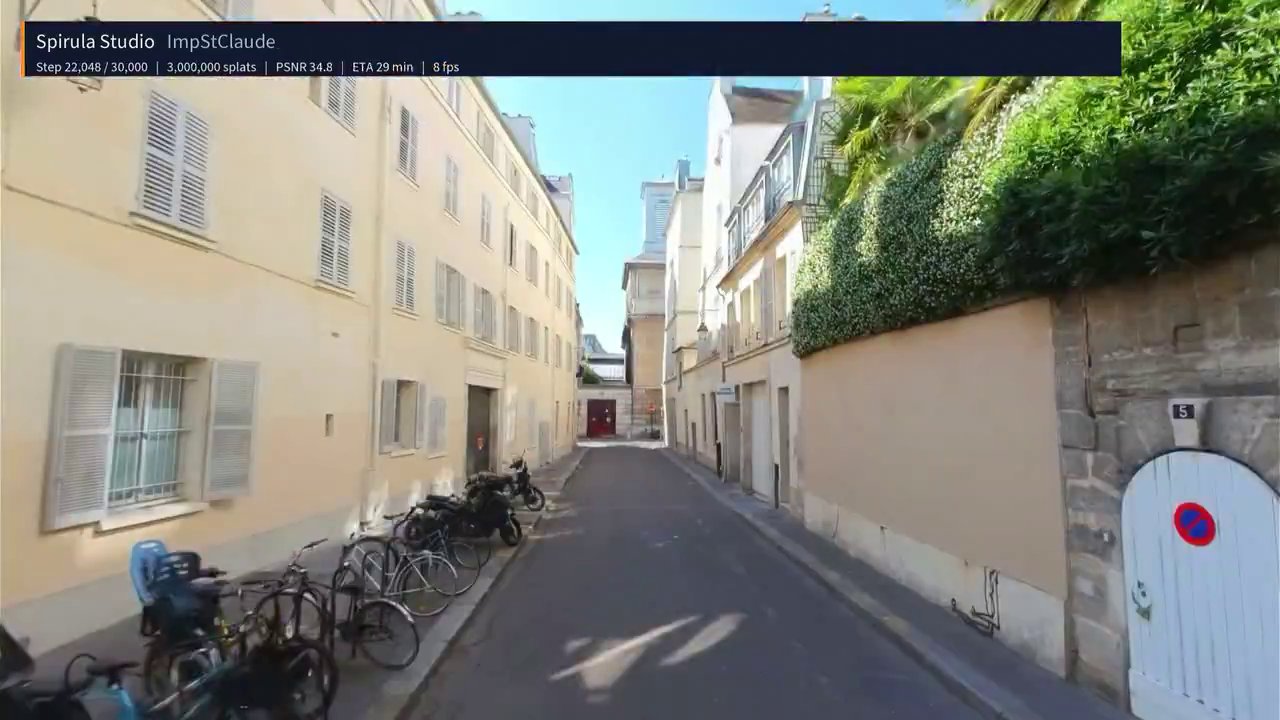
The run trains at half resolution on 486 images. At step 22,048 of 30,000 it holds 3,000,000 splats with 29 minutes left. The clip is edited, and the ETA reads 25 minutes at step 51 and 61 at step 931, so it is an estimate that moves; the video gives no wall-clock time for a run. A finished model, ImpStClaude-2, is then flown through at 2,999,961 splats, SH degree 3, 60 fps. That figure is probably the display's cap, not the renderer's limit (reasoned).
The driver's architecture, licence and CTS log are what its repository says at
252bf91 (10 October); I read it and ran nothing. That training works on the
console, and how fast, rests on one 51-second edited video.
16 October: v2026.10.16
Release v2026.10.16 is the PS5 section's tree with the version bumped: against
d6d0d85 it changes two lines (measured). Since v2026.10.6 it is 43 commits
and +55,074 / −4,967 lines, 28 of them by Harry Chen (measured). The release
page returned 403 to my sandbox, so this comes from the commits and their
notes. I ran nothing.
SfM memory (8ea0744). Data structures changed, not matching:
matches.bin comes out byte for byte the same. Descriptors are memory-mapped
from the feature files rather than copied to the heap. Pair selection keeps
each image's best partners in a bounded heap, n x k edges where it held all
n^2/2 pairs twice. A verified match costs 8 bytes in its pair list and 8 in
the correspondence graph, down from 12 and 16, and past 256 MB both go to a
spill file mapped back, so the OS pages them out instead of the run being
killed. The bundle adjustment's Jacobian is split across up to four buffers:
one buffer past NVIDIA's 4 GB binding limit was not refused, its reads
wrapped, and large solves silently failed. A solve that still does not fit
stores Jacobians at fp32 and keeps accumulating in fp64. On a 4000-image
dual-fisheye capture, peak heap fell from 11.4 GB to 5.1 GB, and fp32
Jacobians took VRAM from 6764 MB to 4027 MB. A 12,580-image Osmo 360 walk,
once killed at 28 GB of heap, now registers whole in 1 h 31 (all reported,
RTX 5070, src/sfm/README.md).
Log footage (abdc29f8, PR #168). The LUT is applied at frame
extraction, so SfM, masking and training all see Rec.709 frames. On the
built-in Vulkan decoder it runs in the GPU colour conversion, before rounding
to 8 bits, so a 10-bit log clip keeps its precision; the ffmpeg fallback
applies it to 8-bit RGB. Auto detection reads only the file's metadata, never
colour tags: DJI's ColorMode in its djmd protobuf (2 is D-Log, 19 D-Log M),
GoPro's PTCL, Sony's CaptureGammaEquation, Panasonic's CaptureGamma.
Insta360's I-Log marker has not been seen, so .insv is chosen by hand. Each
built-in LUT is the maker's published curve plus a 129-number fitted look,
within 0.23 mean / 1.0 p99 8-bit levels of DJI's own D-Log M LUT (reported,
docs/notes/log-luts.md). It matters because SIFT keeps a keypoint only when
its difference-of-Gaussians response clears a fixed 0.02 / 3, and log footage
is flat, so fewer clear it; a trainer fed log frames would also learn grey
splats (reasoned).
GPS (01fe940, d6d0d85). The fit's inlier radius was a fixed 5 m; it
now comes from the fixes' own scatter, so RTK is judged in centimetres and a
phone in metres. The bundle adjustment's position prior follows: its sigma is
floored at 0.6 of that radius, not 3 m. The gate on each new registration
widens with distance r from the fitted positions, by sqrt(1 + (r/R)^2)
for R their spread, and a far-off pose is refused once, not for good. Fixes at
exactly 0, 0, what a receiver without a fix writes, are dropped (read from the
code).
Duckbill Studio, in the thread
(translation mine): "It picked D-Log M automatically: some log videos are
detected and the LUT is applied at frame extraction (log .osv is easier now;
for .insv I chose the LUT by hand)… The big loop closed in one go (I haven't
A/B-tested, so I can't say it was the improvement)." One anecdote, no control.
The widening gate is a plausible cause, not a shown one (reasoned).
12 November: what a 360 frame turns into
The Japanese CG blog 3D人 (@ymt3d)
posted about Spirula Studio today as, in its words, the free 3DGS tool it would
pick right now (translation mine), with a write-up
that lists the same headline features this article started from: free, every
GPU vendor, 360 footage. Two releases have shipped since the last update,
v2026.10.30 and v2026.11.12, and GitHub's compare puts 118 commits between
v2026.10.16 and v2026.11.12. I re-read the 360 path at commit bef5063, two
commits past the v2026.11.12 tag.
That path is the part of this tool closest to my own work: walking a site with a dual-fisheye camera and ending with something a BIM modeller can trace walls over. So this update is written for that reader. I still have not run the binary.
First, a correction. In "The 360 path" I wrote that Spirula does not cut a
panorama into pinhole faces. That holds for the reconstruction of a
dual-fisheye file and for nothing else. A GoPro .360 is cut into ten pinhole
views before a single feature is extracted, and .360 support landed in commit
7534f86 on 8 September, two weeks before I wrote the sentence. The trainer
splits every equirectangular camera into six cube faces by default. The
answer depends on the container, and on whether you ask about SfM or about
training.
| Input | What SfM sees | What training sees |
|---|---|---|
Insta360 .insv, DJI Osmo .osv (two fisheye tracks) | two lens folders, cam0 and cam1, a fisheye model each, tied as a dual-fisheye rig | the fisheye itself; five pinhole faces per lens only with warp_to_pinhole |
GoPro MAX .360 (a cube map, not stitched) | ten pinhole views, five per lens, as one rig | those ten views |
GoPro MAX 2 .360 (a stitched panorama per track) | six 100° views on a tilted cube, or the panorama | those six, or the panorama's cube faces |
an equirectangular image (under the 360-camera dataset preset) | one EQUIRECTANGULAR camera, in the built-in SfM only | six cube faces, unless warp_spherical_to_pinhole 0 |
an E57 scan's panoramas (spirula e57) | no SfM: the scanner's own poses | the same |
The last column has one escape hatch. With warp_spherical_to_pinhole 0 the
trainer renders the panorama directly, and TrainerCore.cpp then refuses depth
or normal supervision: "Direct equirectangular training … does not support
depth/normal supervision yet." For indoor capture that is a real cost. The
normal prior is what keeps a white wall flat, and a site walk is mostly white
walls.
Four lenses, four equations
Every camera model is a rule for where a ray lands. Take a ray at angle off the optical axis and azimuth around it; the model gives its distance from the image centre, at focal length :
A pinhole runs to infinity at , so it cannot hold a lens wider
than 180°, and it is already struggling well before that. Spirula's dataset
notes give the example: forcing a 180° fisheye onto a pinhole target puts
into a degree-8 distortion polynomial, and the fit fails.
So fit_camera_auto chooses the model from the lens's measured field of
view, not its name, and falls back to a plain fisheye with a warning rather
than refusing a dataset. The two fisheye laws stay finite past 90°. An
equidistant lens with , which is the starting focal Spirula's
COLMAP runner uses for an Insta360 X5 track of width , puts a ray 100° off
axis at from the centre. That is just inside
the half-width, a circle of about 200°: what these lenses are.
The panorama is the odd one. It has no axis at all:
for longitude and latitude . Its only parameters are and
, which is why Spirula's dataset docs give the EQUIRECTANGULAR camera
(model 17 in COLMAP's numbering) only (w, h) and no calibration: the image
is the calibration. That is also its weakness. A
stitched panorama claims every pixel came from one centre of projection. The
two lenses of a consumer 360 camera sit a few centimetres apart, so near the
stitch line something close to the camera is drawn from two centres and
blended. A per-lens fisheye model keeps them apart; an equirect model cannot.
On distortion, Spirula compiles three tiers as a template argument (none,
OpenCV's k1 k2 p1 p2, and an eight-coefficient thin prism), and picks the
cheapest that represents the source exactly. It deliberately has no rational
tier: a 93-image COLMAP run on FULL_OPENCV diverged to fy = 3.4 fx, so a
rational lens is fitted onto the thin prism and the images re-distorted
instead. The 360-camera dataset preset sets thin-prism-fisheye for both
lenses.
Why the GoPro is cut and the Insta360 is not
A MAX does not write a panorama. It writes two HEVC tracks that together form a
3×2 equi-angular cube map, and the two lenses meet down the middle of the side
faces, at azimuth ±90°, with real parallax across that line. No single camera
model describes both sides of it. So Spirula cuts per lens: the face on each
lens's axis plus the near half of its four neighbours, five views a lens, each
one a true pinhole whose centre is that lens's centre. An .insv or .osv
needs none of this. Its two tracks are already one central camera each, and a
fisheye model fits each track as it stands.
Try the plans yourself. The map is the whole sphere unrolled; the numbers are
computed live, on 200,000 directions, from the view geometry in
src/app/Pano360.cpp.
At the default face side of 1,504 px the ten-view plan reproduces the project's own sweep exactly: 0.10% of the sphere in no view (a 0.03° hairline at the seam, left so a bilinear tap never reaches the other lens) and 5.9% seen twice. The plan gets the geometry right in places a quick split would not:
- The side views are tilted 67.5° off the lens axis, so their inner edge meets the axial face and their outer edge lands on the seam.
- They are wider than 90° along the seam, because a tilted view narrows as it
approaches it. The circumscribing half-angle is
, so a view spans 94.5° that way. (The table
in
docs/datasets.mdsays 97°; the width the code computes gives 94.5°.) - Every view keeps the sphere's own up. Four of the ten come out portrait, and a learned feature detector never sees the same wall rotated 90°.
Then the number that matters for SfM: 5.9% overlap means the views of one
frame barely share a pixel, so they share no features. Matching them to each
other is pointless. They are held together by matches across time, which is
why pairing has to be content-based (--pairs auto) and not sequential, which
would make ten disconnected chains, and by the rig, which knows the rotation
each view was cut at.
The pixel budget is close: 12.6 MP a frame for the ten views against 13.6 MP
for a plain six-face cube. Density is not close. The panorama route downsamples
to --max-image-size, 1,600 px for the learned front ends at --quality high,
which is 4.4 px per degree. A 1,504 px face is 16.7. For SfM that is the whole
argument: features at a quarter of the resolution are features you do not find
on a corridor wall.
The MAX 2, and a gap in its six faces
A MAX 2 is a different camera. Each track is already a stitched equirectangular panorama (5,952 px wide, of which 3,936 px is the 360°, 10.933 px per degree), so there is no seam to keep views off. Spirula cuts six 100° views on a cube stood on a corner: face centres at ±35.26° of elevation, 60° apart in azimuth. No face points at a pole, where a panorama's few top rows are stretched round the whole frame, and every face holds some horizon. On 38 frames of an 8K clip that took registration from 56% of images (axis-aligned cube) to 74% (on a corner), at 0.61 px mean reprojection.
The code comment above that plan says its six faces "still cover the sphere". With each face kept level, as the code does, I do not think they do. In numpy, on the code's own basis vectors and 4 million random directions, 100° upright faces leave a little over 2% of the sphere in no view: caps reaching about 9° from each pole, and wedges between roughly 15° and 29° above and below the horizon. At 110° the same six faces close it. Pick "Six on a corner" above to see the gaps. For SfM this hardly matters; a direction missed in one frame is seen from the next position. A modeller would care only if those wedges were where the ceiling line sits in every frame. I have not reported this upstream.
Training: native fisheye unless you ask
For a dual-fisheye capture the trainer renders the fisheye directly: the
projection kernels have equidistant and equisolid cameras, including fields of
view past 180°. warp_to_pinhole defaults to off. The 360-camera training
preset turns it on (a separate preset from the dataset one; the GUI starts on
3dgs), and then each lens becomes five pinhole faces, front and the four
around it, cropped to the rays the lens actually holds.
Why split at all, if the rasterizer can draw a fisheye? The repo's tooltip says "better quality and compatibility" and stops there. My guess at the mechanism is the appearance models. Bilateral grids and PPISP keep one exposure and white-balance slot per post-split camera, so a 90° face would get its own correction instead of one for the whole 200° circle. The docs list that slot as a cost, though (a sixth face makes the bilateral grid 20% larger), not as the reason, so take this as my reading. The measured cost is render passes. The repo's numbers, 2,000 steps on an RTX 5070 laptop:
| Capture | Split | Faces | Time | Peak VRAM |
|---|---|---|---|---|
| 1000×1500 fisheye, 108×162° | uniform | 5 × 548×548 | 27.6 s | 804 MiB |
| 960×960 fisheye, ~200° | uniform | 5 × 430×430 | 32.3 s | 818 MiB |
| 960×960 fisheye, ~200° | per-face | 430×430, 4 × 430×352 | 35.4 s | 858 MiB |
A back face is off by default (--warp-back-face): on a real fisheye what
fills the direction behind the lens is the lens folded over itself.
Release v2026.11.12 adds one more thing a walking capture needs: a
"calibration residual" correction, on by default as --calib-correction basic.
It fits a smooth per-image warp of the ground truth during training, so
rolling shutter, stabilisation, focus breathing and a small pose error stop
blurring the splats. The rasterizer and the loss are untouched; the warp only
changes which pixels the loss reads. For a modeller that cuts both ways. The
picture gets sharper, and a pose error the warp absorbed is still in the
cameras you export.
Getting to metres
A splat in arbitrary units is a picture. Scan-to-BIM needs metres and gravity, and Spirula has more ways to get them than any other free trainer I have read:
- The camera's own sensors. Since September the dataset step reads
telemetry from common video and image formats to recover scale and
orientation, and the earlier sections cover the Osmo 360's gravity fit. For a
GoPro
.360the docs are more cautious: thegpmdgravity and orientation streams are read and plotted, but nothing consumes them yet, so an inverted mount needs--360-orient 0,0,180. - Markers. v2026.10.30 added AprilTag and ArUco markers for scale and orientation, marked experimental.
- A known distance. The same release scales a model from the distance between two points you pick in the editor, which is how a tape-measured door width becomes metres.
- A laser scan.
spirula e57turns a scan's registered images, poses and points straight into a dataset withgauge.txtsayingoriented 1andmetric 1, since E57 is metres by definition and scanners level their frame. Tested on a Leica BLK360, an XGRIDS Lixel handheld and a Matterport Pro3.
Splat, mesh, or neither
The mesh is the feature in the reel I would be most careful with. Here is what
src/mesh/ does:
- Sample seven points per Gaussian: its centre, and along each principal axis, with and . So is how far out the Gaussian still clears one 8-bit level of opacity.
- Tetrahedralize those points (3D Delaunay).
- Evaluate an occupancy field at every vertex. With cameras available it is, per camera, the closed-form maximum density along the segment from the point to that camera, minimised over cameras: a point is inside only if every camera's line of sight to it is blocked.
- March the tetrahedra at occupancy 0.5, placing each crossing by bisection rather than linear interpolation.
- Clean up: merge short edges without folding the surface (a 60° normal-flip guard), drop components under 100 faces as floaters, repair needles under 2°, then build a UV atlas by LSCM and bake a 1,024 to 8,192 px texture.
That is close in shape to Gaussian Opacity Fields (arXiv 2404.10772), though nothing in the repository cites it, and it is a sensible design. What I cannot find is a measurement. I grepped the docs and the mesh and dense modules for chamfer distance, F-score, DTU and Tanks and Temples, and the mesh has none of them. Nobody, the project included, has said how many millimetres off a wall it lands.
So for a scan-to-BIM job, this is what I would take from Spirula today:
- The cameras. A COLMAP
sparse/model with agauge.txtthat says whether it is metric and levelled, and which source settled each. Every downstream tool reads COLMAP. - The dense cloud, for modelling.
spirula denseruns RoMa v2 over the registered images with the cameras held fixed and writes a coloured point cloud. Points are what Revit and every scan-to-BIM tool already take, and a point cloud does not pretend to be a surface. It also works on faces: the docs' own table counts a dual-fisheye room walk as 5,730 views, five per frame. - The splat, for people. A progress walk-through or an as-built for someone who will never open Revit. KOLC+ is what that looks like inside a BIM viewer.
- The mesh, as a picture. A textured GLB is fine to look at. I would not trace walls on it until someone measures it against a scan.
Next to the other tools here
Most of the site's capture pipelines make the opposite 360 choice. The practitioners in Gaussian-splat capture in practice run SfM on the stitched panorama, because a dual-fisheye file makes a generic solver discover the rig on its own, and on a 2 km shrine walk it would not. Spirula tells the solver the rig instead. OOOSplat is a phone-video tool on COLMAP and Brush with no 360 path to compare. GOFish is the research version of the same instinct: train on the whole 200° image, then extract a mesh from it. And OmniRay goes further still, predicting a ray per pixel for any central lens with no intrinsics at all.
What I would do with it: an .insv site walk through the built-in SfM with the
dual-fisheye rig, scale from markers or the scan if there is one, then
spirula dense for the modeller and a splat for everyone else. I would skip
the equirect export a stitched-video workflow defaults to. It bakes the stitch
parallax into the one camera model SfM has, and on the GoPro numbers above it
also costs density: 4.4 px per degree against 16.7.
What I read and did not run: docs/datasets.md, src/app/Pano360.{h,cpp},
src/data/PostSplit.cpp, src/config/TrainConfig.h, src/mesh/,
src/sfm/README.md, docs/dense.md and docs/notes/calib-warp.md at
bef5063, and the two release notes. What I computed: the coverage figures in
the widget and the corner-cube gap, from the code's view geometry in numpy and
again in the widget. The timing and registration numbers are the project's.
13 November: seven Avata 360 videos in one model
On 12 November, the day of the last update, a Japanese user, @2012apocalypsis, posted that Spirula Studio had aligned all seven 360° videos from a DJI Avata 360 in one go ("一発で", translation mine), with one screenshot.
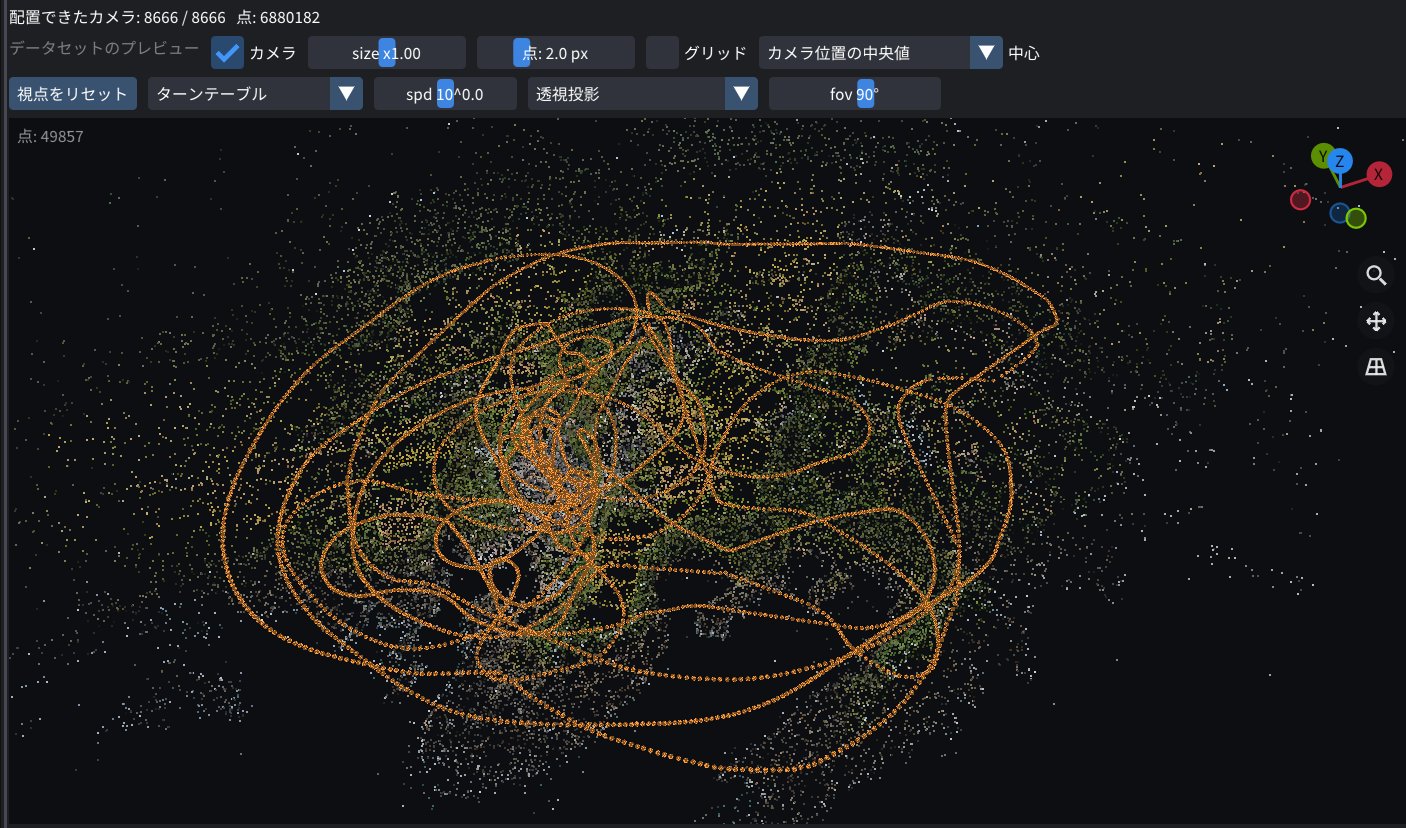
What the screenshot shows, read against the source at commit 48d202d (12 November, after the v2026.11.12 release):
- The top line is the mapper's live count. It is the
model_live_countsstring insrc/i18n/catalog/Dataset.h, "Placed cameras: 0 of 1 Points: 2" in English, filled from the live model's registered images, total images and 3D points. Every one of the 8,666 images got a pose, and the model has 6,880,182 points. - The corner label is the viewport's own counter. "点: 49857" is
overlay_pointsinViewportPanel.cpp, the number of points the preview is drawing, not the size of the model. - 8,666 is even. If the seven clips went in as raw
.OSVfiles, that is 4,333 frames with two fisheye images each, which is what the table above says SfM gets from a.OSV:cam0andcam1, a fisheye model each, tied as adual-fisheyerig. An even number proves nothing, though. 8,666 stitched panoramas is even too.
The Avata 360 is not a special case the user found. Its support landed on 1 October in commit 2a19c68 ("sfm: DJI Avata 360 telemetry, attitude and factory lens calibration", PR #128), which shipped in v2026.10.6. The .OSV is the same container as the Osmo 360's, with its own protobuf field numbers, and docs/notes/imu-gps-for-sfm.md §2.3 documents what the reader takes from it:
- Factory lens calibration. The clip header carries each lens's intrinsics (
PanoDewarpParams: focal length, centre, five radial terms on the 3840 × 3840 frame), andsrc/sfm/README.mdsayscam0andcam1get them unasked, refitted from five radial terms to the four the fisheye model has. Each clip's own header is used, because the focal and centre move by up to a few pixels between clips. - GPS and altitude, but no accelerometer. The drone writes GPS, barometric altitude above take-off, ISO, shutter and colour temperature, checked frame by frame against the SRT of one 139 s flight. It writes no accelerometer, so the report says
IMU absent, and up comes from the attitude quaternion with a declared z-down world. The note says that rests on one flight, where the resulting up landed 0.23° from the GPS-levelled model. - Several videos, one rig. A manifest lists one capture per video, and
--rig '*:cam0,cam1'puts one rig behind every top-level folder, so seven clips share one calibration while their frames stay apart.
What the screenshot cannot show, first, is what went in. The post does not say whether the videos were raw .OSV files or equirectangular exports from DJI's software. What I wrote above about the rig and the lens calibration assumes raw files. For stitched exports the equirectangular row of the table applies instead, with no rig and no factory calibration. Second, whether the 8,666 poses are right. "Placed" means the mapper registered an image, not that its pose is correct, and a long drone orbit is where a solver drifts or folds a loop onto itself without dropping a single camera. There is no reprojection error in the frame, no scale check against the GPS, no version number, no settings, and no splat. The post does not say how long it took or on what GPU. One reply asked to see the final 3DGS model; at the time I read the thread, it had not been posted. My bet is that the result is good, because the camera paths draw as continuous curves rather than scattered points, and, if the clips went in raw, the code path for this camera has been in place for six weeks. A seven-flight model with every camera placed is what this pipeline's Avata support was written to produce, and the evidence for it is still a single screenshot.
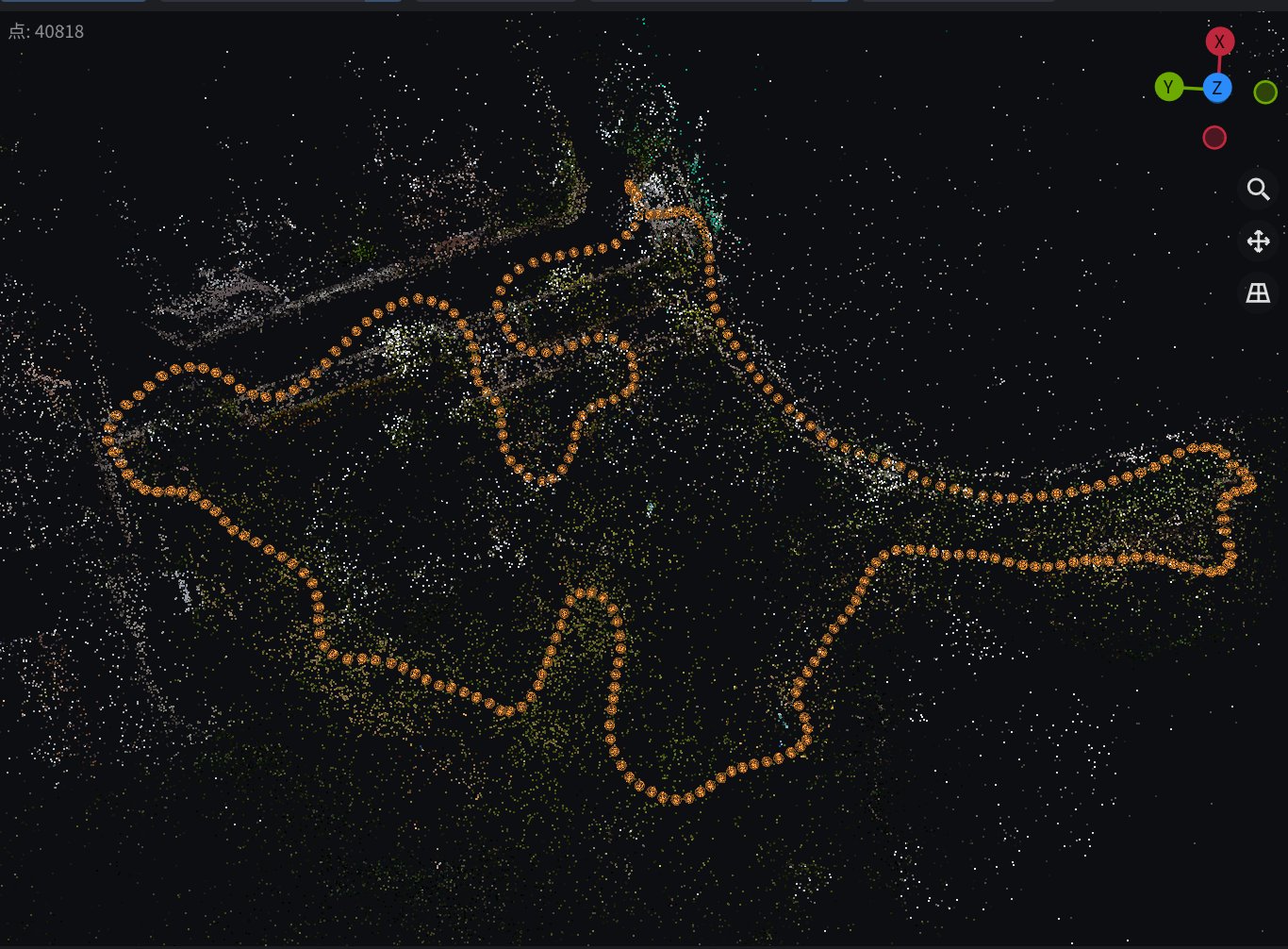
4,066 fisheye frames that never closed a loop
On the morning of 13 November, Japan time, @okhotskuma posted a second screenshot. Because of a mistake during capture ("or rather, being too conscious of the time limit"; translations mine), 4,066 images never closed a loop, and the poster expected them not to connect. In Spirula Studio they did: "Could LoMa's matching actually be extremely good?" A reply in the thread corrects the first post: not full-sphere images but 4,066 fisheye images of 180° each.
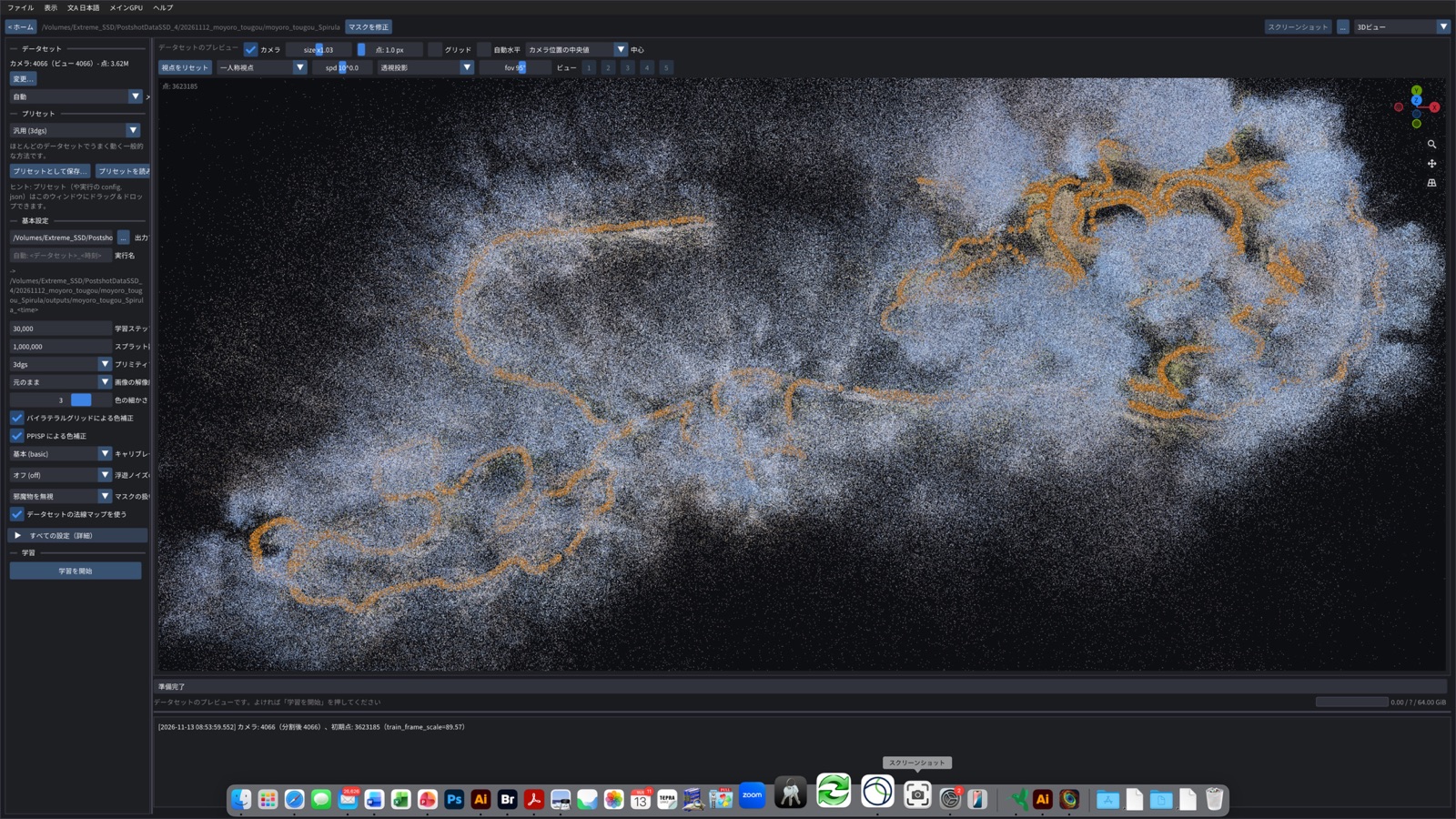
Read against the source at commit fb24398 (13 November):
- This is the trainer, not the mapper. The log line, "カメラ: 4066 (分割後 4066)、初期点: 3623185 (train_frame_scale=89.57)", is the
parsed_datasetmessage insrc/app/TrainerCore.cpp: cameras, cameras after the post-split bake, and the points the splats start from. Every one of the 4,066 images arrived with a pose, and none was cut into pinhole faces, so this run would train on the native fisheye, as the training section above describes withwarp_to_pinholeoff. The panel shows the3dgspreset at 30,000 steps with a 1,000,000-splat cap, which is what the post's last line asks about ("how far should I push the splat count and training steps?"). - Nothing in it shows which frontend matched. SIFT is the default in the CLI (
features = "sift"insrc/sfm/SfmConfig.h) and in the GUI's built-in SfM (features = 0, the first entry ofkSfmFeatures, insrc/app/gui/SfmRunner.h). LoMa is opt-in, as--features loma-b128 --matcher loma-b128or the same two combos in the GUI. I am taking the poster's word that LoMa ran. - 4,066 is even, and the correction says fisheyes, so it is probably 2,033 frames of a dual-fisheye camera tied as a rig. As with the Avata post, an even number proves nothing, and the post does not name the camera.
Is LoMa that good? The only comparison I have is the project's own, in docs/notes/sfm-quality-experiments.md, and it is mixed. On one bracketed capture (M4d), LoMa and ALIKED each register 135 images in a single component, where SIFT's high preset gets 128 in two, but LoMa takes 205.4 s against SIFT's 34.7 s. On another (H1d), SIFT registers all 320 images and LoMa 265, with a largest component of 191 against SIFT's 300. The notes keep SIFT as the default.
The missing loop also matters less for connecting than the post fears. Incremental SfM registers an image when enough of its features match points already in the model, and a forward walk gives each frame neighbours it overlaps heavily, more so with two 180° lenses per frame. The risk is a weak step, and src/sfm/README.md measures it: on a 262-frame walk, sequential matching broke the model into four pieces (144, 74, 19 and 12 images), and content-based pair selection put 254 in one. --pairs auto switches to that selection at 100 images, so a 4,066-image run gets it without asking. Whichever matcher deserves the credit, pair selection likely deserves some.
What a closed loop buys is a check on drift. When the walk comes back to its start, bundle adjustment sees the same place twice and pulls the accumulated error out. Without one, drift is neither corrected nor visible, so "every camera placed" says nothing about whether the path is straight. The orange chain is continuous, which is a good sign. Whether it is metrically right needs GPS, a known distance or a second pass over the start, and the screenshot has none of those.
What would change my mind
5 claims above, and what would falsify each
Spirula Studio wraps almost nothing: its only external build-time fetches are glfw and imgui, and the components it replaced — COLMAP, PyTorch, ffmpeg, onnxruntime — were rewritten rather than vendored.
Checked by grepping
FetchContent_DeclareandGIT_REPOSITORYacrossCMakeLists.txtandcmake/*.cmakeat the tip of the public tree, and by reading the six module READMEs. A vendored third-party tree under a path I did not search, a submodule, or a runtimedlopenof a system library doing the real work would overturn it. Note the scope: this is a claim about code, not about weights — the checkpoints are all somebody else's and the project says so.Keeping bundle adjustment in fp64 buys bit-reproducibility, and fp32 costs 2.7 points of mean AUC@10 with a five-point spread across identical runs.
Three runs of one 379-image capture, reported by the project, not by me. Three runs is thin. Run the same capture ten times at each scalar on a different GPU and vendor: if fp32's spread collapses, the atomic-ordering story is specific to one driver's scheduling and the default is over-cautious. If fp64 ever varies at all, the reproducibility claim is wrong outright.
The dual-fisheye rig path is real 360 support — the two lenses are reconstructed as a rig with known relative geometry, not undistorted into pinhole faces first.
Read from
src/sfm/README.mdandsrc/sfm/core/Rig.h's documentation, plus the.insv/.OSVmulti-track handling inDatasetPrep.cpp. If the frames are in fact resampled to pinhole faces before matching —app/GeometryWarp.hdoes exactly that for the depth models, so the machinery exists — then the rig is operating on rectified crops and the distinction I am drawing is thinner than I claim. Runningspirula sfm autoon a real.OSVwith--riglogging on would settle it in one run.Nothing establishes that Spirula Studio's finished reconstructions are as accurate as COLMAP's; the verification is parity of components, not of results.
An absence claim, and the project asserts it too — item 17 of its own unstarted list is "parity benchmarking on ETH3D / IMC", and item 15 says "nothing here says which [frontend] to reach for". A published ETH3D or IMC table, from the author or anyone else, kills this immediately, and I would like it to.
The hero animation's captions — 5,374 images in 25 minutes on an RTX 5070 Laptop GPU, 10 M SH3 Gaussians in 8 GB — are the project's claims and are unverified here.
This one is trivially falsifiable in the right direction: anyone with the binary and one of those captures can reproduce or fail to reproduce it. I am flagging it because the video in this article is evidence of what the software looks like running, not evidence that the numbers burned into its captions are right, and those two are easy to conflate.