Papers and demos, 23 November: a drafter that misses what the image decides, reasoning cached as Python, and a hummingbird with 11k feathers
mdjsonmcp2026-11-23 · 21 min · speculative-decoding · vision-language-models · agents · threejs · 3d · image-generation · on-device
A 2:58 narrated explainer, drawn in code. Every number and picture in it is this article's own; the sources are below.
› transcript
Two Three.js scenes from this week, and both authors credit a model for the code. This hummingbird's throat flashes violet only when its bill points at you. This outpost loads no model files at all. Both claims hold, in different ways. I'm Gorget. Seven posts went past this week. I read what each one pointed at, starting with that throat. About eleven thousand feathers, each real geometry, each hinged at its root in the vertex shader. And each one carries its own platelet normal. The README says a body-wide tint never looked right. It shades the whole throat at once. So the shader lights a narrow lobe around each feather's own normal. The hue slides from maroon to violet as it faces you, and only a few feathers flash at a time. The brightness is a high power of that alignment. Raise the power and the flash shrinks to a small cone. The README calls it art-directed, not a physical model. NVIDIA's CPU-ARC starts from a model that has already solved a problem. A builder reads the transcript and writes Python, with the parts that vary as parameters. At run time a fine-tuned one-billion-parameter model only extracts the values. The rest is code on a CPU. Anything the cache cannot answer falls through to the full model. On AIME '25, Opus gets 25 of the 30 problems. The cache built from those transcripts gets 28. But while it was built, each program was checked against the golden label. MMFlash runs the target twice, with and without the image, and scores each token by how much the image changes its prediction. A diffusion drafter accepts 46% of the least image-dependent tokens and 22% of the most. So the loss weights the image-dependent ones up. For long video, the drafter attends to sinks, strided frames, text and a local window. On Qwen3.5-9B that is 3.05 times on average, against 2.75 for DFlash trained on the same data. UltraTex makes PBR textures from a mesh and one image. First albedo, with shading normals. Then metallic and roughness, guided by a frozen VLM's middle layers, which know a painted fish from a metal one. Roughness error falls to 16.57 from 25.96. Metallic barely moves. CPU-ARC's wins over its source are not held out. UltraTex is Meshy-affiliated, and its code waits on Meshy's review. And much of the outpost's look comes from its 82 texture maps. The idea I would keep: split a drafter's acceptance by how much the image matters, and you see exactly where it loses. One lobe per feather, a cache with a fallback, and a drafter that learns what the image decides. Every source is in the full article. I'm Gorget. Bye!
Why read this
Solidtop 85%Seven reposts read against papers, repos and bundles; finds CPU-ARC's golden-label check, MMFlash's own bigger number, and what 'no models' means.
- Original analysis
- Concrete numbers to act on
- Explained from first principles
Inference & servingRuns on a consumer GPUMixed licencesPractitioner roundup
How this was scored
- Is it new?
- 1 of 3: An incremental tweak
- Can I trust it?
- 2 of 3: Measures key facts from files, code or configs
- Can I run it?
- 1 of 3: API-only, gated or restrictive licence
- Will I understand it?
- 2 of 3: Mechanism from first principles with figures
- Can I act on it?
- 2 of 3: A concrete recipe, numbers or comparison
- Will it last?
- 1 of 3: Relevant for months
- Does it affect many?
- 1 of 3: A specialist community
- Only here?
- 2 of 3: A teardown or measurement few others did
Score 55 of 100, ranked 585 of 773 rated articles. Each question is answered 0–3 by hand, and a 3 is rare. How articles are scored
Seven posts from my reposts this week, none big enough for a page of its own and each worth more than a line. Three papers: a speculative decoder for vision-language models, a way to cache an LLM's reasoning as code, and a PBR texture generator. Two Three.js scenes that their authors say were built with models. An image LoRA, and AMD's NPU getting a local-inference front end.
For each I read the thing the post pointed at: the paper in full, the released configs, the repository at a pinned commit, or the shipped JavaScript bundle. Two of the papers say less than their abstracts, one says more, and one of the "no imported models" scenes turns out to mean something narrower than it sounds.
MMFlash: the drafter misses exactly the tokens the image decides
Speculative decoding lets a small drafter guess several tokens and the big model check them all in one pass. A guess is accepted only if the target model would have picked it, so the speedup is set by how often the drafter agrees with the target. DFlash made the drafter a block-diffusion model: it fills a whole 16-token block in one forward pass instead of one pass per token, and spends what it saves on a deeper drafter. It was built and tested on text.
MMFlash (Feng, Chen, Wang, Fang and Wang at the National University of Singapore) asks what happens when the target is a vision-language model. To find out, the authors needed a per-token measure of how much the image matters, and they took it from the target itself: run the model twice on the same prefix, once with the image and once without, and take the KL divergence between the two next-token distributions,
A token that only continues a phrase scores near zero. A token read off a chart scores high. On Qwen3.5-4B, with both the released text-only DFlash drafter and one they trained on about 900K multimodal samples, acceptance falls from 46% in the least image-dependent quartile to 22% in the most, and the most image-dependent quartile holds 44% of the first rejections in a block against 7% for the least. Training on images did not close the gap.
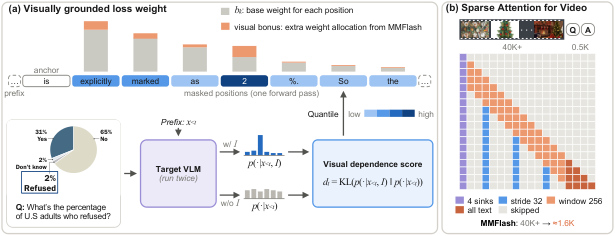
The fix is a loss weight with three factors
DFlash's loss already weights the positions of a block unequally, decaying along the block, because a rejection at position throws away everything after it. MMFlash replaces that decay with a product:
Each factor answers one question. is the chance that verification even reaches position , estimated from the drafter's own confidence in the earlier positions, with keeping it from vanishing after one miss. is the token's image dependence, as a quantile over the training set, multiplied by of the target's with-image entropy. That second part matters: a token where the target itself is torn between near-ties cannot be learned no matter how you weight it. And , under a stop-gradient, is the drafter's current chance of missing the token, so the bonus fades once it has learned it. The scores are computed once, offline, with the target model, so training costs nothing extra.
For long video they add a sparse attention pattern for the drafter: 4 sink tokens, visual tokens at a stride of 32, every text token and a local window of 256, which shrinks a context of more than 40K tokens to about 1.6K. The motivation is measured: on 60 video questions the most recent 256 positions are 0.8% of the context and take 50.1% of the drafter's attention.
The numbers, and a bigger one than the abstract's
Everything below is on one H200 in SGLang at concurrency 1, on 200 random samples per benchmark, with thinking off. On seven image benchmarks at temperature 0, the average speedup on Qwen3.5-9B is 1.68x for EAGLE-3, 2.75x for DFlash trained on the same data and 3.05x for MMFlash (Table 1). On Qwen3.5-4B MMFlash averages 3.00x. The abstract's "up to 3.58x" is one cell of that table: ChartQA on the 9B. On three video benchmarks of about 40K tokens, sparse attention plus a 3-epoch fine-tune on 2K clips gives 2.33x to 2.71x.
Table 5 has a larger figure that the abstract leaves out. On Qwen3.8-27B MMFlash reaches 4.71x on DynaMath and 4.18x on ChartQA. The only baselines in that table are MTP and, for Gemma, EAGLE-3, so it shows the drafter scales, not how far ahead of DFlash it stays there. Table 3 also says the speedup narrows as concurrency rises toward 32, as it does for every speculative method once decoding stops being memory-bound.
The code is MIT and four drafters are on Hugging Face under Apache 2.0. The 9B's drafter config is a 5-layer Qwen3-style model, 4,096 wide, that reads the target's layers 1, 8, 15, 22 and 29; its safetensors hold 1,048,626,432 BF16 parameters, which by my arithmetic is five such layers plus the projection of five hidden states and nothing else, so it borrows the target's embedding and output head.
What I take from it is the diagnostic more than the method. Splitting acceptance by is cheap, works for any drafter, and tells you where a multimodal drafter is losing. The method's own gain over DFlash is about 10% on images. If you already serve a VLM with DFlash, retraining with this weight is a cheap 10%; if you serve with EAGLE-3, the bigger win is moving to a block drafter at all.
[arXiv 2026] MMFlash: Faster Speculative Decoding for Vision-Language Models
- license
- MIT
- branch
- main
- forks
- 1
- open issues
- 0
- source
- 3.0 MB
- commit date
- 2026-11-19
GitHub REST API, 2026-11-23 — branch, commit, commitDate, createdAt, description, forks, homepage, languages, license, openIssues, pushedAt, stars
- architecture
- DFlashDraftModel
- task
- image-text-to-text
- license
- apache-2.0
- safetensors
- 1 shard
- largest file
- 2.10 GB
- files
- 5
- downloads
- 201
- likes
- 3
repo last modified 2026-11-17
CPU-ARC: Opus writes the solution once, a 1B model fills in the blanks
The post says NVIDIA found that "once an LLM has reasoned through a problem, the solution can run as CPU code for rephrased and re-numbered versions of it", 16x to 291x cheaper, and that the cache scored "93.3% versus 83.3% on AIME '25". All of that is in the paper (Belcak, Heinrich, Muralidharan, Diao and Molchanov). One of the numbers means less than it looks.
The idea is to separate finding a solution from executing it. A source model, Claude Opus 4.5 here, solves a problem. A builder model, also Opus 4.5, reads the transcript and works in five phases: isolate the input and the answer, decompose the reasoning into steps, decide which parts of the input are parameters (the 196 in the paper's example, "How many positive whole-number divisors does 196 have?"), plan a set of functions, then write and test them in an agentic loop. The result is a network of what the paper calls semantic functions, Python callables that find their inputs and each other by natural-language description rather than by name. load(ctx, "the vertex count n", d_type=int) pulls a value out of a context through vector search, and do(ctx, "Compute the difference set ...", payloads=...) calls whichever registered function matches that description. Lookup runs on a CPU with EmbeddingGemma's 768-dimensional embeddings in a FAISS flat index. The only model left at run time is a target model for small text jobs: extracting the parameters from a new query, coercing types. They started with Claude Haiku 4.5 and ended with Llama 3.2 1B, fine-tuned for the job. Once a cache stops changing, a compile step replaces every do and load with a direct call and a dictionary lookup, which leaves a plain Python file with no embedding model behind it.
In serving, the cache goes in front of the model, and a miss falls through:
def serve(request):
    try:
        result = cache.use(request)
        if result is not False:
            return result
    except CacheInvocationError:
        pass
    return llm(request)
That is Figure 1 of the paper.
What Table 2 says
| benchmark | source accuracy | cache accuracy | combined rewrites passed | source $/query | cache $/query | savings |
|---|---|---|---|---|---|---|
| AIME '25 | 83.3 | 93.3 | 93.4 | 0.1203 | 0.0004 | 291.1x |
| AIME '26 | 90.0 | 96.7 | 90.8 | 0.1197 | 0.0004 | 281.4x |
| GPQA Diamond | 83.8 | 83.8 | 94.0 | 0.0708 | 0.0019 | 38.1x |
| MATH-500 | 98.6 | 98.8 | 91.6 | 0.0388 | 0.0004 | 88.7x |
| GSM8K | 98.5 | 98.0 | 92.5 | 0.0101 | 0.0006 | 16.3x |
Building a cache entry costs 12 to 84 times one source solve, so it has to be reused to pay off. The paper's break-even is the build cost over the saving per query: about 13 uses for an AIME problem and about 90 for GSM8K, where the source answer was cheap to begin with. Here is that arithmetic on the paper's numbers, with an option to charge the cache for its misses:
Why the cache beats its own source
AIME '25 has 30 problems, so 83.3% against 93.3% is 25 problems against 28. The paper's explanation is that the source reasons correctly and then slips on arithmetic, and the cache runs the same reasoning as code without slipping. That is plausible. But Phase 5 of construction says the root function is "judged by against both the transcript and the golden label" before it is accepted. For individual functions the paper describes a loop of judge feedback and rewrites; for the root it says only that it is judged against both. Either way, matching the known answer is part of what an entry has to pass before it joins the cache. So cache accuracy on the problems a cache was built from is not a held-out score, and "beats the source" partly measures a builder that was shown the answer key.
The perturbation columns are the real test of generalisation, and they are careful: rephrasings and re-parameterisations generated by Opus 4.5, accepted only by a unanimous committee of two more Opus 4.5 instances, the re-parameterised answer checked by having the generator re-derive the original answer first. Every column is at least 90%. Three limits on that: perturbations are run only on problems the cache already answers correctly, the same model family generates and judges them, and 20% of the real usage examples from the benchmark runs went into fine-tuning the 1B target. The "cache cost" column also prices only the 1B model's calls, at $0.023 and $0.194 per million tokens; the CPU time and the embedding lookups are not in it. No code is released.
The pattern is right for the setting the paper says it is aimed at: agent endpoints that run the same instruction over new payloads all day, with the full model as the fallback. The competition maths is a stress test of whether a builder can write such programs at all. I would want one number before believing the rest, accuracy on held-out problems of the same family, built without the golden label.
UltraTex: metallic and roughness from a VLM's middle layers
A PBR texture is three maps: albedo, the surface colour with no lighting in it, plus metallic and roughness, which decide how it reflects light. Getting them from one reference image is ambiguous, since a shiny highlight in a photo could be a metal, a varnish or a bright light. UltraTex (Bao, Ma, Li, Hu and Han, CUHK-Shenzhen and Meshy AI, SIGGRAPH Asia 2026) takes a mesh and one image and generates all three, through two stages of multi-view diffusion over six orthographic views.
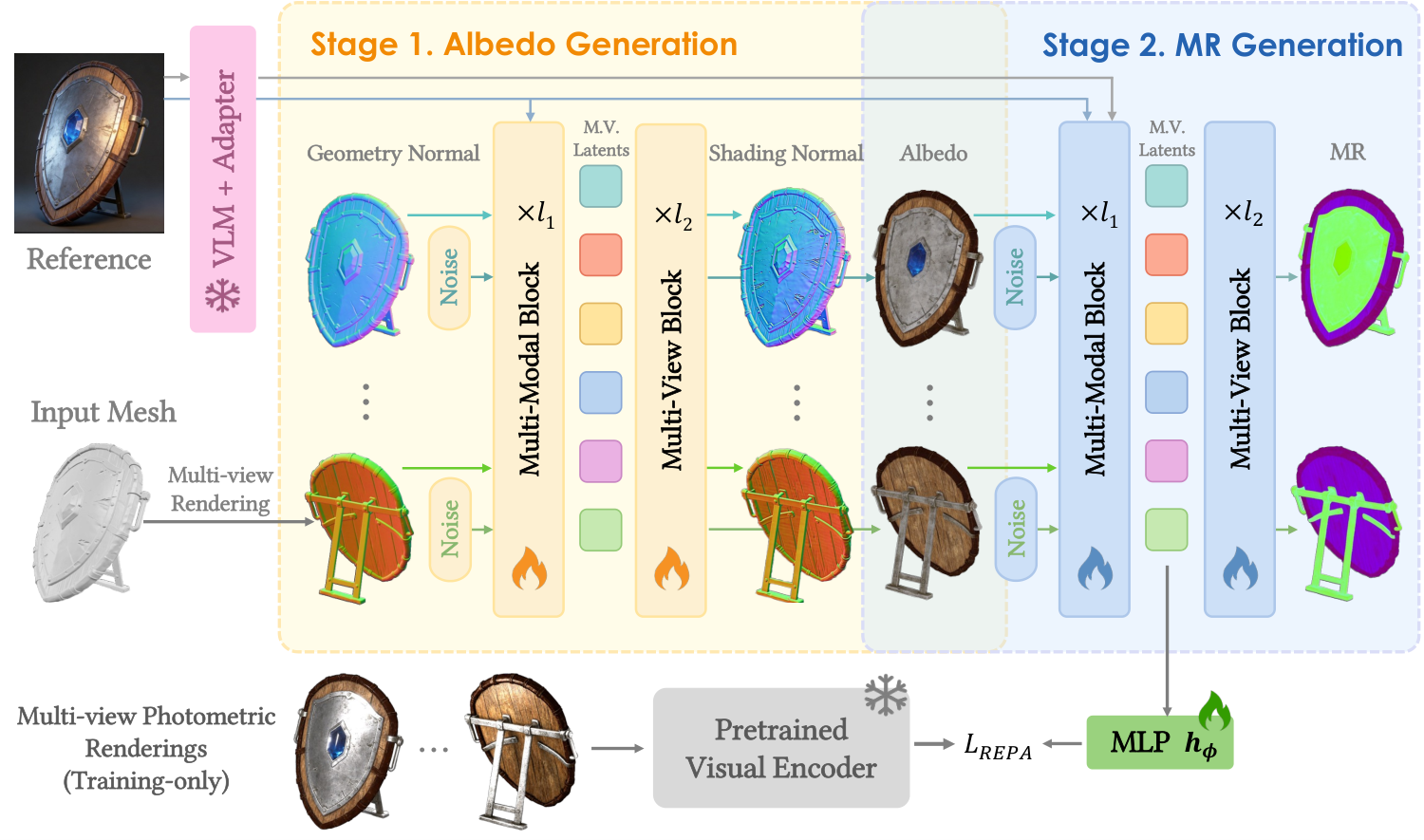
Stage 1 predicts albedo together with world-space shading normals. The normal branch does not start from noise: it flows from the latent of the mesh's own geometry normals to the shading normals, so it learns only the fine surface detail the mesh lacks. World space is chosen over tangent-space normal maps because those depend on the UV unwrap, and a rotated or flipped UV island gives an inconsistent tangent frame and a seam.
Stage 2 predicts metallic and roughness from the albedo and the reference, plus two pieces of outside knowledge. The first is a frozen Qwen3.5-4B. Its hidden states at layers 8, 16 and 24 are concatenated and squeezed by a two-layer MLP into "material tokens", trained on their own against a frozen diffusion model to reconstruct real metallic-roughness maps. The bet is that a VLM's middle layers know a fish is painted and a TV casing is plastic, which pixels alone don't say. The second is photometric alignment, after REPA: ground-truth materials are rendered under a point light at the camera, where highlight size and sharpness make roughness visible, and the diffusion model's features are pulled toward DINOv2's features of those renders. Training used 130K objects from Objaverse-XL and TexVerse, 32 A100s for about two days per model.
On 152 held-out Objaverse-XL objects (Table 1), roughness error falls to 16.57 (×10⁻³ MSE) from 25.96 for LumiTex and 28.23 for TRELLIS.2. Metallic error is 46.77 against 50.04 for Hunyuan3D-2.1, a much smaller step, though the abstract opens on metallic as the hard part. In a blind study 31 professional 3D modellers rated it 4.31 out of 5, against 3.20 for Seed3D 2.0 and 3.13 for Meshy 6.
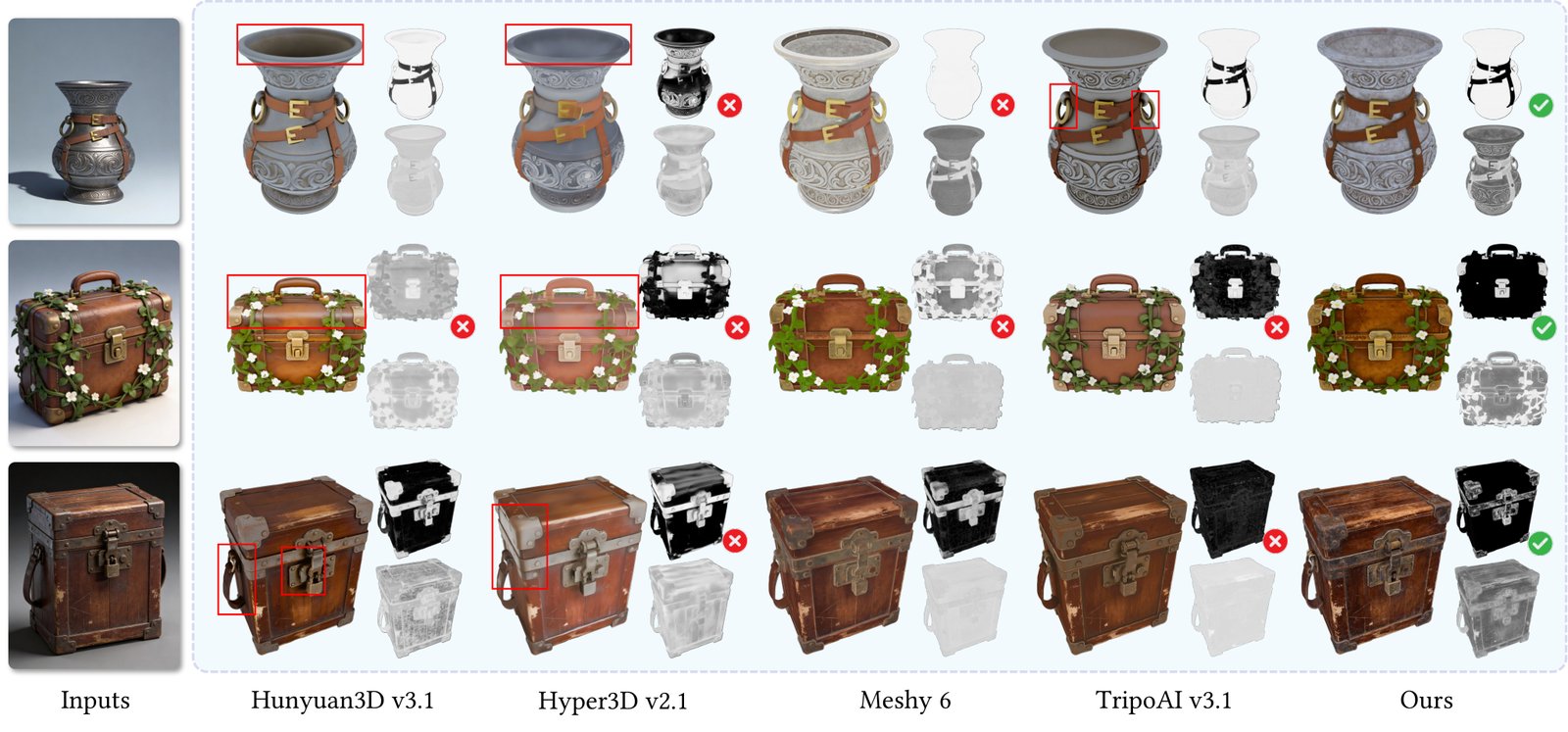
Three of the five authors are at Meshy, whose Meshy 6 is one of the commercial systems it is compared against. The project page says the code "runs within Meshy AI's internal operator framework" and that open-sourcing it "is subject to Meshy's internal review and approval"; the Hugging Face repo holds a README and three images. The VLM-adapter idea is the transferable part. The rest you can try only as Meshy's product. For the site's other texture work, see StableGen, which projects textures in Blender with open models.
Two Three.js scenes, read from their source
Feather: every feather is geometry, hinged in the vertex shader
Codevember 2026, day 12 by Theo Tillberg is a purple-throated mountain-gem on a mossy twig. It breathes, snaps its head about, ruffles, eats a seed you drop, and its throat goes from dull maroon to violet when its bill turns toward you. The repository is MIT, and day 12 is 37 TypeScript files, 9,295 lines.
The README explains it, and the code agrees. The rig is 79 named bones, down to each primary and secondary, a ten-feather tail fan and nictitating membranes. The body is one skinned parametric loft from tail to bill. About 11k contour feathers plus the wing and tail feathers are two skinned meshes with one material, and each feather is real geometry that hinges about its root in the vertex shader, so a ruffle is feathers lifting off the skin in a wave rather than a fatter body.
The colour is the part I would copy. A real hummingbird's gorget is structural colour, bright only from a narrow range of angles. Here a body-wide tint never looked right, the README says, and what replaced it is "art-directed rather than a thin-film model": every feather gets its own platelet normal, and a narrow lobe is lit around it, in plumageMaterial.ts:
float c = clamp(dot(nI, V) + (fBarbRand - 0.5) * fTilt, 0.0, 1.0);
float power = vIri.a * 32.0;
vec3 colV = mix(vIri2.rgb, vIri.rgb, smoothstep(0.3, 0.8, c));
float lobeV = pow(c, power);
nI is the feather's platelet normal, hinged with the feather, and V the view direction. The hue slides from the glancing colour to the head-on one as c rises, and the brightness is c raised to a power of up to 32. At 32, brightness halves about 12 degrees off the platelet normal, by my arithmetic, so the flash lives in a small cone. The motion is equally deliberate. The gaze makes saccades of 40 to 95 ms with a minimum-jerk profile, u * u * u * (10 + u * (-15 + 6 * u)), then holds still with a micro-tremor while the head stays fixed in world space against the moving body. Two lines from its "Learned" section: "The flash is everything." and "A perched hummingbird is a still body under a head that teleports."
The README credits the tools: "Built with Fable 5.2 on the bird and the Blender perch, Opus 5.5 on the scene, post and glue." The perch is the one modelled asset, a Blender branch baked to 4K maps.
- license
- MIT
- branch
- main
- forks
- 34
- open issues
- 0
- source
- 4.5 MB
- commit date
- 2026-11-23
GitHub REST API, 2026-11-23 — branch, createdAt, forks, license, openIssues, pushedAt, stars
Desert outpost: no models, 82 textures
zavrenn posted a desert base that launches two missiles at a target: "I built the whole scene in Three.js with GPT-6.2 Astra. No imported models." The scene is a fictional outpost with three scripted sequences (a launch, a vehicle arrival and an attack on a robot) and free orbit between them.
The source is not published, so I read the shipped bundle: about 1.6 MB of minified JavaScript in three chunks. There is no glTF, OBJ or FBX loader in it and no model file referenced, so as far as the bundle shows, the claim holds for geometry. The surfaces are another matter. The bundle loads 82 texture maps under /scene/maps/, many of them colour, normal and ORM sets whose filenames name a single object (field-office-albedo, quarters-front-normal, fleet-doors-orm), plus an HDR environment (desert.hdr) and a few backdrop images (basin-horizon.webp, desert-matte.png). Where those images came from, the post does not say. Judging by those names, the procedural geometry is dressed in textures made for it, and a good part of the realism is in them.
Put next to the hummingbird, it is a clean contrast. One is procedural down to the barbs in a fragment shader, the other is procedural boxes with bespoke texture maps on them. Both are credited to models and both look good on video, and only one can be read. For what models build in Three.js from a single brief, see three beach houses from three Claude models; for a renderer port done properly, three-nanite.
Kromoss, and the Moss realism LoRA on top of it
The post shows photoreal "casual social-media" portraits it says came from "a locally run image model output on a MacBook": base lodestones/Kromoss, LoRA "FameGrid Moss Preview (strength 1.3–1.5)", trigger word famegrid.
Kromoss is a full fine-tune of MOSS-Image-Base at 1024 px, Apache 2.0, with MOSS-Image's architecture, its Qwen3.5-9B text encoder and the FLUX.2 small VAE decoder, so it drops in wherever MOSS-Image-SFT runs. The card is precise: update 11000 of the fine-tune, EMA weights, 704k training images at 64 per update, Muon-AdamW at a learning rate of 9e-6. The Hub counts 5.08B BF16 parameters. It ships an int8 ConvRot file of 5.4 GB and two 8-step LoRAs distilled from the base with DMD, rank 128, that run at CFG 1. Its one benchmark is a CLIP score over 100 PartiPrompts, 27.90 against the base's 27.19, which says little about faces either way.
The LoRA is on Civitai, a 580 MB bf16 file published on 18 November. Its author says it was trained for "natural faces—minimal makeup, no editing, and no AI filters", on data that is "approximately 80% women and 20% men", that it has "minimal solo NSFW support", and that this preview precedes a final version sold to contributors. The author's own settings are a weight of 1.5 to 2, 24 steps and CFG 2.5, higher than the post's 1.3 to 1.5, and an update recommends Kromoss as the base because it fixes most anatomy problems. The listing permits selling generated images and forbids sharing merges or other derivatives of the LoRA.
On the MacBook: the post gives no model, memory or time. A 5.08B transformer and a 9B text encoder are about 28 GB in bf16 by my arithmetic, before the VAE, so a 32 GB machine needs the int8 file or offloading. Plausible, unverified. I am not reproducing the images. What the LoRA is for is generating believable photos of people who do not exist, in the visual register of a phone camera, and that is exactly what makes it worth knowing about if you moderate or verify images.
- task
- text-to-image
- library
- diffusers
- license
- apache-2.0
- safetensors
- 33 shards
- largest file
- 19.31 GB
- files
- 59
- downloads
- 58.7K
- likes
- 470
- languages
- en
repo last modified 2026-11-17
Unsloth Desktop on AMD's XDNA 2 NPU
Unsloth posted that, with AMD, Unsloth Desktop now runs models on AMD NPUs, which "deliver powerful compute performance while using 2–4× less power than traditional GPUs". The AMD newsroom post and Unsloth's guide fill in how. Supported chips are Ryzen AI 300 (Strix Point, Krackan Point), Ryzen AI Max (Strix Halo) and Ryzen AI 400 (Gorgon Point), on Windows 11 or Linux with kernel 7.0 and the amdxdna driver. Enabling the NPU downloads FastFlowLM, the runtime that executes Q4NX 4-bit models built for XDNA 2, and AMD says Lemonade and FastFlowLM together serve and run the models. Any app that speaks Unsloth's OpenAI-compatible endpoint gets the NPU: AMD lists Hermes Agent, OpenClaw, Open WebUI and Cline among "more than 100".
Unsloth's guide gives measured speeds without saying on which chip:
| model | size | tok/s | time to first token |
|---|---|---|---|
| Qwen3.6-35B-A3B-NPU2 | 20.6 GB | 17.2 | 3.13 s |
| Qwen3.8-27B-NPU2 (MTP) | 18.1 GB | 2.0 | 3.80 s |
| Qwen3.5-9B-NPU2 | 7.6 GB | 9.5 | 1.11 s |
| LFM3-1.7B-NPU2 | 1.5 GB | 40.7 | 0.12 s |
The dense 27B at 2.0 tokens a second against the 3B-active MoE at 17.2 says what this NPU is for: models that touch few parameters per token. AMD's blog adds that the 35B MoE at full context needs about 28GB available to the NPU, which under Windows' default 50% shared allocation means a 64GB machine. The "2–4×" power figure comes with no measurement or hardware in either post, and the docs phrase it as energy per token. For the small end of that table, the site's LFM3 piece covers the 1.7B; for training with Unsloth, see Unsloth's decision-model recipe.
Where each number comes from
Read on 23 November: the three papers in full through arXiv's HTML (MMFlash 2611.18482v1, CPU-ARC 2611.09891v1, UltraTex 2611.24941v1), UltraTex's project page and Hugging Face repo, MMFlash's drafter configs and the Hub's parameter counts, the ttillberg/codevember-2026 repository at commit d4a116f (day 12's README, plumageMaterial.ts, gaze.ts and species.ts, not built or run), the outpost's three shipped JavaScript chunks (searched for loaders and asset paths, not run), Kromoss's model card, the FameGrid listing through Civitai's API, and AMD's and Unsloth's posts and guide. Every benchmark, cost and speed on this page is its source's; the break-even widget is the paper's formula on the paper's Table 2. My own arithmetic is labelled where it appears: 25 and 28 AIME problems from the percentages, the drafter's parameter breakdown, and the 28 GB memory estimate. I ran none of the models.