Open models, 20 November: a 9B that runs its middle twice, and the rest of the week read from their headers
mdjsonmcp2026-11-20 · 33 min · looped-transformers · mixture-of-experts · qwen · video-generation · kv-cache · benchmarks
A 2:25 narrated explainer, drawn in code. Every number and picture in it is this article's own; the sources are below.
› transcript
Same world model, same keypress. The left one takes over eight hundred milliseconds. The right one, about fifty. Hi, I'm Shard. Eleven open releases this week, read through their weight headers. The loop model first. SenseNova Loop nine B stores thirty-two layers. The coloured ones are the loop. The first four run once, the loop runs twice, the last four once. Fifty-six executions from thirty-two layers. Each pass carries two residual streams, averaged into one vector between passes. The bill is the cache. Every execution keeps its own slot: fifty-six kibibytes a token, near the twenty-seven B's sixty-four. Here is SenseNova's own drawing. A router mixes the two streams through a matrix whose rows and columns sum to one. Signals blend, but cannot grow. Per token it touches thirteen billion parameters. The plain nine B touches eight, the twenty-seven B about twice as many. The card never names a base. Its tensors match Qwen three point five, nine B. It is that model, trained further. Against Qwen three point eight, twenty-seven B: two wins, a tie and two losses. The banking loss is the biggest gap, and the card's text skips it. Why two passes? Most of the gain comes from the first doubling. Back to the opening clip. Apple found the denoiser was the minority of the time. The VAE decoder alone took a hundred and forty-seven milliseconds. A tiny pixel decoder and a cache-repair network bring a frame to about thirty-six, on one B two hundred. Hy4 flash ties Claude Haiku in Tencent's blind test, at an eighteenth of the cost. The row the post left out. DeepSeek V four point one Flash beat them both. Also this week: Inworld's voice isolator. The noise goes, the speech stays. On my 3090 the offline model cleaned a minute of audio in under eight seconds. The streaming one fell behind real time. Read the headers before the headline. Big totals are often lookup tables, and new models are often old ones. A loop that buys depth with time, a video model with new plumbing, and a cheap model that is cheap. Every source is in the full article. I'm Shard. Bye!
Why read this
Notabletop 60%Eleven releases checked against cards, papers and safetensors headers; the loop and mHC read from the released code, the batch's numbers recounted.
- Original analysis
- Widely used
- A new technique
LLM architectureRuns on a consumer GPUMixed licencesPractitioner roundup
How this was scored
- Is it new?
- 2 of 3: A real new idea, method or capability
- Can I trust it?
- 2 of 3: Measures key facts from files, code or configs
- Can I run it?
- 1 of 3: API-only, gated or restrictive licence
- Will I understand it?
- 2 of 3: Mechanism from first principles with figures
- Can I act on it?
- 2 of 3: A concrete recipe, numbers or comparison
- Will it last?
- 1 of 3: Relevant for months
- Does it affect many?
- 2 of 3: A widely used model, tool or lab release
- Only here?
- 2 of 3: A teardown or measurement few others did
Score 63 of 100, ranked 364 of 773 rated articles. Each question is answered 0–3 by hand, and a 3 is rare. How articles are scored
Eleven posts about open models went past this week. I read each one, then the thing it pointed at: the model card, the paper when there is one, the config, and the safetensors headers of every shard, fetched by HTTP range request without downloading any weights. A header lists every tensor's name, shape and dtype, so it gives you a parameter count nobody rounded and a map of where the parameters sit. That map turned out to be the most useful thing on the page more than once. Two of the "new" models are other labs' models underneath, one release ships a tensor that its own code never reads, and two of the big numbers are mostly lookup tables.
Here is the batch on one axis. The bar is what each checkpoint stores; the red tick is how much one token touches.
The rest of the article keeps coming back to that picture, so here it is in words. Hy4 flash and Agnes 2.5 Pro Theta each carry tens of billions of parameters in a hashed n-gram table (the hatched part), of which a token reads a handful of rows, so their totals say more about disk than about compute. Sage S2.1 Flash is the largest thing here and is a fine-tune. And SenseNova-Loop-9B is the only model whose per-token figure sits to the right of its stored total: it runs part of itself twice.
That one gets the most room, then Apple's FastFrames, then the rest in shorter sections. Hy4 flash deserves an article of its own; here it gets a claim check.
SenseNova-Loop-9B: 32 layers stored, 56 executed
The post says SenseNova-Loop-9B "is on par with Qwen 3.8-27B with a looped-architecture and mHC". The model card is gated on Hugging Face (automatic approval), so I read the card, the ungated Preview and the release files on ModelScope, which serves them without a login. Licence: Apache 2.0.
The loop
A transformer's depth is usually its parameter count's servant: to make the
model think for more layers, you store more layers. A
looped transformer breaks that link by
applying the same block of layers more than once. SenseNova's version is the
simplest useful one. The execution_plan function in
modeling_sensenova_loop.py returns the order in which physical layers run:
return tuple(range(start)) + tuple(range(start, end)) * count + tuple(range(end, num_layers))With the shipped config (start 4, end 28, count 2, 32 layers) that is
layers 0 to 3 once, layers 4 to 27 twice, layers 28 to 31 once: 4 + 48 + 4 =
56 layer executions from 32 stored layers. Writing the looped block as and
its input as , the middle of the network computes , exactly as the
card says. The first and last four layers stay unshared, a pattern
LOOM and most recent looped recipes also use,
because the layers nearest the embeddings and the output head do jobs (reading
tokens, writing logits) that do not benefit from repetition.
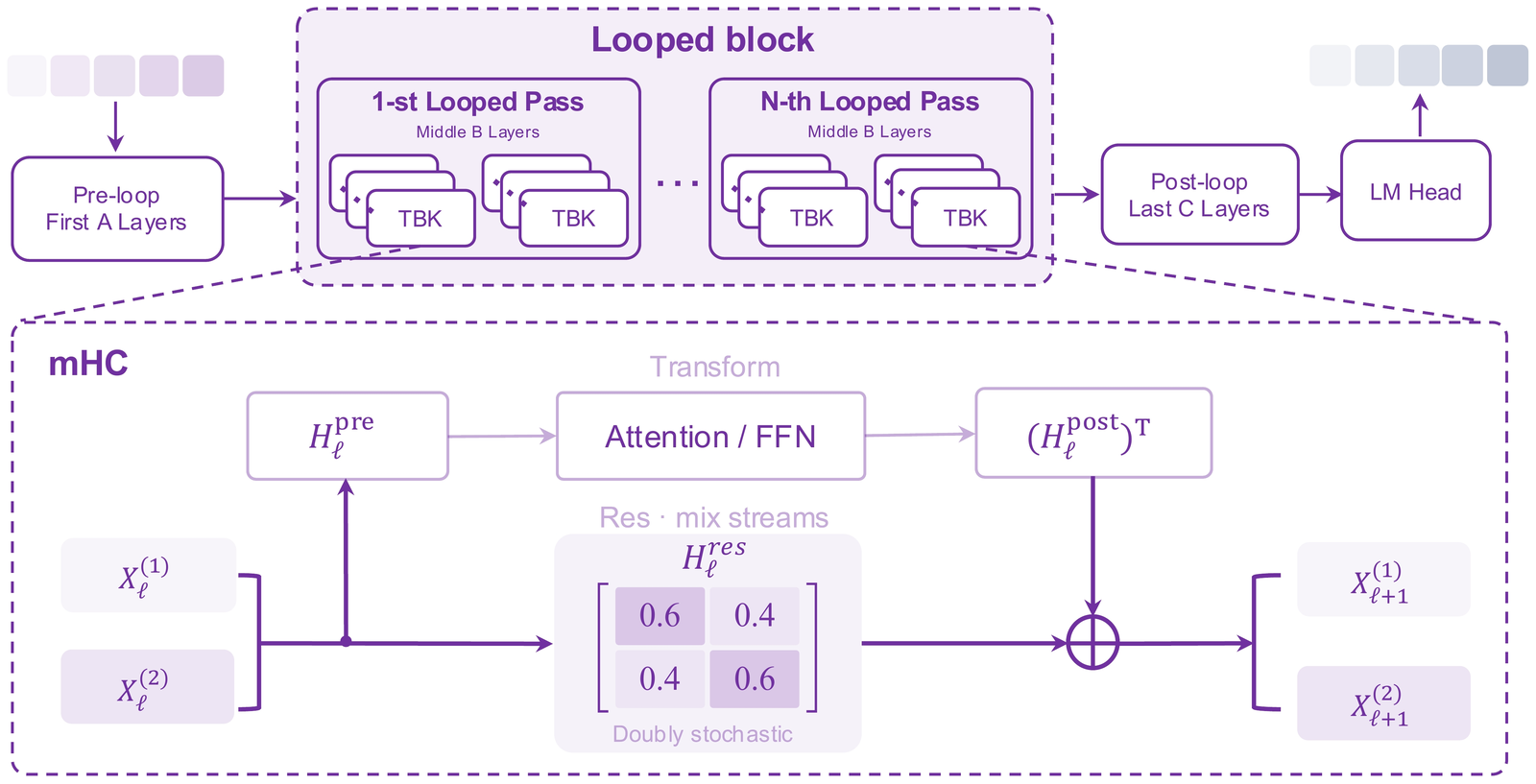
The layer pattern underneath is Qwen3.5's hybrid: three Gated DeltaNet layers, then one full attention layer, repeated. The loop boundaries at 4 and 28 fall on the edges of those four-layer groups, so both passes see the same attention pattern.
Two residual streams, mixed under a constraint
Inside the loop each layer is wrapped in manifold-constrained hyper-connections
(mHC). A normal residual block keeps one hidden vector and does
. With streams the residual state is
vectors, , and each layer learns three small
maps from the current state: how much of each stream to read into the layer,
how much of the layer's output to write back to each stream, and how to mix
the streams with each other. In MHCRouter the read and write weights are
sigmoids and the mixing matrix comes from 20 rounds of Sinkhorn normalisation:
Sinkhorn alternately normalises rows and columns until both sum to 1, so is doubly stochastic. That is the "manifold constraint": a doubly stochastic matrix can shuffle and blend streams but cannot amplify them, which keeps the residual signal's scale from drifting as it passes through many layers. In a looped model the same layers are applied again, so that matters twice over. The routing logits come from a linear map of the RMS-normalised, flattened streams, so the mix is chosen per token. The xHC article walks through this family in more detail.
SenseNova uses two streams (DeepSeek and GLM use four), and the router parameters are kept in FP32 while the rest of the model is BF16. On the headers that is 24 looped layers × 2 routers × 65,544 parameters = 3,146,112 FP32 parameters, the whole cost of mHC here.
One detail the card does not spell out. The function enter expands the hidden
state into two identical streams when physical layer 4 runs, and leave
averages the streams back into one vector when physical layer 27 runs. Both
happen on every pass. So the two streams do not persist from the first pass
into the second: the interface between passes is a single 4,096-wide vector,
and the streams are re-copied from it at the start of the second pass. The
widget below draws them that way.
What a second pass costs
Running 24 layers twice is not free, and the card states the bill in one direction only (memory for weights). On my header count, layers 0 to 3 and 28 to 31 hold 1.73B parameters, layers 4 to 27 hold 5.19B, and the output head 1.02B. A token's forward pass touches 1.73 + 2 × 5.19 + 1.02 = 13.1B parameters in matrix multiplies, against 7.9B for a plain Qwen3.5-9B and 25.6B for Qwen3.8-27B. The card's "approximately 14.6B inference-equivalent parameters" is the same arithmetic with the embedding table and vision encoder counted too: I get 14.61B.
The KV cache is the part people miss. The code gives every execution its own
cache slot (_VisitCache maps a physical layer to its execution index, and the
vLLM pull request says
outright that sharing parameters "does not reduce the number of attention or
recurrent cache entries"). Full attention sits at layers 3, 7, …, 31; six of
those are inside the loop and run twice, so a token writes K and V into 2 + 12
= 14 slots. With 4 KV heads of width 256 in BF16, that is 4 KiB per slot and
56 KiB per token, against 32 KiB for Qwen3.5-9B and 64 KiB for Qwen3.8-27B.
The loop nearly doubles the 9B's cache and lands within an eighth of the 27B's.
The card's deployment table survives that arithmetic. It says multimodal inference at 256K tokens needs about 15 GiB with 4-bit weights and an 8-bit cache. At 8 bits, 14 slots × 2 KiB × 262,144 tokens is 7 GiB of KV; add about 4.9 GB of weights and the recurrent states of 42 DeltaNet executions, and 15 GiB is a fair round-up.
It is Qwen3.5-9B, continued
The card never names a base model. The headers do. The release's BF16 tensors have the same names and shapes as Qwen3.5-9B, and the Preview's BF16 count, 9,653,104,368, equals Qwen3.5-9B's total parameter count exactly (Qwen keeps 3,840 of them in FP32, the Preview casts them to BF16); only the mHC routers are new. Same shapes could be coincidence, so I range-read slices of the same tensors from both repos (the first 131,072 values of each) and compared them. The cosine similarity is 0.976 on the token embeddings, 0.95 to 0.96 on MLP weights in layers 0, 4, 10, 20 and 27, 0.977 on a full-attention query projection and 0.996 on the output head. Two models trained from different random initialisations give cosines near zero. This is Qwen3.5-9B with continued training, which also explains why the card's Loop Scaling section can start from "the original 9B model with a standard single forward pass".
None of that is a problem: Qwen3.5 is Apache 2.0 and building on it is the sensible way to test a loop. It does change the comparison that matters. The question a reader has is how much the loop and the extra training added over Qwen3.5-9B, and Qwen3.5-9B is the one model the benchmark chart leaves out.
A loop gate nobody reads
The release has one tensor the Preview did not: model.language_model.loop_gate.logits,
4,096 FP32 values. The published modeling code matches the Preview's line for
line (my diff ignored trailing whitespace) and never mentions it, and the vLLM pull request skips it by name
and lists "learned loop gates" as unsupported. I fetched the 16 KB it occupies.
All 4,096 values are −3.8918, which is : one constant that
looks like a sigmoid gate's initialisation. From the values alone I cannot tell
whether the gate was never trained, or was applied during training and frozen.
The reference code does not read it, and the card's numbers presumably come from
that code path, so ignoring it is probably harmless. It is still something to
check for if you port the model to another runtime.
"On par with Qwen3.8-27B", panel by panel
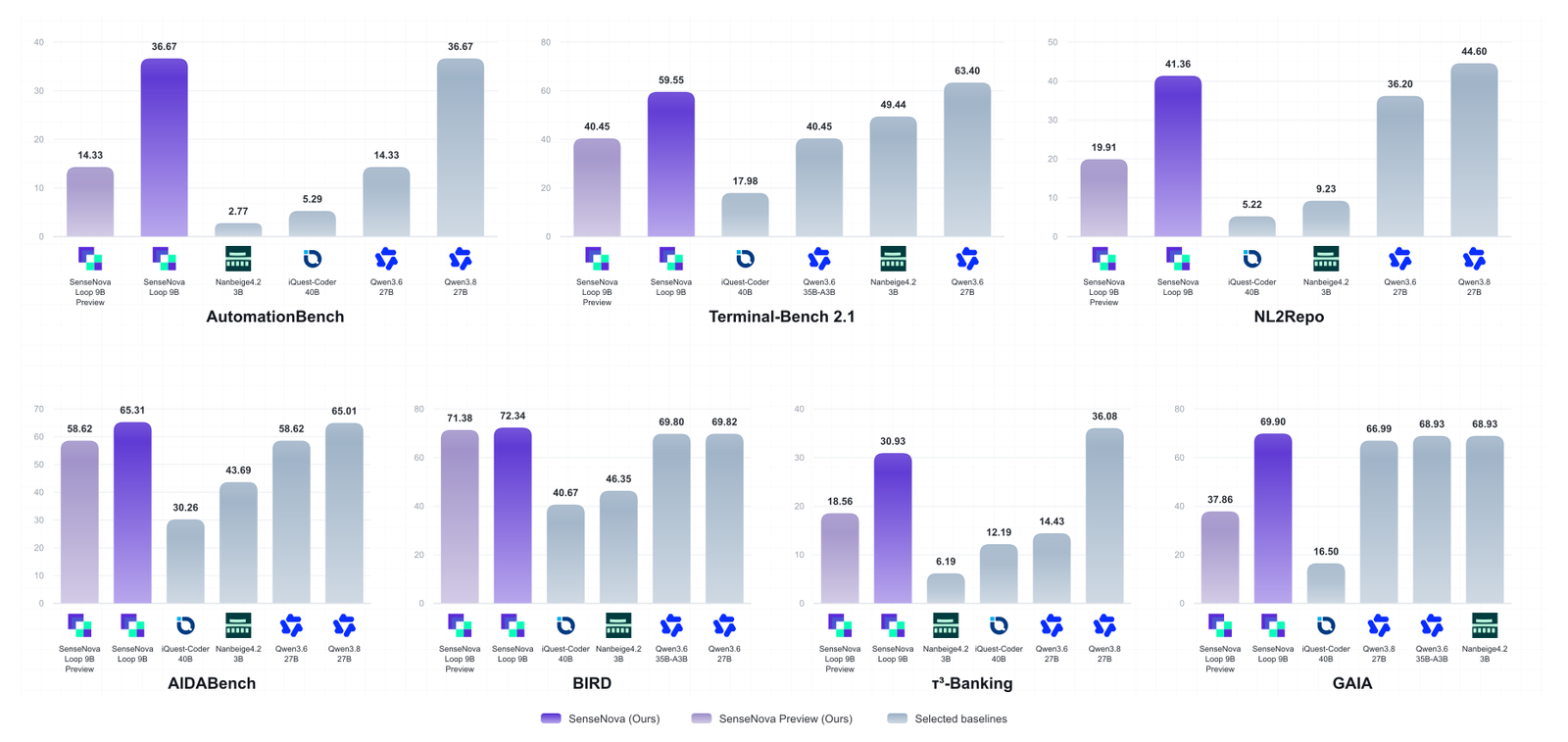
The chart has seven panels, and the baselines change between them. Qwen3.8-27B appears in five. Against it, SenseNova-Loop-9B:
| Panel | Loop-9B | Qwen3.8-27B | |
|---|---|---|---|
| AutomationBench | 36.67 | 36.67 | tie |
| NL2Repo | 41.36 | 44.60 | loss |
| AIDABench | 65.31 | 65.01 | win by 0.30 |
| τ³-Banking | 30.93 | 36.08 | loss |
| GAIA | 69.90 | 66.99 | win |
Two wins, a tie and two losses. The card's text mentions the tie, the AIDABench win and the NL2Repo loss; it does not mention τ³-Banking, the largest gap in the chart. The GAIA scores all look like fractions of 103 tasks (72/103 = 69.90, 69/103 = 66.99, 71/103 = 68.93), which would make the GAIA win three tasks; that is my inference from the numbers, not something the card states. The other two panels compare against Qwen3.6-27B instead: Terminal-Bench 2.1 (59.55 against 63.40, a loss) and BIRD (72.34 against 69.82).
So "on par" is fair as a summary of a selection, and the selection is the publisher's. A 9B that ties a 27B on half of an agent-heavy chart is a good result. It is also a 9B that does about half the 27B's per-token compute and holds seven eighths of its KV cache, so "9B" undersells what you pay to run it.
Why two passes
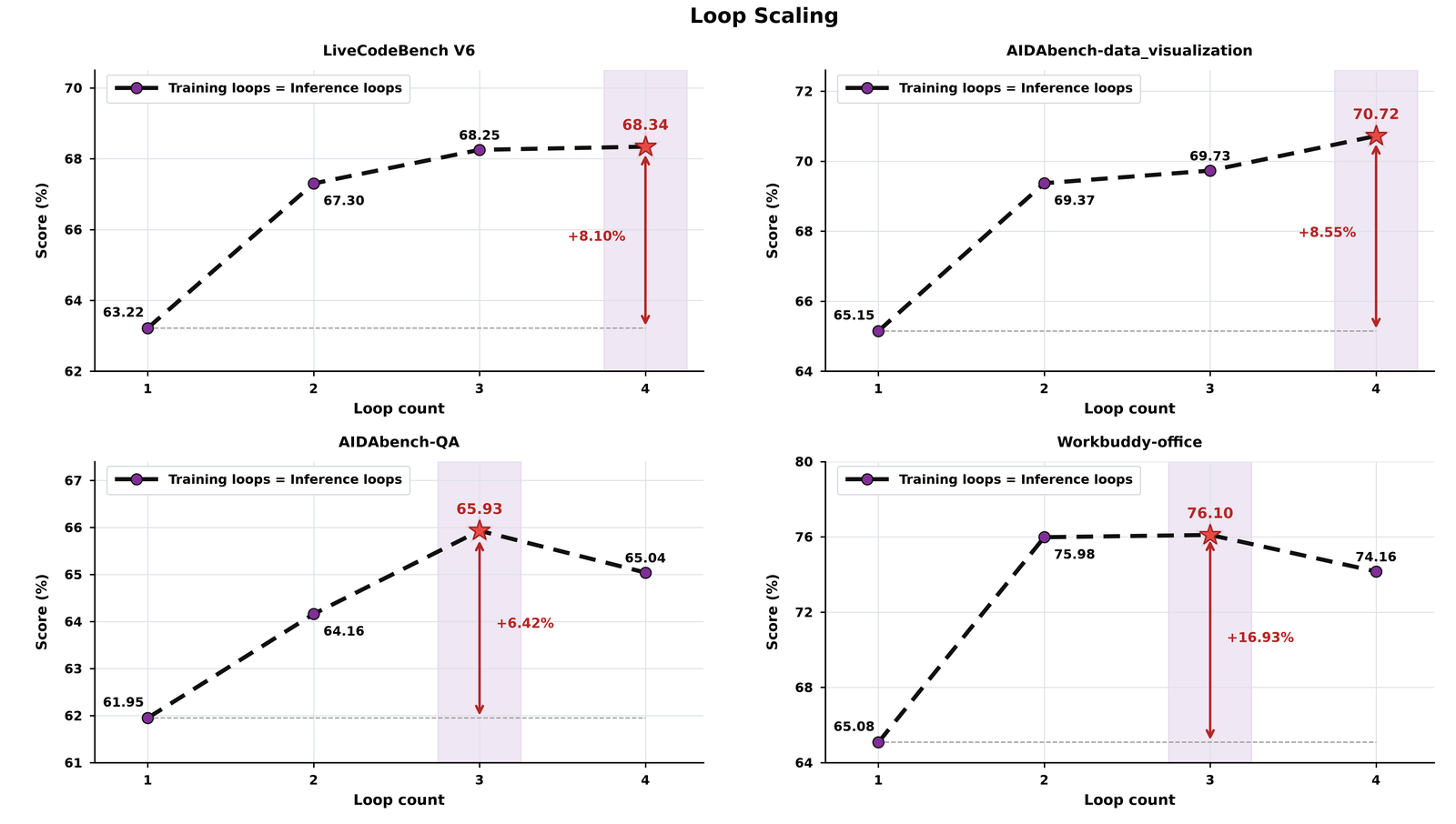
The scaling figure trains a model for each loop count and evaluates it at the same count. The relative gains the card quotes check out against the plotted points (68.34 / 63.22 is +8.10%, 76.10 / 65.08 is +16.93%). The shape matters more than the peaks. On all four tasks most of the gain arrives between one loop and two: Workbuddy-office goes from 65.08 to 75.98 and then to 76.10 at three loops. Going from two loops to four buys 1.04 points on LiveCodeBench V6 and costs 104 layer executions instead of 56. Two of the four tasks get worse at four loops. Shipping two is the right call, and the figure is the evidence for it.
One caution for anyone who tries other loop counts on the released weights: the
curve above is retrained per count. The vLLM build lets you override
eval_count, but a checkpoint trained for two passes run with three is off its
training distribution, and its scores say nothing about what a three-loop model
would do.
The run I tried, and what came back
I wanted that missing comparison, so I wrote a job for an RTX 3090: Qwen3.5-9B, then SenseNova-Loop-9B at its shipped two passes and at one and three, each scored on the same 1,400 MMLU-Pro questions (100 per subject, thinking off, the answer letter read from the next-token logits). Half of it ran. Qwen3.5-9B scored 780 of 1,400, 55.7%, with biology the strongest subject (88 of 100) and math the weakest (37). Its perplexity pass then ran out of the 3090's 24 GB on a 2,048-token window, because the full-vocabulary logits alone need about 2 GB, so I have no perplexity, speed or memory figure for it. The SenseNova-Loop-9B weights never arrived: the download from ModelScope (the Hugging Face repo is gated) timed out twice, and the job moved on. So the Loop-9B arms did not run, and 55.7% is a baseline with nothing beside it yet. I am not going to guess at the other side.
What I would do with it
Use it if you want Qwen3.5-9B's footprint with more reasoning depth and can spare the cache. Benchmark it against Qwen3.5-9B on your task, since that is the comparison the release does not make. Check that your runtime allocates a cache slot per execution (llama.cpp and MLX ports that reuse the physical layer's cache would mix the two passes' states; the vLLM pull request had to work around exactly that). And take "on par with 27B" as "close on half of these agent benchmarks".
FastFrames: the expensive parts were not the denoiser
Apple's FastFrames (paper, code) is the most carefully argued release of the week. The post quotes its subtitle, "generate videos at interactive latency".
Where the time goes
An autoregressive video diffusion model makes a video one chunk at a time, each chunk conditioned on what came before through a KV cache, which is what makes it steerable: you can change the input between chunks. Interactive use needs the delay from input to the first frame showing its effect to sit under about 50 ms, the human detection threshold the paper cites. The paper's measure is responses per second (RPS), the reciprocal of that delay, which unlike FPS does not credit a model for producing many frames at once.
The authors profiled the fastest baseline, Causal Forcing++ at 1.3B on a B200, and found that denoising was the minority of the time. Each latent frame costs 41.6 ms to write the KV cache (a whole extra DiT pass on the clean frame), two denoising steps at 41.6 ms each, and 147 ms in the VAE decoder: 271.8 ms in all, of which sampling is about 30%.
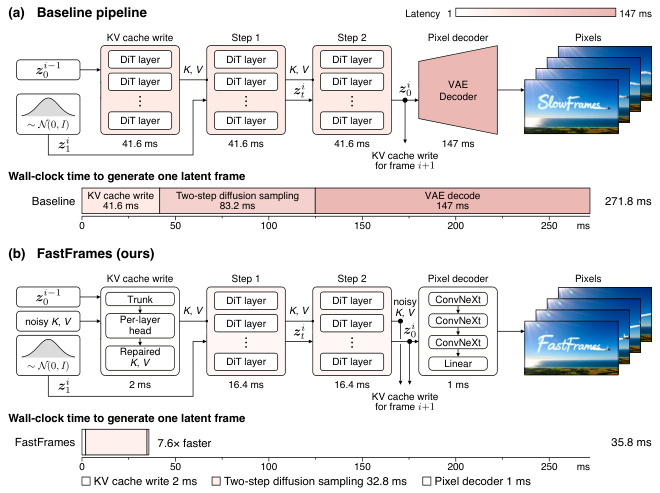
FastFrames attacks the two "accessories" and then the DiT itself:
- Pixel decoder. The VAE decoder is 73.3M parameters but runs dense 3D convolutions at full resolution. FastFrames replaces it with three causal ConvNeXt-style blocks that stay on the transformer's 21×30×52 token grid and a linear layer that turns each token into a 4×16×16 RGB patch. It has 63.9M parameters, takes 1 ms instead of 147 ms, and is trained adversarially in pixel space, which the authors credit for FastFrames-S scoring slightly higher than the baseline that shares its DiT weights.
- KV refinement network. The extra DiT pass exists because the final denoising step writes the KV of a still-noisy input, and the next frame should attend to the clean one. FastFrames trains a small network to repair the noisy KV into clean KV: about 2 ms at 1.3B and 6 ms at 14B. Removing the pass without a replacement makes subjects drift between frames, which the paper's ablation shows.
- Systems work. Persistent KV buffers, precomputed RoPE and conditioning, fused QKV projections, attention over the 32,760-token cache split into five segments merged by softmax (13% on its own), and CUDA graphs bring a DiT evaluation from 41.6 to 16.4 ms at 1.3B and from 89.2 to 75.6 ms at 14B. Context parallelism over eight GPUs, the only scheme of the five they tried that paid for its communication, takes those to 5.8 and 20.3 ms.
The numbers, and the hardware behind them
Table 1 puts FastFrames-S (1.3B) at 36 ms on one B200 with a VBench total of 84.23, against 272 ms and 84.11 for Causal Forcing++. FastFrames-L, the 14B model the post links, takes 158 ms on one B200, so it is not interactive on a single GPU. On an 8×B200 node it takes 45 ms (22.2 RPS) with a VBench total of 84.44, against 84.42 for Krea-Realtime at 1,675 ms. The appendix adds that H100s are 25% to 50% slower. "Interactive latency" for the 14B model means eight B200s.
On the headers, FastFrames-L's release is a 14.29B DiT (Wan2.1-14B distilled to two steps), a 0.89B KV refiner and a 71.7M pixel decoder, plus the intermediate checkpoints of the distillation (causal teacher, consistency and DMD stages), which is generous.
The interactive demo is where it lands. FastFrames' tricks transfer to other autoregressive models: LingBot 1.3B, a camera-controlled world model, goes from 842 ms to 52 ms on eight GPUs, and the physics-conditioned RealWonder from 1,141 ms to 51 ms.
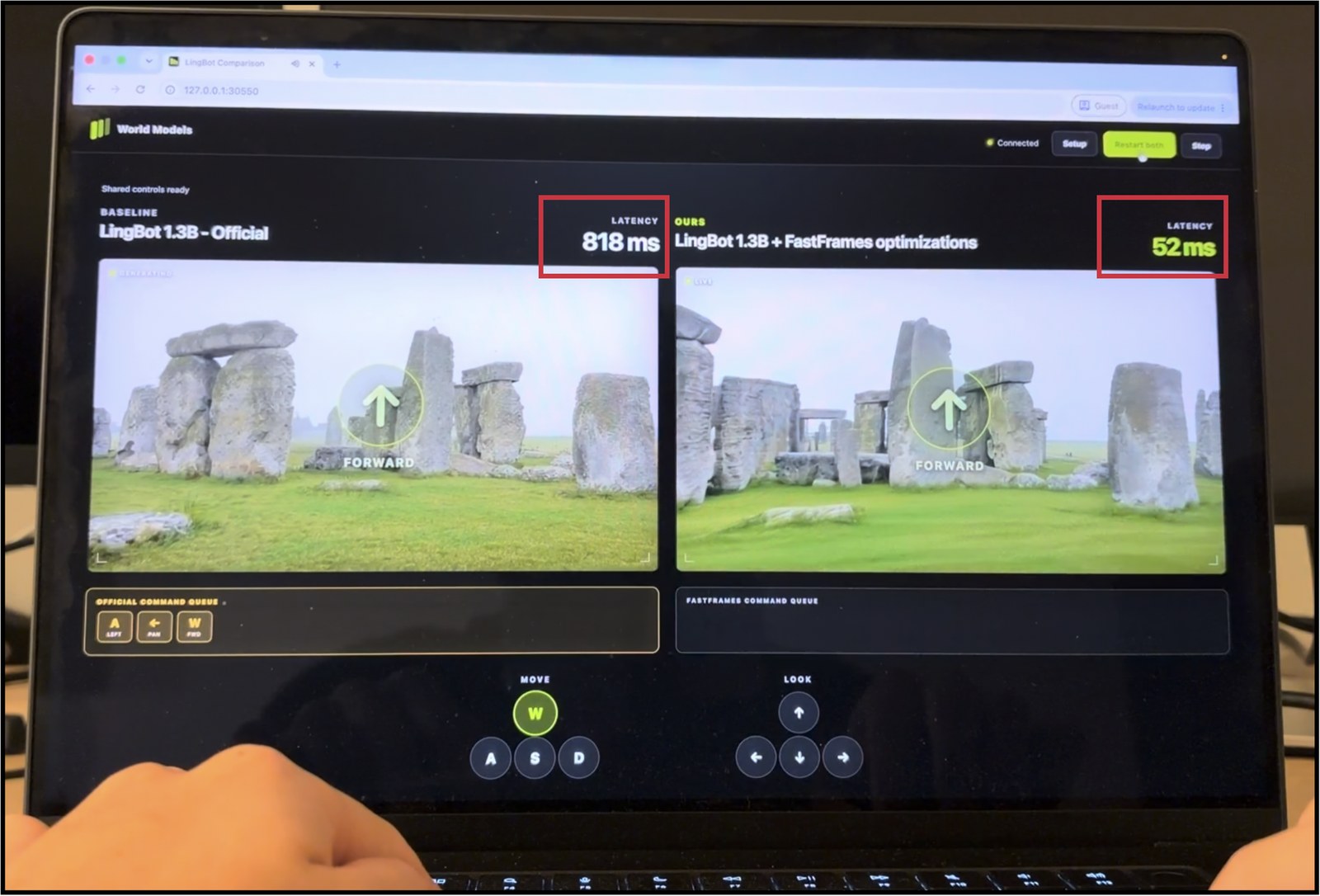
The licence is Apple's research licence (apple-amlr on the weights, Apple
Sample Code License on the code), and the LingBot parts are CC BY-NC-SA 4.0.
This is a release to learn from, not to ship. What it teaches applies well
beyond video: profile the whole critical path before optimising the model in
the middle of it.
Hy4 flash: cheap per task, and 220B on disk
Tencent's post calls Hy4 flash "the cheapest model for everyday productivity" and says it "matches Claude Haiku 5.5 (high) on daily work (human blind tests), yet 18x task cost reduction". This model has enough new architecture (LatentMoE, a 1:3 sparse-to-sliding-window attention split, Engram n-gram embeddings, a drafter that reuses the target's sparse KV) for its own article, after Hy4 preview and Hy4. Here, the claims.
Size. On the headers it is 220,251,201,958 parameters. The card's breakdown matches my count: 155.5B of backbone, 63.4B of Engram tables, 0.43B of vision encoder (0.47B with its projector) and a 0.85B drafter. The Engram tables are four layers × two n-gram orders × eight hash heads, each about 10.3M rows of 96 values; a token reads 64 of those rows. Active parameters per token are 11.3B by the card and 11.27B by my count. Only 4.64B of that is routed experts (16 of 512 per layer, each 7.08M parameters in a 1,536-wide latent); attention, the shared expert and the output head make up the rest. "Cheap" describes the per-token compute; serving it still means holding 440 GB of BF16 weights, or about half that in the FP8 release.
The blind test.
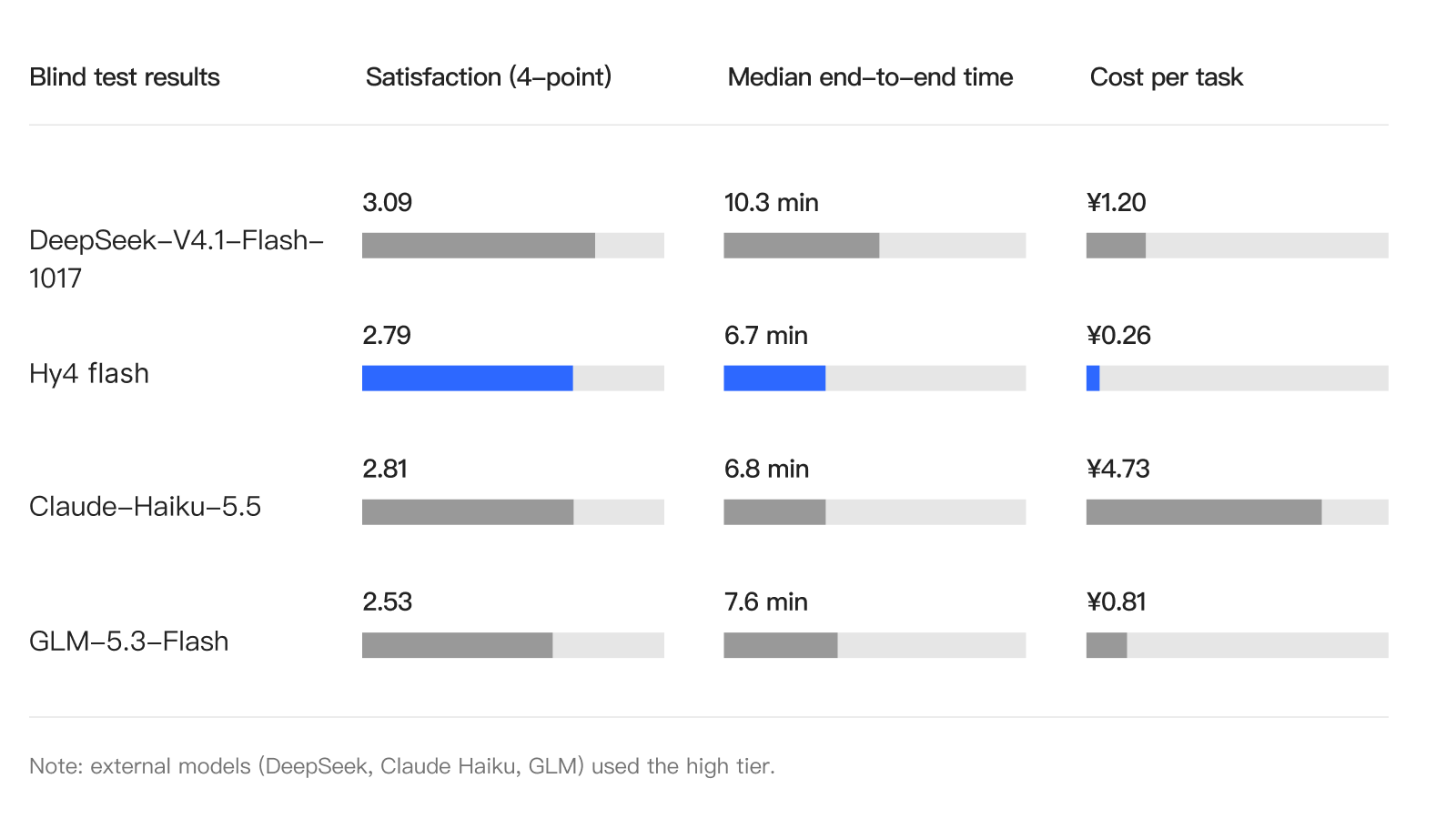
Hy4 flash scored 2.79 out of 4 against Claude Haiku 5.5's 2.81, at ¥0.26 a task against ¥4.73. The ratio is 18.2, so the "18x" holds. The post leaves out the top row: DeepSeek-V4.1-Flash-1017 scored 3.09, clearly above both, at ¥1.20 a task. The raters are Tencent's own WorkBuddy users on WorkBuddy tasks.
WorkIndex and cost. The card's appendix lists all eight WorkIndex tasks, so the averages can be recomputed. They come out at 42.1 for Hy4 flash, 51.4 for Hy4 and 39.7 for Hy4 preview, as published, but the last one only because Hy4 preview (text only) is given Hy4 flash's own score on the vision task, which the appendix notes. Average cost per task comes out at ¥0.234, ¥5.73 and ¥3.24, which gives the figure's 24.5× and 13.8×. The card's prose says "1/20 of Hy4" and "1/13 of Hy4 preview", which understate the figure's own ratios, and "1/8 of DeepSeek-V4.1-Flash-1017", where the table gives 7.0×.
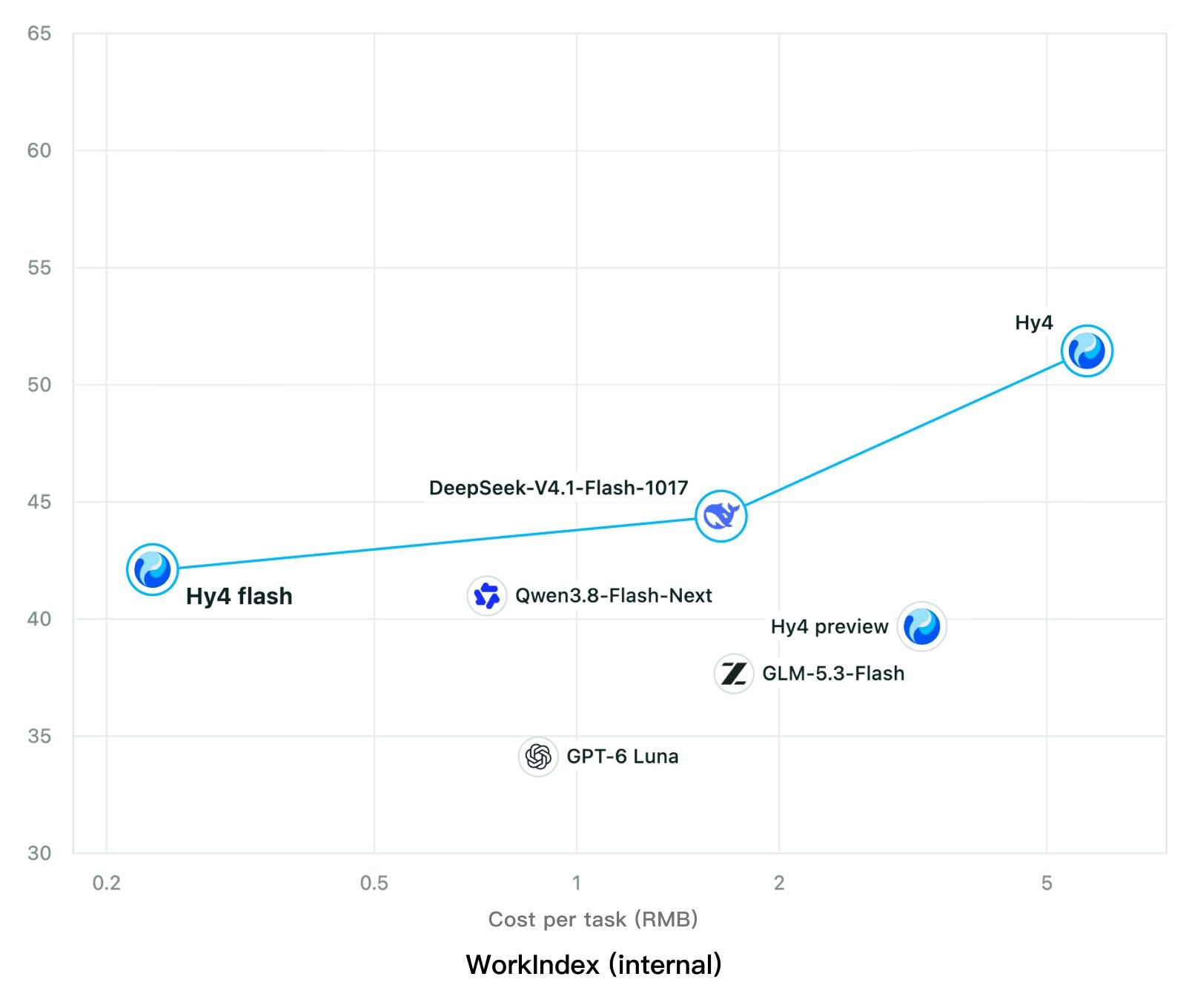
Public agent benchmarks. On the seven public ones in the same appendix (DeepSWE, ProgramBench, Terminal-Bench 4.0, APEX-Agents, AutomationBench, HLE with tools, OSWorld 2.1), Hy4 flash averages 48.3 and DeepSeek-V4.1-Flash-1017 56.5. Hy4 flash is behind DeepSeek on all seven, by the most on Terminal-Bench 4.0 (19.2 against 40.0). Its case is the cost column: ¥0.29 a task on DeepSWE against DeepSeek's ¥1.30.
Prices and licence. The post gives API prices (USD 0.070 per million input
tokens, 0.281 output, 0.003 cached) and links Tencent's research page, which
refused my requests; the model card has no prices, so I could not check them. The licence is the Tencent Hy
License, Apache 2.0 with an added section: a model-as-a-service business needs
a separate licence if its revenue passes US 50 million a year or the product
passes 100 million monthly users; internal use is exempt. For most readers that
is Apache in practice. The full Hy4 is on Hugging Face now as well
(tencent/Hy4, 774.4B parameters by the Hub's count).
Maxwell V1 Flash: the unnamed 35B/3B
The post is Maxwell V1 Flash, Apache 2.0. On the headers: 36,810,559,422 parameters, of which 0.84B is the multi-token-prediction layer and 0.82B the embeddings and output head, leaving 35.15B, the card's "35B excluding embeddings". By my estimate from the routing (12 of 256 routed experts, plus two shared experts and everything dense), a token touches about 3.3B, consistent with the card's 3B. The post's 73.6 GB checkpoint is the BF16 count doubled.
The architecture is a sampler of this year's ideas: 45 layers, block-sparse attention in which every KV group always sees 8 prefix and 8 local blocks of 128 tokens and an indexer picks up to 16 more, four mHC residual streams with 20 Sinkhorn iterations (the same mechanism as SenseNova's, with twice the streams), and an MTP layer. The card says pretraining took about 26T tokens and started dense, adding sparse attention at 128K once the indexer had been trained against dense attention.
The post's arrows ("Terminal-Bench 47.42 → 58.65") are Qwen3.6-35B-A3B's score then Maxwell's, from the card's table: Terminal-Bench 47.42 against 58.65, SWE-bench Verified 63.40 against 65.40, BrowseComp 47.00 against 76.30 (82.20 with context management), Tau3-Bench 64.00 against 67.37. RULER at 256K for the base model is 93.35 against 85.75 for the Qwen3.5 base. The same table has places where it trails: IFBench 64.80 against 83.20 for Muse Glimmer and 79.10 for Gemma 4, and the base model's CMMLU and C-Eval (79.41 and 77.41 against 87.41 and 88.78 for a Qwen3 base). The post's own benchmark image is a re-creation whose footnote says the other models' scores were estimated from a bar chart, so I used the card.
"Trained from scratch" I cannot verify from outside, but I looked for the commonest kind of re-badge. Maxwell's attention and expert shapes are the same as Qwen3.5-35B-A3B's (hidden 2,048, 512-wide experts, 4,096-wide queries, 512-wide keys and values); its tokenizer (200,704 entries) and layer count are not. Same-shape slices from both Qwen3.5-35B-A3B and Qwen3.6-35B-A3B (key, value and expert weights at layers 3 and 11) give cosines between −0.003 and 0.005, where the continued models in this article give 0.95 or more. That is weak evidence, since layers or experts could be reordered, but nothing in the weights says Qwen. The card does not say where the team is; it does single out Southeast Asian languages (Thai, Lao, Myanmar, Khmer, Shan) for its tokenizer.
Astrantia: Qwen3.5-35B-A3B cut to 9.4B, still an MoE
Astrantia (the repo is named Sharpen-Qwen-3.5-9B-A2.6B-Preview; the thread is in Japanese and English) prunes Qwen3.5-35B-A3B to roughly the size of Qwen3.5-9B without turning it dense. Most expert pruning drops whole experts, as REAP does in the Kimi K3.1 Pro pruned75 release. This keeps each expert at its own width: a budget of 28,160 FFN neurons per layer (chosen, the card says, to match Qwen3.5-9B's parameter count) is spent across experts by importance on chat text, so a heavily used expert keeps all 512 of its neurons and a rarely used one keeps a sliver. Then three rounds of LoRA (rank 16, about 15M tokens in total) heal the attention and shared expert, with the routers and routed experts frozen.
The headers let me check the cut. Each layer stores a widths vector, one
entry per kept expert. Every layer's widths sum to 28,160. Layers keep between
101 and 128 experts, 113.45 on average, matching the config. The median kept
width is 219 by my count (the card says 225). The distribution is extreme: in
layer 20, 32 experts keep the full 512 neurons and the smallest keeps 1. In
total the checkpoint holds 9.36B parameters, 74% fewer than the original's
35.95B.
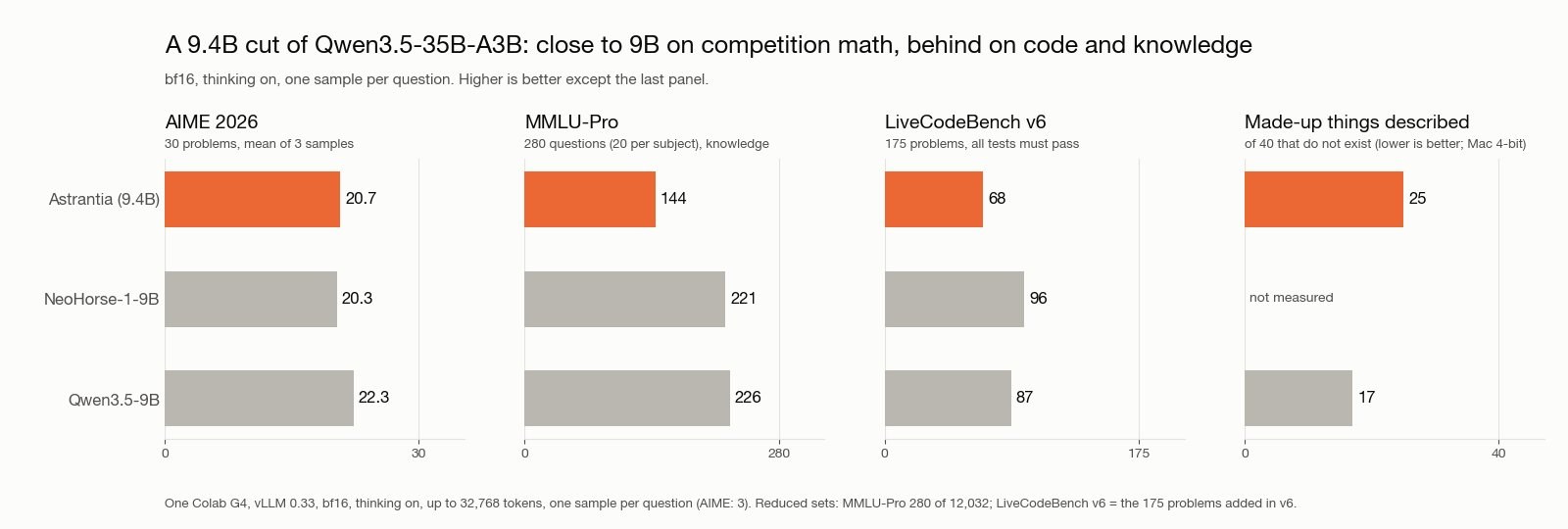
The card is unusually candid about the result. AIME 2026 is close to Qwen3.5-9B (20.7 against 22.3 out of 30), but MMLU-Pro is 144 against 226 out of 280 and LiveCodeBench v6 is 68 against 87 out of 175, with 95 of Astrantia's 175 code answers running into the 32K-token limit. It loses factual knowledge, breaks outside English and is worse at 4-bit; the card says Qwen3.5-4B beats it on knowledge and instruction following. The interesting number is the one before healing: the uneven 9.4B cut has a KL divergence of 0.155 to the original, against 0.159 for keeping every expert at half width, which is 18.5B. How you keep neurons matters as much as how many. This is a research preview and says so.
Agnes 2.5 Pro Theta: 187.8B, a quarter of it a lexicon
Agnes 2.5 Pro Theta, Apache 2.0, is from Agnes AI; the post calls the company Sapiens AI of Singapore, which the card does not mention. The headers confirm the card's 187,763,545,616 parameters. Of those, 51.2B sit in a hashed lexical lookup table split into 128 shards (an n-gram memory like Hy4 flash's Engram), 130.9B in routed experts (512 per layer, top 10) and about 5.7B in everything else (embeddings, output head, attention, vision). The card gives no active count; from the routing I estimate about 7.2B per token. The config describes 52 layers as 13 repeats of three recurrent layers and one sparse-attention layer, with four residual streams.
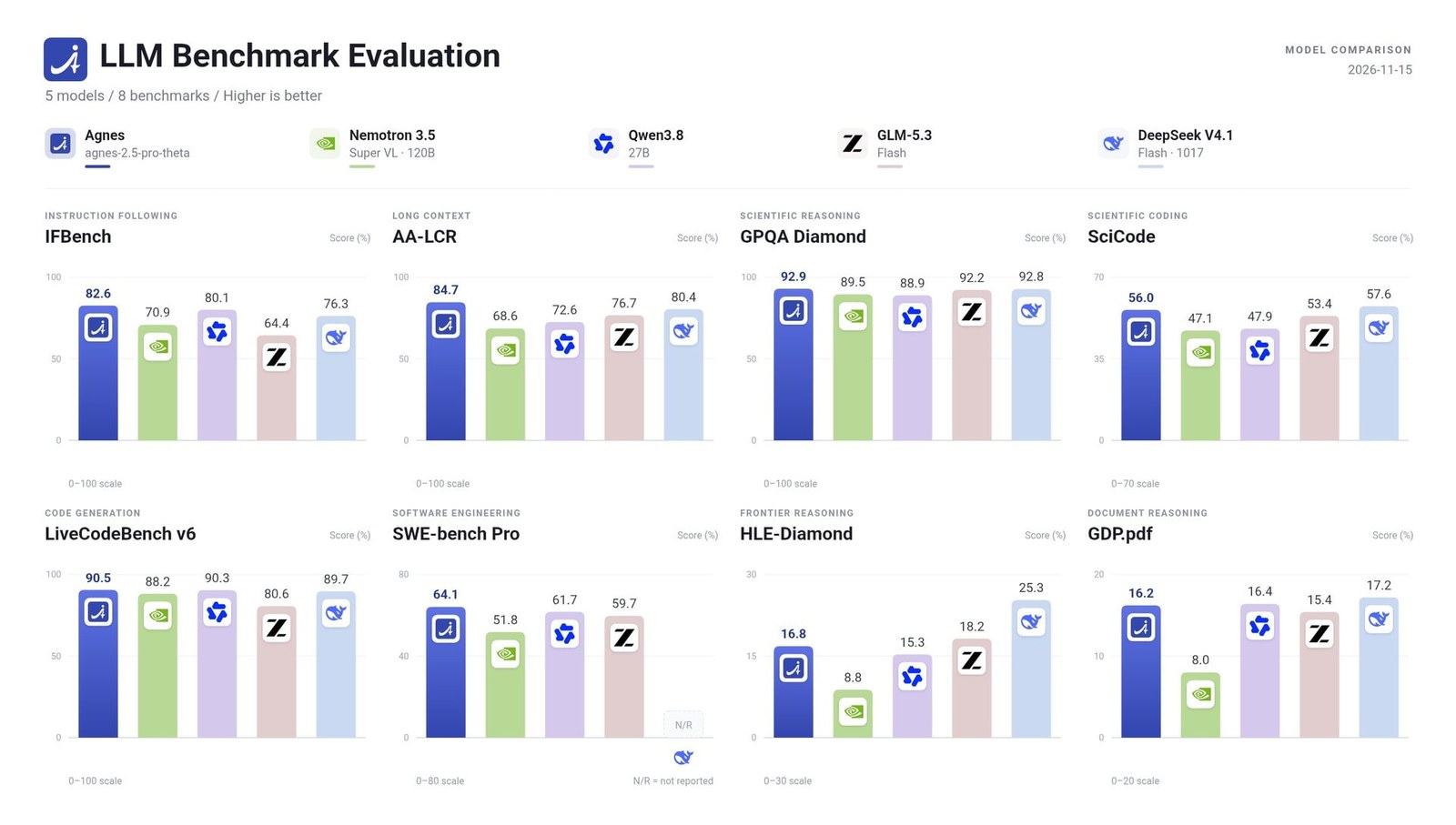
The post says Agnes tops five of eight benchmarks. It does: IFBench, AA-LCR, GPQA Diamond (92.9 against 92.8), LiveCodeBench v6 (90.5 against 90.3) and SWE-bench Pro, where DeepSeek has no score. Two of those leads are 0.1 and 0.2 points. The card's own data file adds notes that matter: Agnes's AA-LCR score is labelled v1.1 with "competitor versions need alignment", and its SciCode score uses subproblem-level scoring. The card also says its checks covered model construction and input preparation, "not a full end-to-end generation qualification". I would wait for someone to serve it.
Sage S2.1 Flash: GLM-5.3-Flash, fine-tuned for science
Sage S2.1 Flash, from
Shanghai AI Laboratory's InternLM group, MIT licence, is 321.37B parameters on
the headers, "Flash" notwithstanding. The architecture string is
Glm5NextForConditionalGeneration, and the shapes are
GLM-5.3-Flash's. The card names no base, so I
compared tensors: cosine 0.993 on the token embeddings, 0.9998 on the output
head, 0.9999 on the layer-20 router and 0.9998 on a layer-20 attention
projection. It is
GLM-5.3-Flash with further training, which is MIT too, so the licence is
consistent. By my count from the routing, about 16.7B parameters are active per
token, excluding the MTP layer and the vision encoder; the
GLM-5.3-Flash article quotes Z.ai's 18B, and I do
not know exactly what that figure includes.
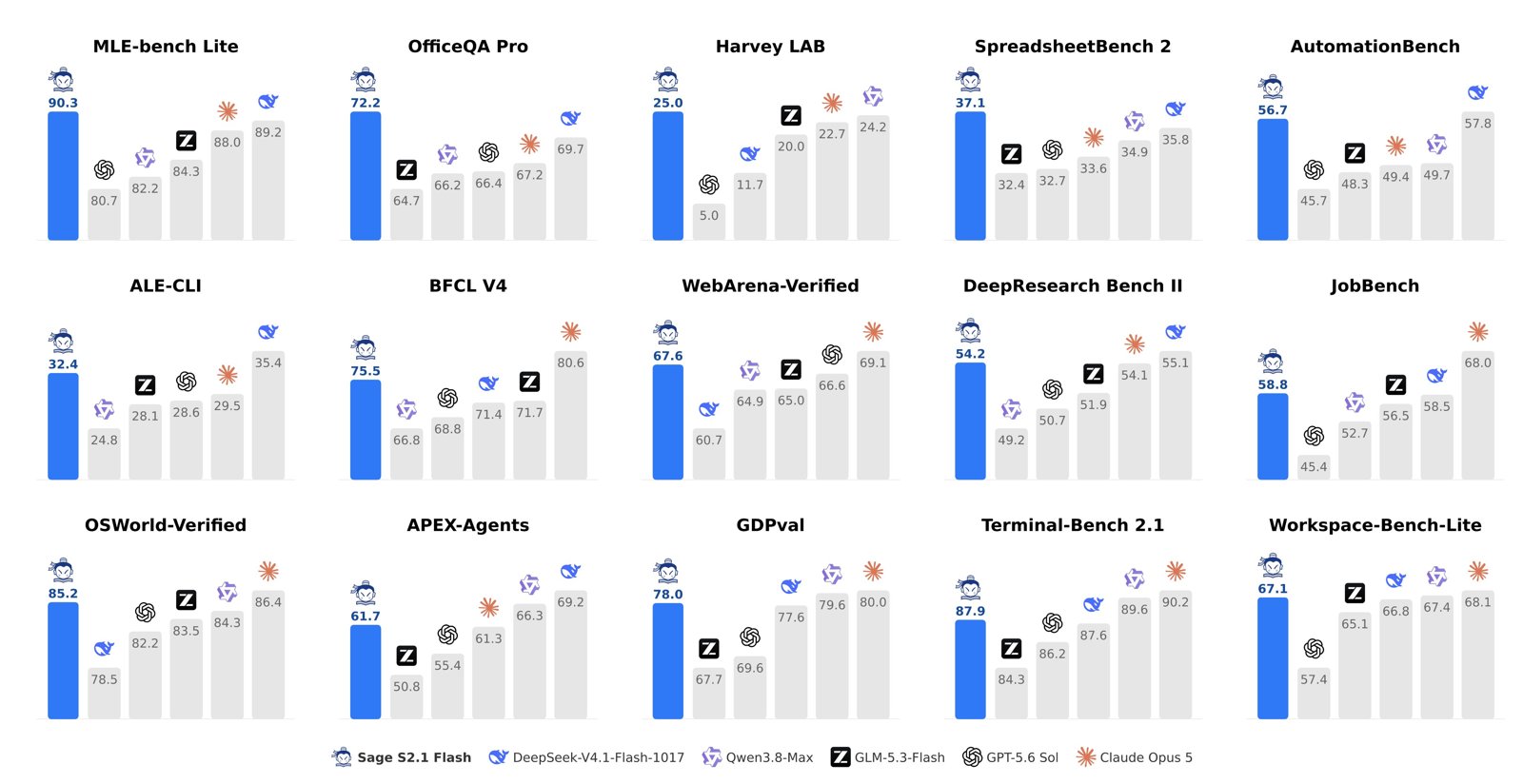
What it adds is nine projector files (protein sequence and structure, RNA, DNA, spectra, crystal structures, ECG, EEG, X-ray diffraction), 42M parameters in all, which map the output of separate scientific encoders from Sage-SciPerception into the language model's embedding space. The post's "ranks first on multiple benchmarks" is right in the narrow sense: in the card's full table of 33 rows against GLM-5.3-Flash, DeepSeek-V4.1-Flash-1017, Qwen3.8-Max, GPT-5.6 Sol and Claude Opus 5, it is first on five (SpreadsheetBench 2, OfficeQA Pro, Harvey LAB, MLE-bench Lite and PostTrainBench). The more useful comparison is with its own base: it beats GLM-5.3-Flash on 32 of 33 rows. That is what a domain fine-tune should do.
LongCat Video Avatar 1.6: second in its own arena
Meituan's LongCat-Video-Avatar-1.6, MIT licence, makes a talking, gesturing person from a reference image and an audio track, and the post leads with its length: more than ten minutes. The card attributes that to reducing error accumulation across autoregressive continuation; I have no way to check a ten-minute claim without running it.
On the headers the base DiT is 15.85B parameters, with two 0.63B LoRAs (one DMD-distilled, one OPSD) that the sampler blends over eight denoising steps, an INT8 copy of the DiT, and Whisper-large-v3 for the audio. The card's human preference study is fair to its rivals: across 33,051 votes and six systems it ranks second, with a Bradley-Terry Elo of 1068.1, behind OmniHuman-2.0 and ahead of HeyGen, OmniHuman-1.5, Kling Avatar 2.0 and its own 1.5. An open model placing second to a commercial one in its own study is believable precisely because it did not place first. The LongCat 2.0 article covers the lab's language model.
Inworld Voice Isolator: small, Apache 2.0, and slower than real time on my 3090
Inworld's voice isolator is two models with one architecture: an offline one (64.0M parameters) and a realtime one (58.2M) with 20 ms of look-ahead. My header count for the two files together is 122,225,168, which agrees. The post says it "can do real time". The card says the realtime model's algorithmic latency is 63 ms at 20 ms of look-ahead.
The architecture is a band-split network over the STFT: each 10 ms frame's spectrum is cut into 46 bands, one 512-wide token per band, refined by seven blocks that alternate attention over time and bands with Mamba over time and bands, then turned into a bounded complex mask plus a residual. It was trained on about 10,000 hours of audio. Two caveats from the card: it has been tested on A100, H100, B200 and B300 GPUs and on CPU, with smaller GPUs not yet tested, and its benchmark (VIBE) scores systems on an internal set that is not distributed.
I ran both models on an RTX 3090 and on its host CPU, over a minute of the repo's own noisy sample, through the package's Python API. The offline model cleaned the 60 seconds in 7.8 seconds on the GPU, a real-time factor of 0.13, and took 7.05 times real time on the CPU. The streaming model is the surprise: pushed 20 ms of audio at a time, each push took 30 ms at the median (38 ms at p99) on the GPU, a real-time factor of 1.54. That is slower than real time, so in my harness it falls behind a live microphone even on CUDA. On the CPU it was 6.63 times real time, 117 ms a chunk. The card does not claim a 3090, and the gap may be per-call overhead in a batch-of-one Python loop rather than the model, but "real time" is not something I could reproduce on this card.
Inworld's announcement also open-sourced a turn-detection model whose 71 ms against 210 ms comparison I have not checked.
Gemma 4 E2B at Airbnb: a classifier, fine-tuned
Google's post is a victory lap for Gemma 4, and the source is Airbnb's own write-up. The task is a production classifier that screens content for violations of Airbnb's pricing and payment transparency policy, called thousands of times a minute with a 200 ms budget. Airbnb fine-tuned Gemma 4 E2B "on hundreds of thousands of domain-specific examples" and served it with vLLM 0.28.0 on one RTX Pro 6000.
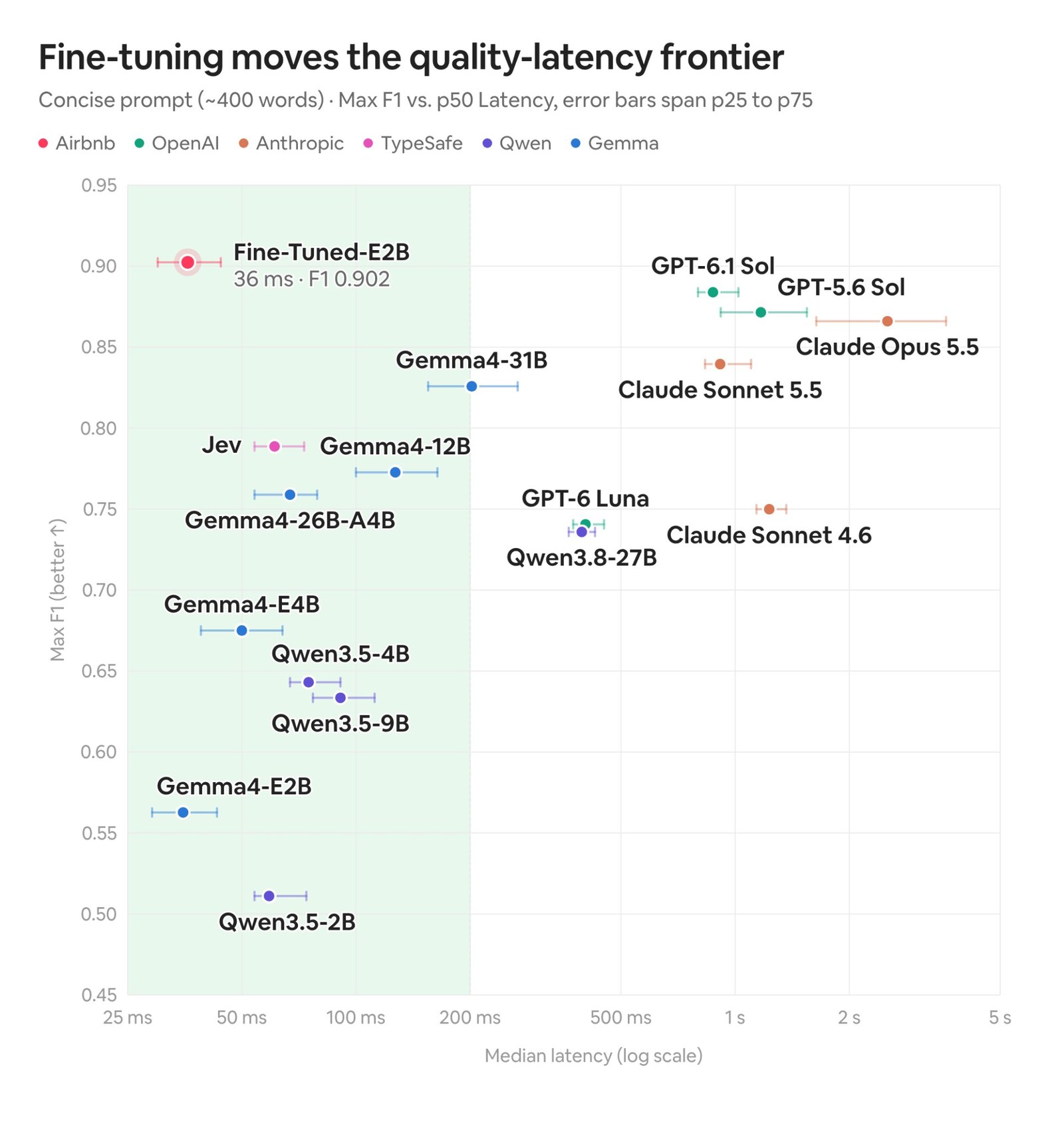
Max F1 goes from 0.563 to 0.902 on 10,000 weighted held-out examples, at 35 ms median and about 85 ms p99 (the chart labels the median 36 ms), against about 900 ms median for GPT-6.1 Sol and Claude Sonnet 5.5. The "1% of the cost" holds at Airbnb's volume and not below it: the post says hosted models are cheaper below roughly 15 to 30 requests per minute. Airbnb is also careful about its own assumptions (list prices, a 71% cache hit rate that favours the hosted models) and calls it "just one example". E2B stores 5.12B parameters, 2.3B "effective"; the "2B" in the name is not its memory footprint. Fine-tuning a small model for a narrow, high-volume classifier is old advice. It is good to see it measured this carefully.
SmolVLM2-256M: not this week's
The post about SmolVLM2-256M-Video-Instruct is someone noticing a model, not a release: the repo dates from 11 February 2025. It is a 256,484,928-parameter (FP32 on disk) vision-language model that takes images and video and answers in text, Apache 2.0, and the poster says they have not tried it yet. It is still one of the smallest models that reads video at all.
What I take from the week
The loop is the idea I will keep watching. SenseNova showed that a 9B can buy depth with time instead of parameters, published the scaling curve that justifies stopping at two passes, and released code clear enough to read the whole mechanism from. It also showed the bill that comes with it: the cache grows with executions, and "9B" stops describing what you run. I would like to see the comparison against Qwen3.5-9B that the release skipped.
FastFrames is the one I would read in full. Hy4 flash is the one to price before you dismiss it, with the caveat that its own appendix puts it behind DeepSeek-V4.1-Flash on every public agent benchmark. Read the headers before the headline: twice this week, a model's size was mostly lookup table, and twice a new model was an older one, continued.
What I read, and what I computed
Read, not run: every parameter count in this article is mine from the
safetensors headers (range requests, no weights downloaded), except where a
sentence says it is the publisher's. The SenseNova and Sage lineage checks
compare the first 131,072 values of matching tensors fetched by range request
from both repos. The loop_gate values and Astrantia's per-expert widths were
fetched the same way. The loop schedule, cache slots and mHC behaviour are read
from modeling_sensenova_loop.py and the vLLM pull request. Benchmark scores are
the publishers', recounted from their tables where the tables exist; averages,
ratios and the GAIA task-count inference are my arithmetic. I did not run any of
these models except two. On an RTX 3090, Qwen3.5-9B was scored on 1,400 MMLU-Pro
questions before its perplexity pass ran out of memory, and the SenseNova-Loop-9B
download timed out, so none of its arms ran. Inworld's two isolators were timed
on the same box, GPU and CPU. Hy4 flash's API prices could not be checked.