2026-10-24 · 29 min · kimi · mixture-of-experts · reinforcement-learning · benchmarks · agentic-coding · pricing
A 4:50 narrated explainer, drawn in code. Every number and picture in it is this article's own; the sources are below.
› transcript
Moonshot sold Kimi K3.1 Pro as K3 with more training. But its weight files hold one part the launch blog never mentions. Hi, I'm Bowline! Kimi K3.1 Pro is Moonshot's new flagship. The launch said: same model, more training. The weights say a little more. Chapter one. What carried over from K3. K3's architecture. Ninety-three layers, mostly Kimi Delta Attention, a linear attention with a constant-size state. Every fourth is a full-attention Gated MLA layer. Every layer feeds a mixture of experts. Each token goes to sixteen of eight hundred and ninety-six. The article read the header of all ninety-six weight shards in both repositories. K3 has four hundred ninety-seven thousand tensors. Every one is in K3.1 Pro, same name, same shape, same precision. But no shard's hash matches, so the weights moved everywhere. And there are a hundred and twenty new tensors, five in each of twenty-four layers. About a hundred and seventy-nine million new parameters. Exactly the gap between the two models' counts. Chapter two. A sparse-attention indexer. The twenty-four new sets of tensors sit in the twenty-four full-attention layers. Each is a small indexer that scores every earlier token and passes only the best two thousand and forty-eight to attention. Open one of those layers. The tensor names are DeepSeek's lightning indexer, and the model card calls the layer Gated DSA. Reading from the shapes: the indexer forms thirty-two small query heads from the query latent the layer already computes. It scores every earlier token, using one small key per token. No positional encoding. Only the top two thousand and forty-eight reach the real attention. Below that much context, nothing is left out. The repository ships no modelling code, so this is the article's reading of the tensors, not something run. In K3, each full-attention layer reads every earlier token. Those twenty-four layers are the only part whose cost grows with context. In K3.1 Pro, the indexer scores every earlier token first, with one small key each, a hundred and twenty-eight wide. Only the top two thousand and forty-eight reach the real attention. Below that much context, nothing is left out. At the full million-token window, the expensive attention reads five hundred and twelve times fewer entries. The indexer still scans everything, but cheaply. The price: if the indexer key is cached too, those layers store twenty-two percent more per token. Chapter three. More reinforcement learning, less said. K3 trained nine separate experts, then distilled them into one model. K3.1 Pro runs joint reinforcement learning across hundreds of domains, and strips cyber data, even from mid-training. Start from the K3 checkpoint. The experts keep their shape. Most of the cost is generation: long agent runs against tools, in sandboxes across hundreds of domains. Every domain has its own reward. One buggy environment can teach the wrong thing, so Moonshot vets them on a shared platform. Then update, and around again. The claim is that extra compute now pays off predictably. Chapter four. Does the launch hold up? On Terminal-Bench four point oh, K3.1 Pro nearly ties Claude Opus five point five. It leads on agentic, tool-using work like OfficeQA Pro, and trails on closed-book knowledge and cyber. The sixty-five percent drop is this internal stress test, checked claim by claim. GPT-6 Astra is still lower. The article checked the launch claims. Against the proprietary models, K3.1 Pro is ahead or tied on sixteen of forty-five rows, mostly agentic ones. Counted per response, the hallucination drop is fifty-seven point six percent. And a viral demo's tokens and price cannot both be right at Moonshot's own rates. A new flagship can be mostly the same network, trained much harder afterwards, with one indexer for long context. Same experts, a new attention indexer, much more reinforcement learning, and a lead on agentic work. Thanks for watching! Every source is in the full article. I'm Bowline. Bye!
Why read this
Notabletop 60%Diffs the released weights against K3 and finds a new sparse-attention indexer, tallies all 47 launch rows, and checks the −65% and a viral demo's cost.
- Checked against the source
- Widely used
- Concrete numbers to act on
Training & RLNeeds datacenter GPUsSource-availablePractitioner model
How this was scored
- Is it new?
- 1 of 3: An incremental tweak
- Can I trust it?
- 3 of 3: Reproduces the headline result, or shows from primary files it is wrong
- Can I run it?
- 1 of 3: API-only, gated or restrictive licence
- Will I understand it?
- 1 of 3: Partial mechanism
- Can I act on it?
- 2 of 3: A concrete recipe, numbers or comparison
- Will it last?
- 1 of 3: Relevant for months
- Does it affect many?
- 2 of 3: A widely used model, tool or lab release
- Only here?
- 2 of 3: A teardown or measurement few others did
Score 61 of 100, ranked 439 of 773 rated articles. Each question is answered 0–3 by hand, and a 3 is rare. How articles are scored
Moonshot launched Kimi K3.1 Pro at 17:15 UTC on 23 October, after a teaser earlier the same day. The launch post calls it "our most capable 3T-class open-weight model": a 1M-token context, 2.8T total and 104B active parameters, multimodal, full-project game builds in Unreal, Unity and Godot, parametric 3D in Blender and CAD, finance hallucination "down by 65%", and "matching the strongest proprietary models across coding, agentic and knowledge benchmarks". It is live on the Kimi API now, with a Highspeed variant "2–3× faster". The weights were promised by 4 November 2026.
When I first wrote this, on 24 October, the Hugging Face API listed one K3 repository under moonshotai, the July
Kimi-K3, and nothing for K3.1 (measured then). With no config.json to diff, that version checked what could be
checked: the launch blog's own benchmark table, the pricing pages, a third-party measurement, and the arithmetic of
the demo that went viral with it. Those sections stand, dated. moonshotai/Kimi-K3.1-Pro was created on 2 November at
04:13 UTC (measured, from the repository's initial commit), and its files now answer the architecture question
directly. Every claim is labelled measured (read from files or pages), reported (Moonshot or another party
says it) or reasoned (my arithmetic or inference).
If you have not read the Kimi K3 article, the short version: K3 is a 93-layer MoE that routes each token to 16 of 896 experts, mixes Kimi Delta Attention with Gated MLA 3:1, reaches back across depth with Attention Residuals, and was post-trained as nine RL experts merged into one model by on-policy distillation. The experts, the KDA layers, Attention Residuals and the 1M window carry over to K3.1 Pro unchanged. The 24 Gated MLA layers do not.
What changed from K3
The blog's first technical sentence settles the architecture question: "Kimi K3.1 Pro is a post-trained version of
Kimi K3, with substantially larger post-training compute" (reported). On 24 October I read that as same base, same
shape, and the files say that was half right. The 2.8T / 104B, the
1,048,576-token window and the text, image and video inputs in the launch post are K3's numbers, and the API docs say
"All K3 series models support a 1,048,576-token context window." OpenRouter lists both K3.1 Pro endpoints with the
quantization tag mxfp4, which matches the MXFP4 expert weights K3 was trained to serve in (third-party listing).
So most of the diff is not in the weights' shape. It is in training data, RL scale, price and speed, plus one structural change the launch blog does not mention:
Besides the attention row, which the next section takes apart, the one row that does not fit "post-trained version" is the cyber row. The blog says that for the open-weight release Moonshot "identified and removed cyber-related data from both training stages": the mid-training corpus and the RL environment mix. You cannot remove data from a stage you did not rerun, so a mid-training stage was redone for K3.1 Pro, not only RL stacked on the K3 checkpoint (reasoned). That is still "the same base model" in the sense that pre-training was not redone, and it is the same move Z.ai made with GLM-5.3, which kept GLM-5.2's base and spent a month on post-training.
For reference, here is K3's architecture from its own report. On 24 October I wrote that if K3.1 Pro's config.json
differed from K3's, this figure would be the thing that was wrong. One box was: the Gated MLA layers.
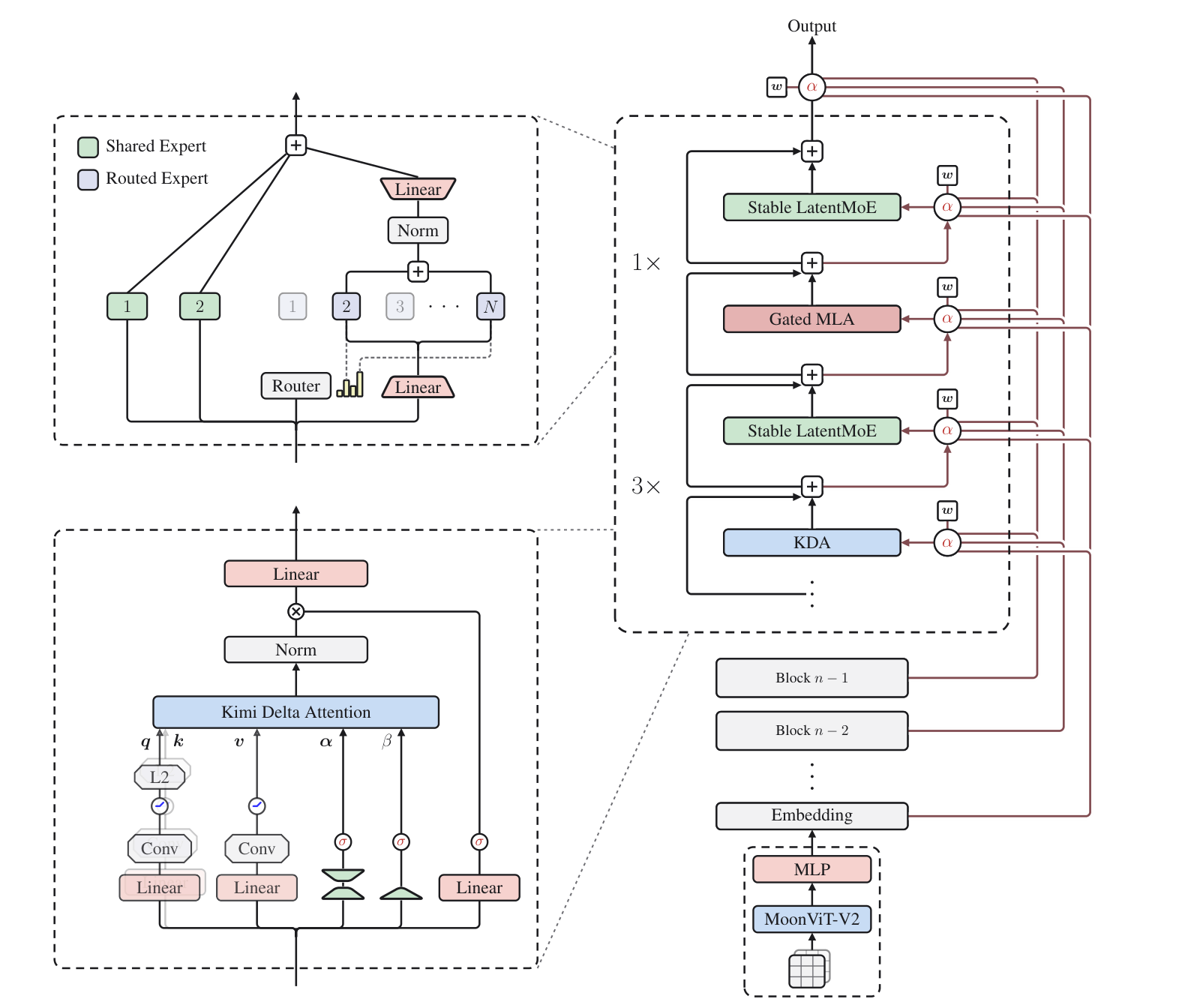
What the weights show: a sparse-attention indexer
Added 12 November. I fetched config.json, LICENSE, the model card and model.safetensors.index.json from both
repositories, then read the JSON header of every one of the 96 safetensors shards in each by HTTP range request: the
first eight bytes give the header length, a second request reads the header. That is the name, dtype and shape of
every tensor without downloading a weight (measured).
config.json differs from K3's in six places. model_type goes from kimi_k3 to kimi_k31, and the architecture
class from KimiK3ForConditionalGeneration to KimiK31ForConditionalGeneration. The text config gains a dsa_config
block. The quantization ignore list gains two entries, for the router gate and the latent up and down projections;
those were BF16 in K3 already, and no tensor's dtype changed. auto_map loses its model classes, and
transformers_version moves from 4.56.2 to 4.57.6. Everything else matches field for field: 93 layers, the first one
dense, 896 routed experts with 16 per token and 2 shared, kv_lora_rank 512, q_lora_rank 1,536, 96 heads, the
same 69-entry KDA layer list and the same 1,048,576 positions (measured).
The headers agree with the config:
| Kimi K3 | Kimi K3.1 Pro | |
|---|---|---|
| tensors | 497,220 | 497,340 |
| parameters (Hugging Face count) | 2,779,931,837,184 | 2,780,110,363,392 |
| BF16 parameters | 57,179,884,544 | 57,358,410,752 |
| MXFP4 expert parameters | 2,722,740,830,208 | 2,722,740,830,208 |
| tensor payload | 1,560,860,324,864 B | 1,561,217,377,280 B |
| shards whose sha256 matches K3's | 0 of 96 |
All 497,220 of K3's tensors are in K3.1 Pro under the same name, at the same shape and dtype, in the same shard
(measured). None of the 96 shards has K3's hash, including the 72 whose byte size is identical, so the weights moved
everywhere, as more training would make them. The tokenizer, tiktoken.model, has the same sha256 as K3's.
The 120 new tensors are five per layer in 24 layers: zero-indexed layers 3, 7, 11 and so on to 91, plus 92. Those are the layers the config lists as full attention, numbered from one: 4, 8, … 92, 93. In each (measured shapes; what each one reads from is reasoned from its input width):
self_attn.indexer.wq_b, 4,096 by 1,536: 32 heads of 128, read from the 1,536-wide query latent the MLA already computes.self_attn.indexer.wk, 128 by 7,168: one 128-wide key per token, straight from the residual stream.self_attn.indexer.weights_proj, 32 by 7,168: a weight per head, per token.self_attn.indexer.k_norm, a 128-wide LayerNorm weight and bias.
That is 7,438,592 parameters a layer and 178,526,208 in all, all BF16. It is exactly the gap between the two Hugging
Face counts, so nothing else was added or removed (measured). The dsa_config block names the same 24 layers and
sets index_num_heads 32, index_head_dim 128, index_topk 2,048 and index_rope_dim 0.
The model card says what it is: "Compared with Kimi K3, we replace the full-attention Gated MLA layers with Gated
DeepSeek Sparse Attention (Gated DSA) layers for more efficient long-context modeling" (reported). "Replace" is
stronger than the files. Every MLA tensor is still there at K3's shape, q_a_proj 1,536 by 7,168,
kv_a_proj_with_mqa 576 by 7,168, kv_b_proj, o_proj and the output gate g_proj. What changed is that each of
those layers gained an indexer in front of its attention (measured shapes, reasoned reading).
What the indexer does is reasoned, not read: the repository ships no modelling code. The tensor names are DeepSeek's
lightning indexer, the same set the HY4 Preview and Le Chonk
files carry. For each new token, the indexer forms 32 small query heads, scores every earlier token's 128-wide key with a
weighted sum over those heads, and hands only the top 2,048 tokens to the real MLA attention. With index_rope_dim at
0 it uses no positional encoding, like K3's MLA. Below 2,048 tokens of context nothing is left out.
Why bother, in a model that is already mostly linear attention (reasoned)? K3's 69 KDA layers keep a constant-size state, so the 24 MLA layers are the only part whose per-token attention cost grows with the context. With the indexer, their expensive attention reads 2,048 cached entries instead of all of them: at the full 1,048,576 tokens, 512 times fewer. The indexer still scans every earlier token, but with one 128-wide key against MLA's 576-wide cache entry. The cache grows: if the indexer key is cached at the same precision as the MLA entry, each of the 24 layers stores 128 more values per token on top of 576, 22% more in those layers.
Two consequences for the rest of this article (reasoned). First, "post-trained version" covers more than RL: indexer weights that K3 never had were trained after K3. DeepSeek, which introduced DSA, added it to an existing checkpoint by continued pre-training before post-training: a short warm-up that trains only the indexer, aligned to the dense attention's distribution, then all parameters with the sparse selection on (reported, the DeepSeek-V3.2 paper, section 2.1.1). Moonshot says nothing about how it did it. The launch blog, still dated 24 October when I reread it on 12 November, does not mention sparse attention and still says "The full model weights will be released by Nov 4" (measured). The card is the only source. Second, the doubled output speed Artificial Analysis measured is no longer purely a serving question; see the Highspeed section below.
One practical note (measured): K3's repository ships modeling_kimi_k3.py and modeling_kimi_linear.py; K3.1
Pro's ships neither, and its auto_map names only the config class. So transformers with trust_remote_code finds
no model class in the repository. The card recommends vLLM, SGLang and TokenSpeed instead, with recipes I did not run.
Joint RL against K3's nine experts
The indexer is about what long context costs; no source credits it with benchmark points. So the points K3.1 Pro gains over K3 are, on Moonshot's account, bought with post-training. That account is one paragraph, and it is about plumbing, not a new objective. To run "large-scale joint RL across hundreds of downstream domains" they optimized "the RL framework, long-context inference, training efficiency, sandbox infrastructure, rollout scheduling, and a shared platform for environment quality checks", so that "each increment of RL compute delivers stable, predictable returns" (reported).
That list reads like a list of the ways RL spending gets wasted, and it is worth taking one item at a time:
- Long-context inference is most of the cost. An agent's RL step is mostly generation: long trajectories against tools before any gradient. K3 already paused straggler trajectories and resumed them next iteration so a few long ones would not stall the batch.
- Sandboxes and rollout scheduling decide how many environments are live at once. K3's AgentENV microVMs sit idle up to 98% of their lifetime waiting on the model, and pausing them is what made 51 million sandboxes affordable.
- Environment quality checks are the quiet one. Hundreds of domains means hundreds of reward functions, and one that pays for the wrong behaviour poisons the shared policy. K3's GPU-kernel reward already needed a growing list of hacking detectors.
- "Joint" is the change from K3, whose RL trained nine separate experts, three domains by three effort levels, and merged them with Multi-Teacher On-Policy Distillation. Joint RL across hundreds of domains is a different recipe, but the blog does not say whether the expert-then-distil structure survived.
The blog gives no number for the compute: no GPU-hours, no ratio to K3's post-training, no curve of score against RL steps behind "stable, predictable returns", and no technical report yet.
Set side by side, the two recipes show how little is on the record. K3's report names every stage: an SFT cold start; RL that trains nine separate experts, three domains (general tasks, general agents, coding agents) crossed with three reasoning efforts; and Multi-Teacher On-Policy Distillation, which folds the nine back into one model by paying the student a dense per-token reward, the clipped log-ratio between the matching expert and itself, inside the same RL framework (reported, from the K3 article's reading of the report). Within a domain, the low and high experts come from the max one by annealing a token-budget multiplier. K3.1 Pro's sources give four facts and no order: it starts from K3; mid-training was redone without cyber data; the RL is "joint" across "hundreds of downstream domains" with "substantially larger post-training compute"; and, from the files, 24 layers gained an indexer.
- 1. SFT cold startreported
Supervised fine-tuning gives a starting policy for RL.
- 2. RL: nine separate expertsreported
Three domains (general tasks, general agents, coding agents) crossed with three reasoning efforts. Within a domain the max-effort expert is trained first, then a token-budget multiplier is annealed down to get high and low.
- 3. Multi-Teacher On-Policy Distillationreported
The student samples, the matching expert scores each token, and the clipped log-ratio between them is a dense per-token reward inside the same RL framework.
- 4. One checkpoint, three effortsmeasured
reasoning_effort low, high or max on the K3 card.
- 1. Start from the K3 checkpointreported
“Post-trained from Kimi K3”. Pre-training is not redone.
- 2. Mid-training, cyber data removedreported
Cyber-related data was removed from “both training stages”: the mid-training corpus and the RL environment mix.
- 3. A new indexer in 24 attention layersmeasured
120 tensors K3 does not have. The card says Gated MLA became Gated DSA. When and how the indexer was trained is not stated.
- 4. Joint RL across hundreds of domainsreported
“Substantially larger post-training compute”. No GPU-hours, no ratio to K3, no reward curve, no report.
- 5. Experts and distillation?not stated
Whether the nine-expert split, the effort curriculum or on-policy distillation survived. No source says either way.
- 6. One checkpoint, three effortsmeasured
reasoning_effort low, high or max on the K3.1 Pro card, the same three as K3.
What both ends share is measured. Both cards expose reasoning_effort with the same three values, low, high and
max, defaulting to max. So whatever replaced or extended the expert grid still yields one checkpoint with three
effort behaviours. Whether that is still the budget-multiplier curriculum, whether "joint" means one policy trained on
every domain at once instead of nine experts, and whether on-policy distillation survived, no source says. Hundreds
of domains in one RL run is a different problem from three, mostly because of the reward functions, which is the
point of the quality-check platform in Moonshot's list; beyond that list, I have nothing to add that the sources
support.
The results that can be laid side by side with K3 are all Moonshot's (reported): Kimi Code Bench 3.0 Long-horizon from 55.95 to 61.2, financial modeling up 7.2 points, financial research up 11.6, a simulated business operation at about 4.2× K3's score, and xdev-bench-hard, Moonshot's exploit-writing benchmark, from 33.3 to 81.0. One independent number agrees on direction: Artificial Analysis's current Intelligence Index has K3 (Max) at 43.6 and K3.1 Pro at 55.1 (third-party, read from AA's model page on 24 October; that is a newer index version than the v4.1 score in the K3 article, so the two are not comparable).
The benchmark table, not the chart
The launch chart is 14 bar panels. The blog's table, at the bottom of the same page, has 47 rows across coding, agentic, knowledge-and-vision and cyber, against five models: Claude Fable 5.1, GPT-6 Astra and Claude Opus 5.5 on the proprietary side, DeepSeek-V4.1-Flash-1017 and GLM-5.3 on the open side. Here is the chart:
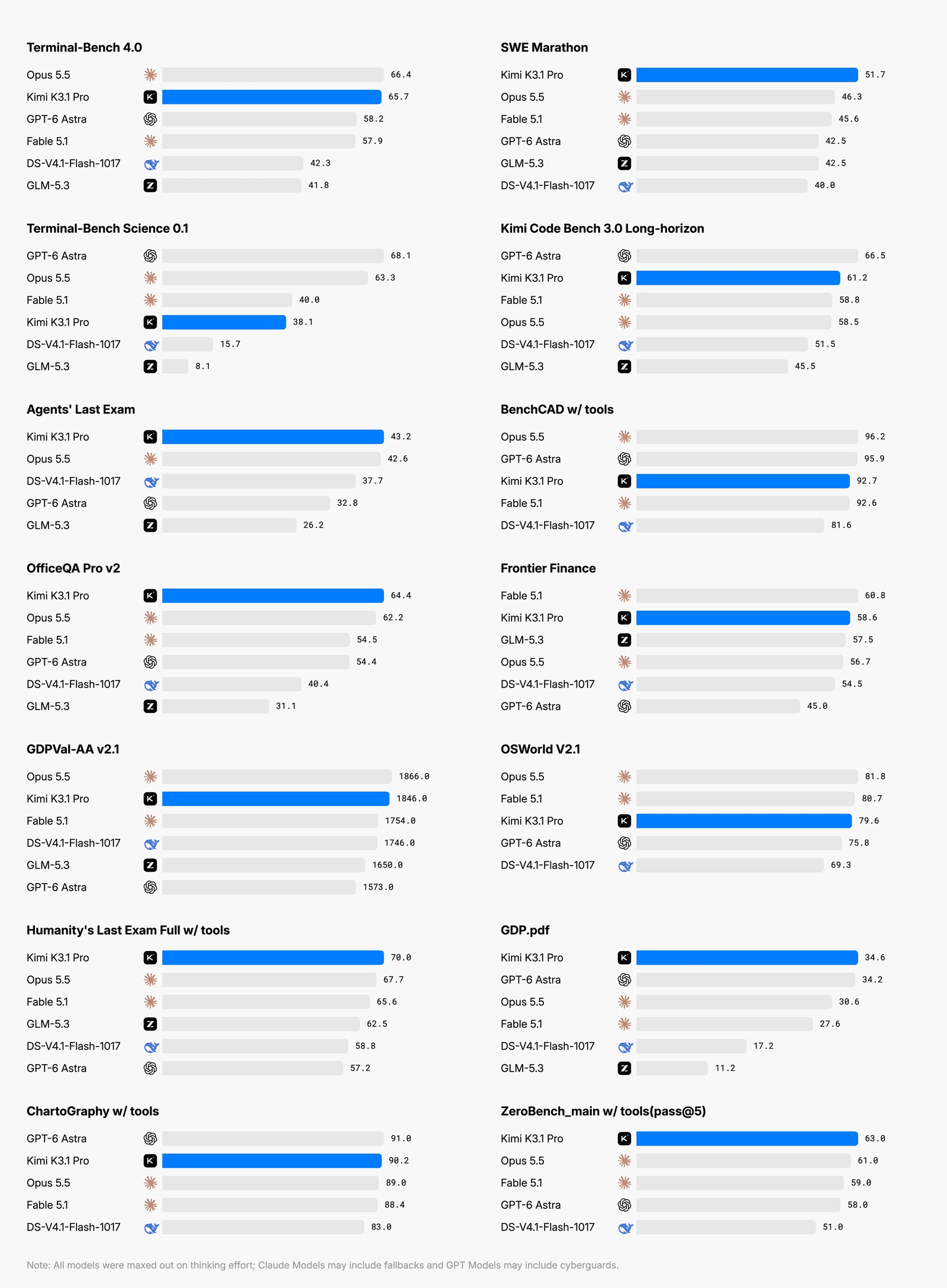
I pulled the table out of the JSON the page ships and ranked every row (measured from the page). With the three proprietary models as the comparators, 45 rows have at least one of their scores, and K3.1 Pro is ahead or tied on 16 of them. Counting all five comparators, it is first on 16 of 47 rows, and by category the picture is lopsided: first on 13 of 25 agentic rows, 2 of 10 coding rows, 1 of 9 knowledge-and-vision rows, and 0 of 3 cyber rows. The chart is a mild selection: K3.1 Pro is first in 6 of its 14 panels, against 10 of the other 33 rows (measured). Program Bench (31.5 against Opus 5.5's 65.0) and HLE-Diamond (39.4 against GPT-6 Astra's 65.8) are in the table and not the chart.
Toggle the comparators and categories to see which claims hold against which models:
Corrected 12 November. The model card carries the same 47 rows, and checking the widget's data against it found three rows that differed, and the Internet Archive's copies of the blog show that Moonshot revised the page twice (measured). On Agents' Last Exam, GPT-6 Astra was 32.8 and 38.8 in every copy from 23 October and 41.8 and 44.2 from 08:01 UTC on 24 October, so the CLI row is now a tie, not a lead. On APEX-Agents, K3.1 Pro was 67.2 and DeepSeek 63.4 in every copy up to 25 October; the card and today's blog say 69.4 and 69.8. The widget now uses the card's values. None of the three changes a tally above.
Four things in the footnotes change how much any single row says (all reported):
- Who ran what. K3.1 Pro was run by Moonshot at max effort, temperature 1.0, top-p 0.95, mostly in the Claude Code harness, but in Kimi Code for BioMysteryBench and Agents' Last Exam and in the Kimi Agent harness for OSWorld. Most comparator scores were copied from each lab's report or a public leaderboard, run in their own harnesses. Terminal-Bench 4.0, the headline row, takes "the maximum value reported in either their blog posts or the official Terminal-Bench 4.0 leaderboard" for everyone else.
- Fallbacks and guards. Every Claude column is labelled "max, with fallback" and the GPT-6 Astra column too. The chart note adds that "GPT Models may include cyberguards". Both are mechanisms that tend to lower a comparator's score, so if anything they cut against the comparators, not for them.
- Zeros assigned by Moonshot. On OfficeQA Pro the blog says some external models "retrieved reference answers online; Consequently, we assigned a score of zero to these tasks", and Agents' Last Exam zeroes runs that bypass the task. Both are defensible. Both are a lab adjudicating its competitors' transcripts.
- Internal rows. Kimi Code Bench 2.0 and 3.0, Business Operation, DECK-Arena, Design Bench, both Kimi Hallucination rows and xdev-bench-hard are Moonshot's own. Drop them in the widget and the agentic lead survives; it rests mostly on public benchmarks.
So "matching the strongest proprietary models" is true of agentic work with tools: browsing, document and office tasks, Agents' Last Exam, Automation Bench. Terminal-Bench 4.0 is the honest headline, 65.7 against Opus 5.5's 66.4 and GPT-6 Astra's 58.2, a near tie in a harness that is not Moonshot's. It is not true of closed-book knowledge, of the harder vision sets, or of Program Bench, where K3.1 Pro scores 31.5 and Opus 5.5 65.0. Artificial Analysis's index lands in the same place: K3.1 Pro at 55.1 sits between Opus 5.5 (Max) at 57.6 and GPT-6 Astra (Max) at 52.7 (third-party).
What the −65% counts
"Hallucination down by 65%" comes from one sentence in the blog: on "Kimi Hallu Bench Hard", "an internal benchmark designed to stress-test factual accuracy, its claim-level hallucination rate fell from 23.4% for K3 to 8.3%" (reported). That is a 64.5% relative drop (reasoned), which the post rounds to 65%. The same sentence gives the response-level number, which is less dramatic: "the share of responses containing at least one factual error was just 42.4% of its predecessor's rate", a 57.6% drop.
A claim-level rate means a model's answer is split into individual factual claims and each claim is checked; the footnote says the checking is done by "fact-checking agents". Two things follow. The rate depends on how the splitter counts claims, so a model that writes more small, safe claims looks better per claim than per response, which is why the response-level 42.4% is the more conservative figure. And the checker is an LLM agent, so the benchmark measures agreement with Moonshot's fact-checker, not with ground truth.
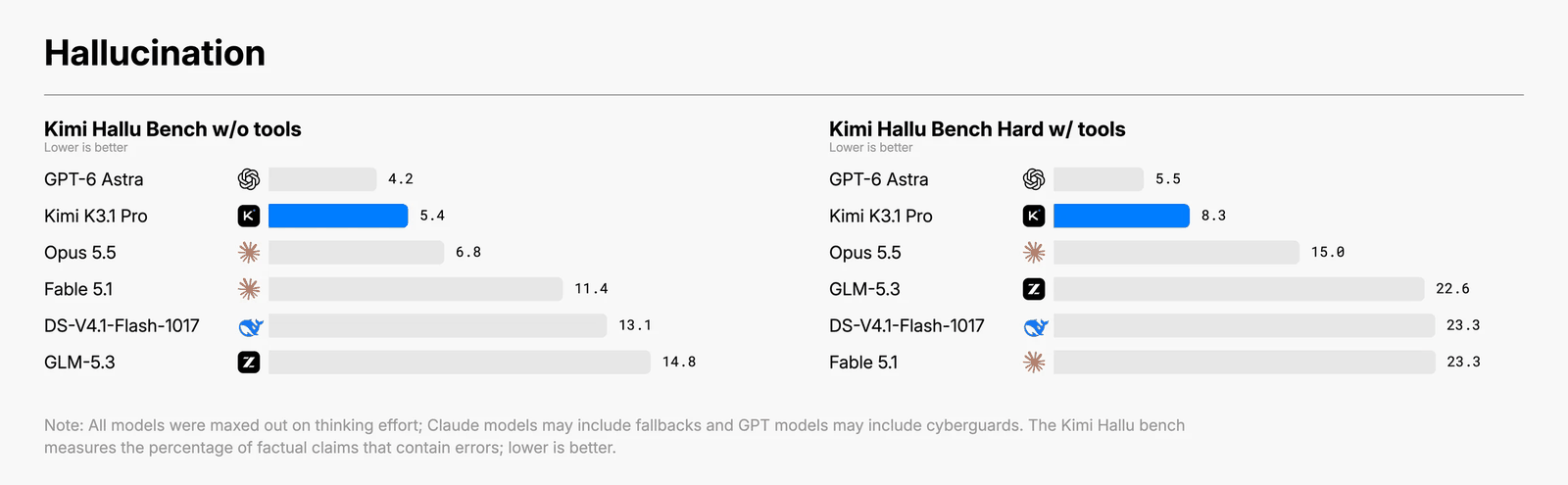
The blog is careful to say the rates "do not represent overall error rates in daily use". On its own chart GPT-6 Astra is lower than K3.1 Pro on both hallucination rows, 5.5 against 8.3 on the hard set.
The more interesting finding is on the API platform. The K3.1 Pro quickstart at platform.kimi.ai, read on 24 October,
carries what looks like an earlier draft of the blog. Its version of the same paragraph says the rate "fell from
23.35% for K3 to 6.85%", with the error-containing share at "46.4% of its predecessor's rate", and it describes the
set differently: "de-identified conversations where users had flagged factual errors in earlier models's responses"
(measured, from the page). The same page still has unfilled slots, [xx.x%] where the Terminal-Bench numbers go.
Two readings follow, both reasoned. The numbers moved between drafts, from a 70.7% drop to a 64.5% drop, so the published 65% is the more cautious of the two. And if the set really is built from prompts where users flagged errors in earlier models' answers, it is selected on the predecessor's failures. A model rerun on its own worst prompts regresses toward its average, so part of K3's 23.4% is the selection itself, and K3.1 Pro's drop overstates the improvement on a fresh sample. The published blog no longer says how the set was built, and it is internal, so I cannot check which description is current. The Hugging Face card, published 2 November, gives a third one: "an internal set of challenging, de-identified prompts drawn from practical work tasks" (measured, from the card). It does not mention flagged errors.
Highspeed: same price for a cache hit, double for everything else
Highspeed is the variant with the least explanation. The model list calls it "the high-speed variant of Kimi K3.1
Pro — same capabilities at about 2-3× the speed". Prices: $4.00 per million input tokens and $20.00 output, exactly
double the standard $2.00 and $10.00, with cached input unchanged at $0.20 (reported). OpenRouter lists it as a
second endpoint of the same model, tagged moonshotai/highspeed, with the same mxfp4 quantization and the same
943,718-token output cap (third-party listing). No tokens-per-second figure is published for either, and Artificial
Analysis does not list Highspeed yet. The 2–3× is unverified.
How would the same weights at the same precision go faster? The usual levers, none confirmed by Moonshot (reasoned):
- Smaller batches per replica. Decode for a big MoE is memory-bound: each step reads the active weights and the KV and KDA state once, whether it serves one sequence or many. Batching amortizes that read across users, which is what makes tokens cheap and each user slow. Serve fewer sequences per replica, or spread one replica over more GPUs, and each user's step gets shorter while each GPU's throughput falls. The GB300 decode article shows the trade on K3 itself: one user on 16 GPUs at batch 1 is a configuration chosen for speed, not for cost.
- Harder speculative decoding. K3 ships an EAGLE-3-style draft built from its multi-token-prediction layer. More draft tokens per step raise speed for one user and waste compute on rejected drafts, which also costs throughput.
Both cost GPU-time per token, which fits a doubled per-token price. The unchanged cache price fits too: a cache hit skips prefill, and the speed-up is in decode. That is consistent; it is not evidence.
The standard endpoint already moved. Artificial Analysis measures K3.1 Pro's median output speed at 77.1 tokens per second against 38.5 for K3 (Max), and its average time per Intelligence Index task at 609 seconds against 1,174 (third-party). That is about 2× on the regular endpoint before Highspeed enters (reasoned). On 24 October I put it down to a serving change or shorter reasoning, because the network was supposed to be the same. It is not quite: the indexer cuts what the 24 full-attention layers read per token at long context, and Artificial Analysis's tasks are long agent runs. Serving, shorter reasoning and sparse attention could each contribute, and the files cannot say how much each does (reasoned).
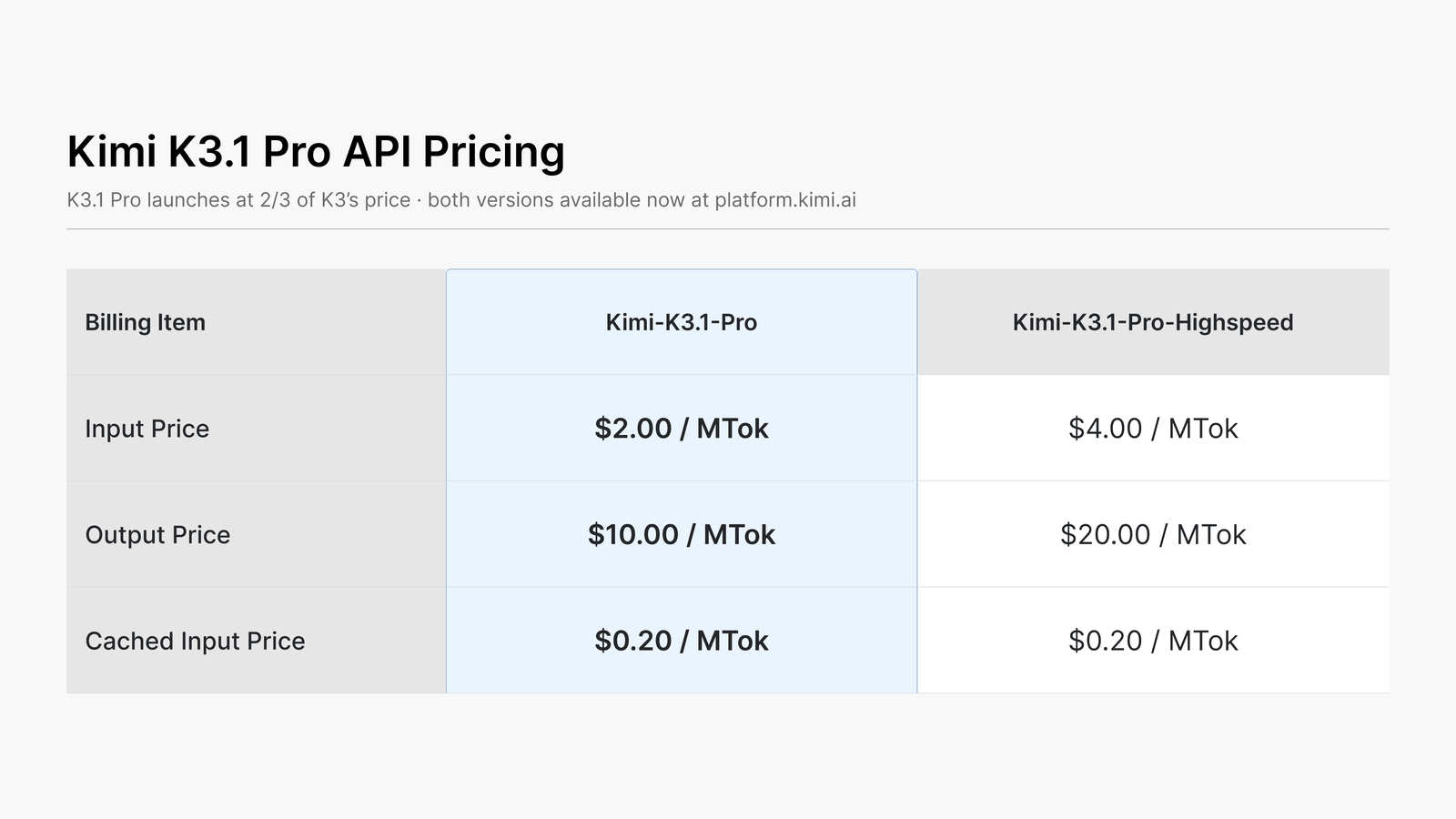
The Spider-Man demo, checked against list price
The demo that travelled with the launch was a post of a Spider-Man city game: "Kimi K3.1 Pro built Manhattan, added web swinging between skyscrapers, then threw in street combat. 8 hours. 3.8M tokens. Total cost: $34.72." Three things do not add up.
The arithmetic. At list price, 3.8M K3.1 Pro tokens cost between $0.76, if every token is a cache hit, and $38.00, if every token is output (reasoned). To land on $34.72 with nothing cached, 3.39M of the 3.8M tokens, 89%, must be output. On Highspeed it takes 1.22M output tokens, 32%, still with no cache hits. Neither looks like an agent session. Moonshot's own cyber table gives the mix of a long agentic trajectory: 159.8M input and 546K output tokens per successful xdev-bench-hard run, 0.34% output (reported). Artificial Analysis's runs of K3.1 Pro across its whole index used 5.39B input and 148M output tokens, 2.67% output, and 94% of input was served from cache; they cost $3,117 in total, about $0.56 per million tokens (third-party token counts and costs, my division). At that rate 3.8M tokens is about $2.14, and $34.72 buys about 62M tokens. One reply on the post makes the same point from experience, estimating an hour of agent work at ten to twenty million tokens. The post claims under half a million an hour.
The clock. The demo was posted at 18:36 UTC, 81 minutes after the 17:15 launch post (measured from the two posts' timestamps). Eight hours of building needs access from before the announcement. Early testers exist for most launches, so this is not impossible, but the post does not say so.
The provenance. The developer behind an earlier project, spiderbench, posted a similar browser Spider-Man city on 27 September, made with Claude Opus 5.5 using Blender, image generation and Three.js, and published its source and assets. He replied that the K3.1 Pro post is his project with new lighting, and says a community note was added. I compared the two clips frame by frame at 2 fps and found no identical frames: the repost is relit at golden hour and has no minimap (measured). That neither proves nor rules out a derived build, and I make no claim either way. What I can say is that the post's cost and token numbers are not consistent with each other at Moonshot's prices, so the demo is not evidence for K3.1 Pro's cost or ability. The blog's own examples, built "end to end by K3.1 Pro", are the ones to judge it by, and none of them comes with a token count either.
Cyber: capability removed on purpose
The cyber section is the part of the blog with the most actual numbers, and it is unusual enough to note. During development, Moonshot saw vulnerability-research scores rise steadily with post-training scale, traced the source to cyber content in the mid-training corpus and cyber tasks in the RL mix, and removed both for the open-weight release.
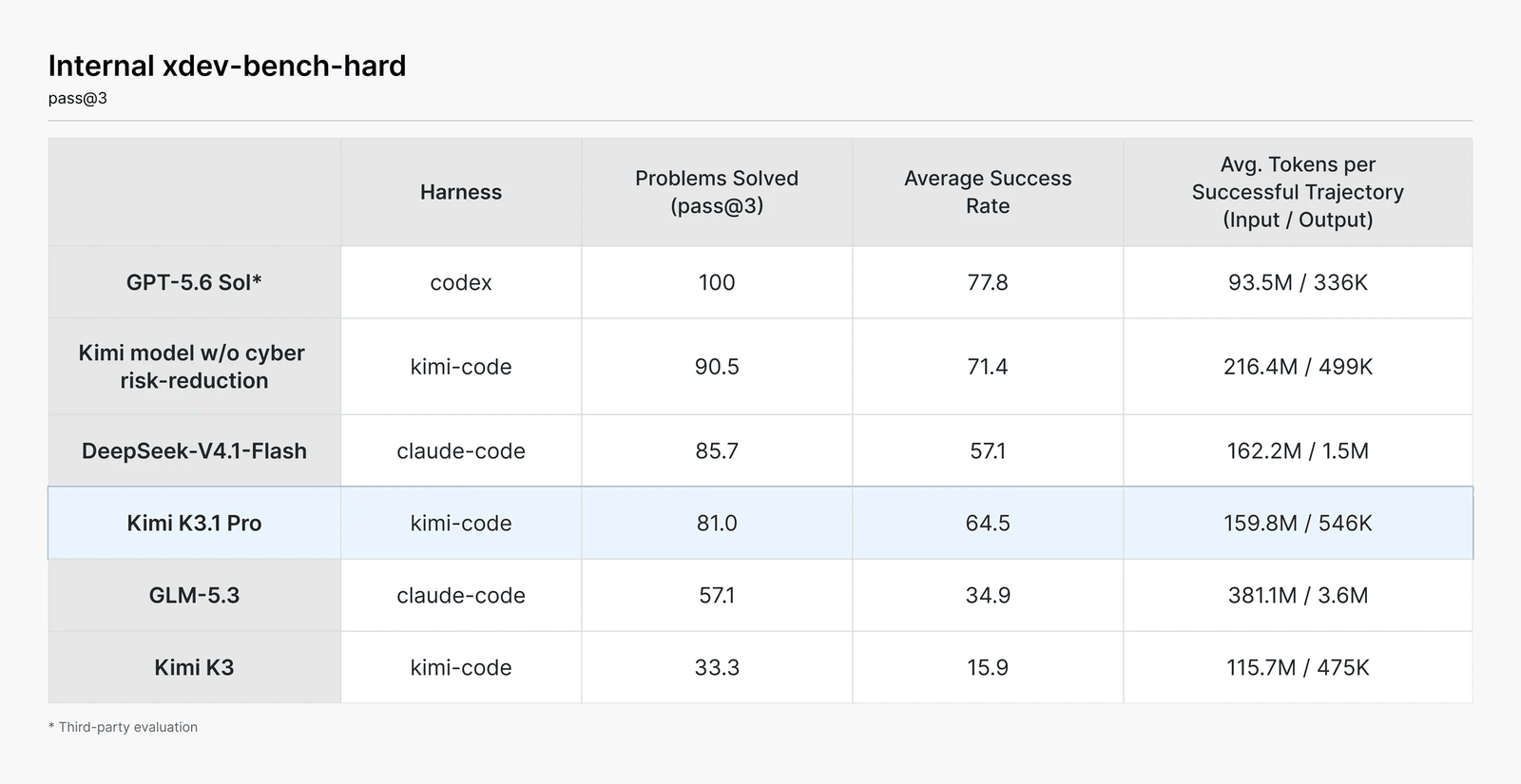
The same pipeline without the removal solves 90.5% at pass@3; the final K3.1 Pro solves 81.0%; K3 solved 33.3% (reported). So the removal cost about 9.5 points of exploit capability on Moonshot's own benchmark, while general coding gains still lifted it far past K3. On the public cyber rows, ExploitBench and ExploitGym, K3.1 Pro is fourth of five, behind all three proprietary models, which is what Moonshot says it is aiming for: open weights that do not "extend the absolute frontier of cyber capability". The tokens column doubles as a cost receipt for the previous section: a successful run is around 160M tokens.
The 24 October checklist, run on the weights
On 24 October I listed what the weights would settle when they landed. Here is that list, scored against the files the way the Le Chonk follow-up scored its own preview:
| 24 October said | The files say, 12 November | Result |
|---|---|---|
| Weights by 4 November | Initial commit on 2 November, 04:13 UTC (measured) | Held |
config.json matches K3's field for field | Same except model_type kimi_k31, the class name, auto_map, a dsa_config block, two ignore entries and the transformers version (measured) | Did not hold |
| Tensor names and shapes identical | K3's 497,220 identical; 120 indexer tensors added (measured) | Half held |
| Every shard's hash changes | 0 of 96 match K3's (measured) | Held |
| Licence: not named | "Kimi K3.1-Pro License" (measured) | Named; K3's terms |
TPU megakernel and kimi-k3-in-c load it unchanged if the config matches | The config does not match | Not checked |
The licence. It is K3's licence word for word, with "Kimi K3" changed to "Kimi K3.1-Pro" in the title and in the attribution clause (measured, diffed in full). An MIT-style grant to use, modify, fine-tune and sell, with two conditions. A business that offers model inference or fine-tuning as a service, where the customer controls inputs, parameters or training data, needs a separate agreement with Moonshot before any commercial use once its group's revenue passes $20 million over any 12 months. And a commercial product with more than 100 million monthly active users, or more than $20 million in monthly revenue, must show "Kimi K3.1-Pro" prominently in its interface. Internal use, and use through Moonshot's own products or certified inference partners, are exempt from both. I am not a lawyer; the boundary of "Model as a Service" is the line to take advice on.
Local speed. Highspeed did not ship, as expected: the repository holds one checkpoint, and Highspeed is a way of serving it. The TPU megakernel and kimi-k3-in-c were written for K3's dense MLA layers, so the condition I gave was false. To run K3.1 Pro they need an indexer path, or they attend densely and ignore it, which for contexts past 2,048 tokens is not the attention the card describes (reasoned). I have not checked whether either project has added one.
The released card, as the site's snapshot recorded it:
- architecture
- KimiK31ForConditionalGeneration
- task
- image-text-to-text
- library
- transformers
- license
- other
- safetensors
- 96 shards
- largest file
- 16.99 GB
- files
- 112
- downloads
- 70.5K
- likes
- 2.4K
repo last modified 2026-11-05
Three days after release, vLLM published Kimi-K3.1-Pro-pruned75, which keeps 224 of the 896 experts in each layer.
That article reads its headers and every router against these weights, and counts
the same 2,780,110,363,392 parameters across 92 MoE layers.
The take
K3.1 Pro is the clearest case yet of a lab shipping a new flagship with almost no new network. The experts, the KDA layers, the 1M window and every one of K3's tensor shapes carry over. The one structural change, a sparse-attention indexer in the 24 full-attention layers, is in the model card and the files and not in the launch blog. Around it: an implied mid-training rerun with cyber data removed, and a large, unquantified increase in RL. What that buys is real but narrow: K3.1 Pro leads on agentic, tool-using work and finance-flavoured document tasks, nearly ties Opus 5.5 on Terminal-Bench 4.0, and still trails the proprietary models on closed-book knowledge, harder vision sets, Program Bench and, by design, cyber. It costs a third less than K3 and the standard endpoint runs twice as fast.
The −65% is a real number from an internal stress test, measured per claim by an LLM fact-checker, and the per-response figure is 58%. An earlier draft of it, still live in the API docs, said 71% and described a set selected on earlier models' failures. And the demo is not a measurement of anything: its tokens and its price cannot both be right at Moonshot's own rates.
Sources: the Kimi K3.1 Pro tech blog (benchmark table and footnotes, finance,
hallucination and cyber sections; figures 1-3 here are its charts), Moonshot's
launch thread (figure 4), the Kimi API
pricing page, model list and K3.1 Pro quickstart, OpenRouter's endpoint
listing for moonshotai/kimi-k3.1-pro, and Artificial Analysis's model page
(speed, index, token counts and run cost), all read on 24 October 2026. The architecture figure is from the
Kimi K3 technical report. Tallies are mine, computed
from the table the blog page ships; the widgets use the same data. Updated 12 November from the Hugging Face
repositories moonshotai/Kimi-K3.1-Pro (commit d9e99b07) and
moonshotai/Kimi-K3: config.json, LICENSE, the model cards, the
Hub API's parameter counts and file hashes, and all 96 safetensors headers of each by HTTP range request, no weights
downloaded. The blog was reread the same day, and its 24 October version read from the Internet Archive.