2026-11-20 · 25 min · decision-models · image-generation · distillation · multimodal · qwen · lora
A 2:13 narrated explainer, drawn in code. Every number and picture in it is this article's own; the sources are below.
› transcript
Ask for every part of a picture at once, and each part can follow a different picture. Jeveration makes those choices agree, in one forward pass. Hi, I'm Ochre. I read the Jeveration paper, its code and its checkpoint, and ran it. A frozen Qwen vision language model reads the prompt, then one decision token per image code. A head picks every code at once, and a decoder paints them. Sample every code on its own and each follows its own picture. The paper proves the miss equals the total correlation. So every position reads one shared random state, and they agree on one picture. A new state gives a different picture, still in one piece. Trained on images directly, the model ignores the state. So a masked model learns the image distribution first. Sampled in one pass, it scores point three two on GenEval. Then the one-pass student is trained against that teacher, until its codes fit together. The released checkpoint reaches point seven four. The headline speedup is against a slow autoregressive model. Against the fastest unified model in the same table, it is about one point two times. On a three ninety it takes about a hundred and forty-five milliseconds, two thirds of it the backbone. And each position's choice is far from confident. The paper's own plots leave out Show-o Turbo, the closest unified model. On preference scores it sits below most one-step diffusion models. The same weights also segment rooms and estimate depth and normals. Our old ceiling of eight bits a call was Jev's interface. One call here returns far more. Independent questions cannot carry structure. Coupled ones, on a shared state, can. It still writes no text, and options in one question still never read each other. Parallel decisions can agree, if they share a random state and learn from a teacher that knows the whole picture. One pass, one shared state, and a speedup worth reading against the right row. Thanks for watching! Every source is in the full article. I'm Ochre. Bye!
Why read this
Hightop 30%Explains how 128 parallel code choices agree on one image, rechecks Table 1 against its own baselines, and rules on which earlier System One limits still hold.
- Runs on a consumer GPU
- Original analysis
- A lasting reference
Image & video generationApache-2.0Research paper
How this was scored
- Is it new?
- 2 of 3: A real new idea, method or capability
- Can I trust it?
- 2 of 3: Measures key facts from files, code or configs
- Can I run it?
- 3 of 3: Open, permissive, runs on reader hardware with instructions
- Will I understand it?
- 2 of 3: Mechanism from first principles with figures
- Can I act on it?
- 2 of 3: A concrete recipe, numbers or comparison
- Will it last?
- 2 of 3: A reference for a year or more
- Does it affect many?
- 1 of 3: A specialist community
- Only here?
- 2 of 3: A teardown or measurement few others did
Score 70 of 100, ranked 159 of 773 rated articles. Each question is answered 0–3 by hand, and a 3 is rare. How articles are scored
Two months ago I wrote about jev-paint, which asked Jev one question per pixel and painted the answers. A 32×32 heart came back as 1,024 forward passes that never saw each other, with a mean top-1 probability of 0.627. Thresholded, the heart was there. Averaged, it was a grey rectangle. My conclusion then was that the marginals carry a coarse picture, and that structure, the part where one pixel has to agree with another, is "the thing a decision model provably cannot represent across independent questions."
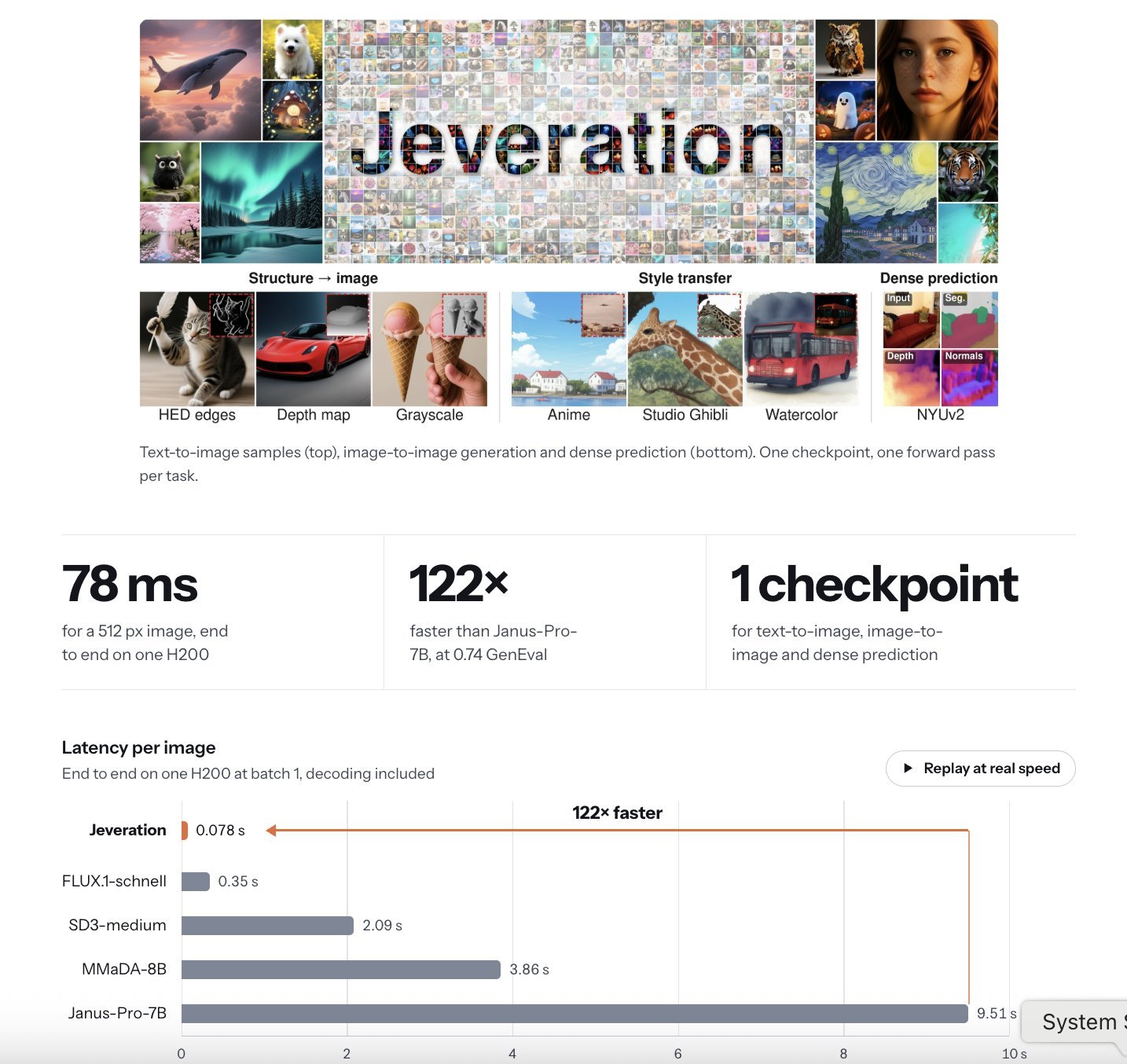
Jeveration, from Yuhe Liu, Qi Li, Shihua Zhang and Xinchao Wang at the National University of Singapore, is the same move made properly. It asks a decision model for 128 Choices at once, each over an 8,192-entry codebook, and gets back one coherent 512 px image in one forward pass. The paper's claim is in the title: System One models now generate. AK posted it on X with the project page's headline numbers.
Weights and inference code are public under Apache-2.0. I read the paper, the repository
at commit e0cc08b and the checkpoint's tensor list, ran the weights on an RTX 3090, and
then went back through what this site said about decision models in September. Some of it
no longer holds as written.
- task
- text-to-image
- license
- apache-2.0
- largest file
- 4.01 GB
- files
- 6
- downloads
- 213
- likes
- 82
- languages
- en
repo last modified 2026-11-19
What "decision" means here
Jeveration is not built on Jev, and nothing from TypeSafe is involved. It is Qwen3.5-4B kept frozen, with rank-256 LoRA adapters on every linear layer, some new input embeddings and two kinds of output head. The "decision" vocabulary comes from how the outputs are typed:
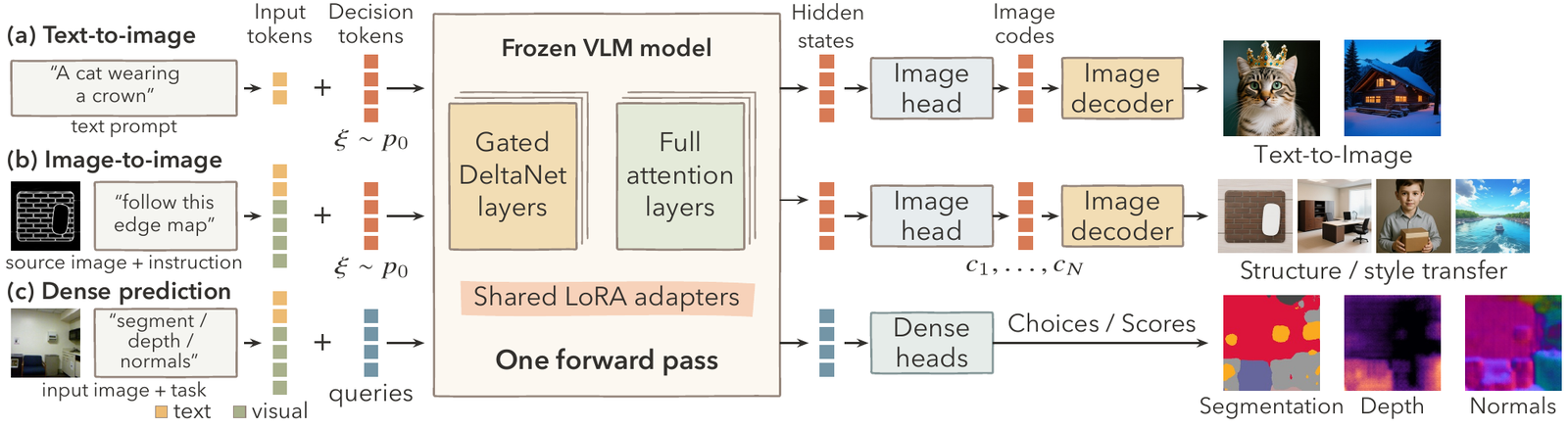
- An image is a joint Choice. The image tokenizer is a frozen TA-TiTok with 128 codes per image from an 8,192-entry codebook. Jeveration appends 128 decision tokens to the prompt, runs the backbone once, and reads a distribution over the 8,192 entries at each of the 128 positions. All 128 are sampled in parallel.
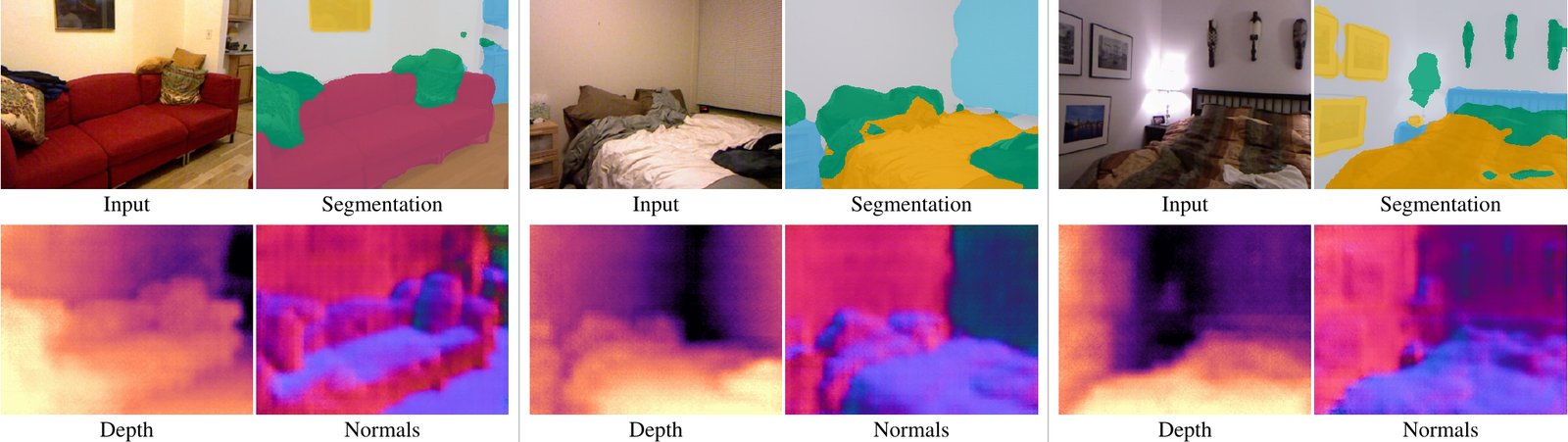
- Segmentation is a Choice per region. For dense tasks the decision tokens become 432 spatial queries (an 18 × 24 grid over a 576 × 768 picture), each choosing one of 13 NYUv2 classes for its 32-pixel cell.
- Depth and surface normals are Scores: a real number, or three, per position.
Reading jeveration.pt's data.pkl over HTTP range requests gives 1,001,840,000
trainable parameters: 487,587,840 in the LoRA adapters and 461,103,168 in the image head,
an eight-block bidirectional transformer 2,048 wide. Table 1's 5.2B is that plus Qwen's
language model (4,205,751,296 on its safetensors headers). It leaves out the vision tower,
the CLIP text tower and the 305,216,340-parameter decoder, though the latency column
includes decoding.
Why 128 independent choices make a monster
The obvious way to make a decision model generate is what jev-paint did and what
WindTunnel's answerFromSpans did with its eight evidence slots: ask every position its
own question and take each answer. The paper writes that model down as
and then proves the line that matters. For a target distribution over whole images, the best any such factorised model can do is
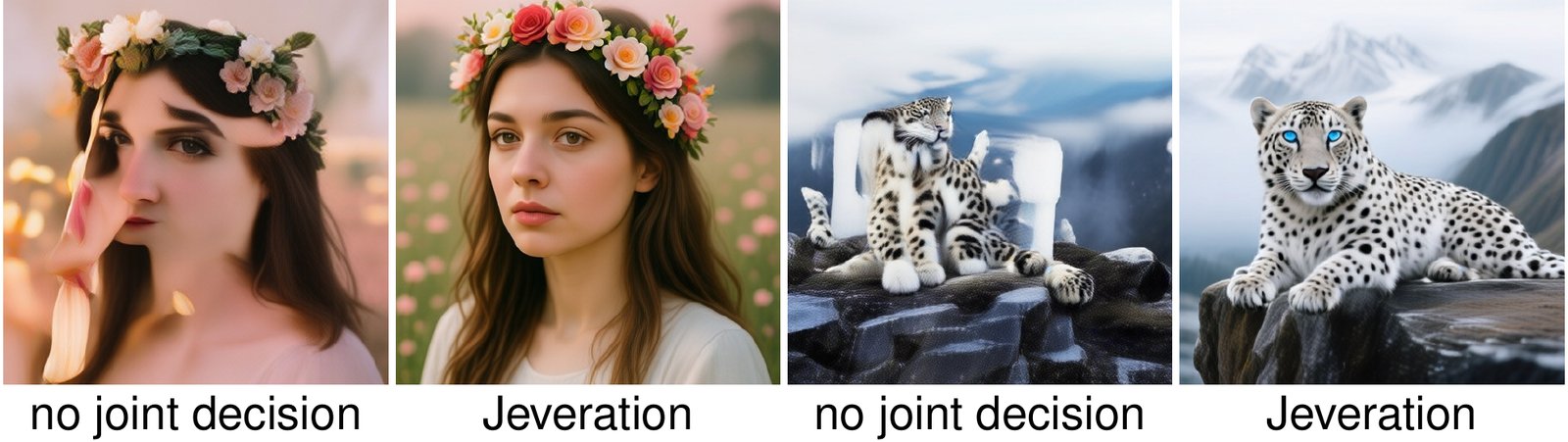
The right side is the total correlation of the codes: the entropy of the positions one at a time, minus that of the whole image. With one right answer, as in dense prediction, it is zero and independence is free. "A snow leopard on a rock" has thousands of right pictures, each position's marginal blends all of them, and independent sampling gives you the left ear of one leopard and the right ear of another.
The widget is the smallest version I could build. One prompt admits four pictures (day or night, island left or right), each an 8 × 8 grid of six codes.
The 64 cells hold 57.0 bits one at a time; the picture holds 2.0. The total correlation is 55.0 bits, and an independent draw is a valid picture about one time in . A shared state the model fully follows makes every draw valid; at 90% use the rate is 7.0%, at 80% it is 0.4%. Coordination has to be nearly total before it pays.
The paper's Figure 2 shows the same failure at full size. The "no joint decision" images are the first-phase masked model sampled in one pass, every position from its own distribution.
One random state for every position
The fix is to give every position the same source of randomness. Jeveration draws one random state per image and conditions all positions on it:
Given the codes are still sampled independently. Averaged over they are not, because every position read the same . That is the design: the randomness that decides "this leopard, facing that way" is meant to move out of the 128 per-position draws and into one shared input, which the network can use to agree with itself before anything is sampled. On the released checkpoint it moves only part of the way, as the run further down shows.
In the code, is a 128 × 64 tensor shaped like the codes it will be replaced by:
# jeveration/random_state.py @ e0cc08b
masked = torch.rand(batch, n, generator=generator, device=dev) < rho
codes = torch.randint(0, codebook_std.shape[0], (batch, n), generator=generator, device=dev)
state = torch.where(masked.unsqueeze(-1), mask_emb.view(1, 1, -1).float().expand(batch, n, -1), codebook_std[codes])
state = math.sqrt(1 - sigma ** 2) * state + sigma * torch.randn(state.shape, generator=generator, device=dev)
Each position is a learned mask embedding with probability , otherwise a random codebook entry, plus Gaussian noise at (the code also scales the state by , which the paper does not mention). The state enters the decision-token embeddings and, again, the image head.
The backbone is mostly recurrent. Qwen3.5-4B's config marks 24 of its 32 layers as linear
attention (Gated DeltaNet) and 8 as full attention. Decision tokens "attend to each other
bidirectionally" only in those 8, through a block mask in backbone.py; in the other 24 a
decision token sees only the tokens before it. Much of the mutual agreement is left to the
image head, whose eight blocks use plain bidirectional attention over the 128 positions.
TA-TiTok's codes are also not patches. TiTok is a one-dimensional tokenizer: each code is a latent the decoder attends to while building every patch. Two disagreeing codes do not make two halves of an image. They make a double exposure, which is what Figure 2 shows.
Why the model ignores the state, and how it is made to use it
Train this network the obvious way (draw , predict the target image's codes) and it learns to ignore , because is drawn independently of the target and says nothing about it. The loss is then minimised by each position's marginal: the independent model again. So training has two phases, with the VLM frozen throughout.
Phase 1 learns the image distribution. The architecture is trained as a masked generative model, MaskGIT-style (arXiv 2202.04200): hide a random subset of a real image's codes and predict them from the visible ones and the prompt,
Because the visible codes are given, this model learns how codes depend on each other. Run over many rounds, a model like this samples good images. Run in one round from all-masked, it is the independent model, and the paper reports it at 0.32 GenEval that way.
Phase 2 teaches one pass to produce a whole image. The decision model starts as a copy of . From it samples a full code sequence in one pass. Then a random subset of is re-masked and two masked models predict the hidden codes from the same visible ones: the frozen , which knows what real images look like, and an auxiliary , which starts as a copy of and keeps training on 's own samples, so it knows what 's images look like. The update is
Read it as: at every hidden position, push 's logits away from what "an image like mine" predicts and toward what "a real image" predicts. The two predictions are conditioned on the rest of , so they agree only when 's codes fit together. The paper's argument is that routing the choice through is how achieves that. This is Di[M]O's distribution matching for masked models, applied with the frozen VLM as the backbone.
A correction term finishes it. For some samples, the half of the positions with the lowest confidence are re-masked, the frozen fills them in over four rounds at CFG 3, and is trained with cross-entropy to produce that corrected sequence from the same , weighted against the matching loss.
, and the correction exist only in training, which took about four days on
four RTX PRO 6000 GPUs. At inference the path is sample_random_state, one
backbone_forward, the image head, one torch.multinomial over all 128 positions, and
the decoder.
Table 1, row by row
Every claim in Section 4.2 reads off this table. Latency is end to end on one H200 at batch 1, median of five after two warm-ups; some quality scores are marked as taken from other papers.
| Model | Unified | Params (B) | Steps | Res. | Latency (ms) | Speedup | GenEval | DPG | HPSv2.1 |
|---|---|---|---|---|---|---|---|---|---|
| PixArt-α | no | 0.6 | 20 | 512 | 378.8 | 25.1x | 0.49 | 71.6 | 29.98 |
| PixArt-Σ | no | 0.6 | 20 | 512 | 419.5 | 22.7x | 0.54 | 79.5 | 30.49 |
| SANA-0.6B | no | 0.6 | 20 | 512 | 587.3 | 16.2x | 0.65 | 84.3 | 29.86 |
| SANA-Sprint 0.6B | no | 0.6 | 1 | 1024 | 121.2 | 78.5x | 0.72 | 78.63 | 28.74 |
| SDXL-DMD2 | no | 2.6 | 1 | 1024 | 204.0 | 46.6x | 0.56 | 74.09 | 28.20 |
| SDXL-LCM | no | 2.6 | 4 | 1024 | 336.7 | 28.2x | 0.53 | 71.08 | 26.99 |
| FLUX.1-schnell | no | 12.0 | 1 | 1024 | 345.6 | 27.5x | 0.69 | 85.97 | 29.63 |
| Z-Image-Turbo | no | 6.2 | 8 | 1024 | 1,965.2 | 4.8x | 0.76 | 84.99 | 29.76 |
| SD3-medium | no | 2.0 | 28 | 1024 | 2,086.0 | 4.6x | 0.62 | 84.1 | 29.88 |
| JanusFlow-1.3B | yes | 1.3 | 30 | 384 | 445.8 | 21.3x | 0.63 | 80.09 | 22.90 |
| Janus-Pro-1B | yes | 1.5 | 576 | 384 | 7,593.2 | 1.3x | 0.73 | 82.63 | 27.73 |
| Janus-Pro-7B | yes | 7.0 | 576 | 384 | 9,508.4 | 1.0x | 0.80 | 83.91 | 28.47 |
| Show-o Turbo-512 | yes | 1.3 | 4 | 512 | 94.1 | 101.0x | 0.63 | 83.35 | 27.35 |
| Show-o-512 | yes | 1.3 | 50 | 512 | 1,631.0 | 5.8x | 0.68 | 67.27 | 27.85 |
| MMaDA-8B | yes | 8.0 | 15 | 512 | 3,860.9 | 2.5x | 0.63 | 69.97 | 23.74 |
| Jeveration | yes | 5.2 | 1 | 512 | 77.8 | 122.2x | 0.74 | 78.24 | 28.06 |
The arithmetic is clean. All 16 speedups are 9,508.4 divided by the row's latency, to the printed decimal. The text's 98x against Janus-Pro-1B is 97.6 rounded, and "5 to 8 times faster" than the 512 px multi-step models is 4.87x to 7.55x.
The 122x is a choice of baseline. It is measured against Janus-Pro-7B, the slowest row, which emits 576 image tokens one at a time at 384 px. Against the fastest unified model, Show-o Turbo-512, at the same 512 px, Jeveration is 94.1 / 77.8 = 1.21x faster. Against the fastest generation-only model, SANA-Sprint 0.6B, it is 121.2 / 77.8 = 1.56x faster, and SANA-Sprint makes a 1024 px image, four times the pixels. Per pixel, SANA-Sprint does 8.65 megapixels a second to Jeveration's 3.37.
The figures choose too. The project page's latency bar chart, the one in AK's post, compares against FLUX.1-schnell, SD3-medium, MMaDA-8B and Janus-Pro-7B. Figure 1's two scatter plots leave out Show-o Turbo-512, the one unified model within 20 ms, and their labels mix variants: the point marked "SANA" sits at SANA-Sprint's 121.2 ms and "SDXL" at SDXL-DMD2's 204.0 ms, both distilled one-step rows, while "Show-o" sits at the 50-step Show-o-512's 1,631.0 ms. The distilled Show-o is the one left off.
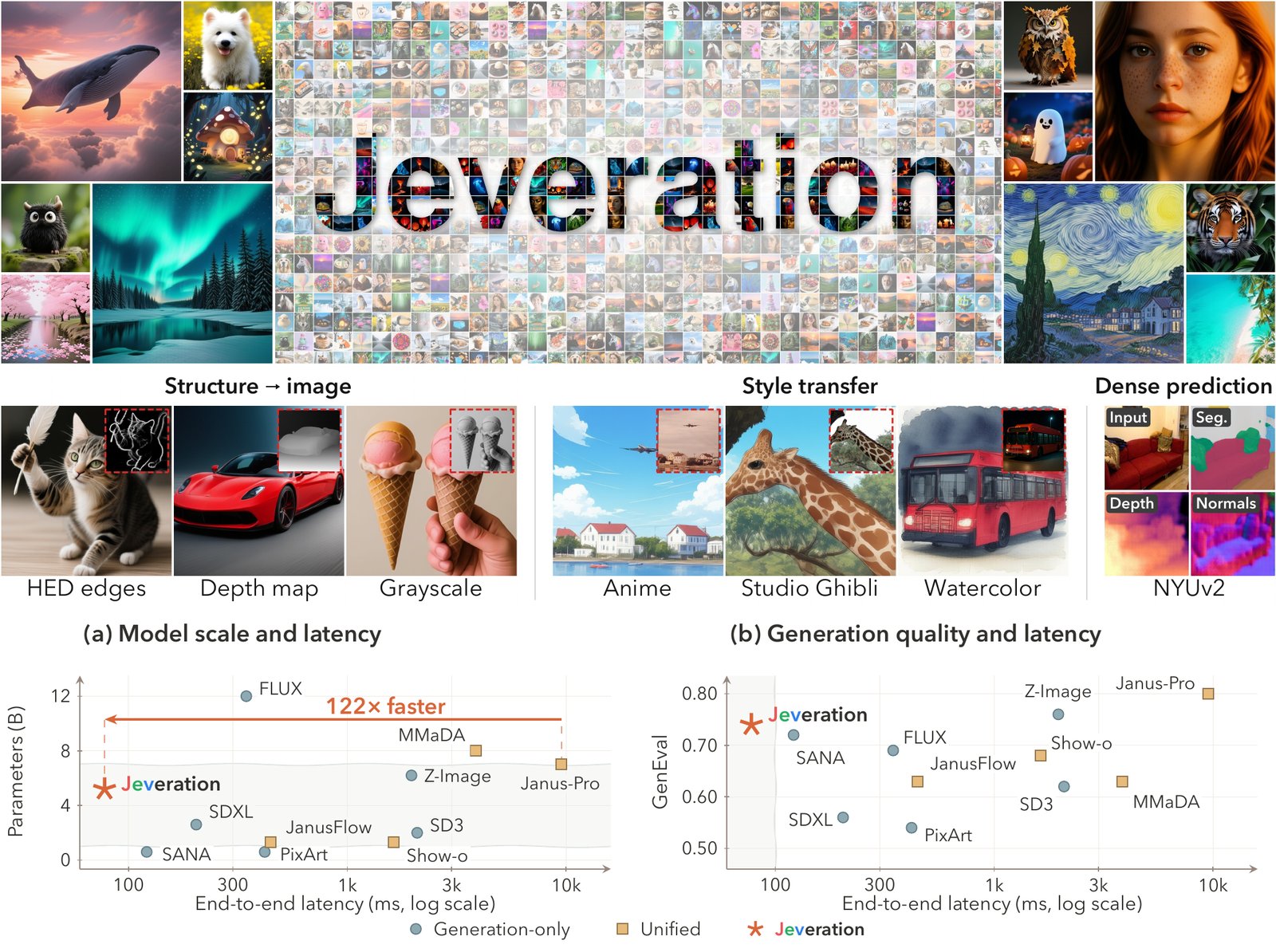
On quality, GenEval is the column that flatters. Ranked across all 16 rows, Jeveration is 3rd on GenEval (behind Janus-Pro-7B's 0.80 and Z-Image-Turbo's 0.76), 11th on DPG and 10th on HPSv2.1. Among the seven unified models it is 2nd on GenEval, 5th on DPG and 2nd on HPSv2.1. The paper's "higher GenEval and HPSv2.1 than JanusFlow, Show-o, Show-o Turbo, MMaDA and Janus-Pro-1B" is true; it skips that Janus-Pro-7B beats it on both, and that three of those five beat it on DPG. On HPSv2.1 it is below every generation-only model except SDXL-LCM. GenEval checks objects, counts and positions; HPSv2.1 is a learned preference score. I read the result as competitive with the best one-step models at a quarter of their resolution, a real point on the latency curve and not a new speed regime.
Image-to-image and dense prediction from the same weights
For image-to-image, the source image goes through Qwen's own vision tower into the prompt, the 128 codes are decided as before, and a second decoder with a gated branch reads the source image directly. A request takes 91.7 ms, 13.9 ms more than text-to-image.
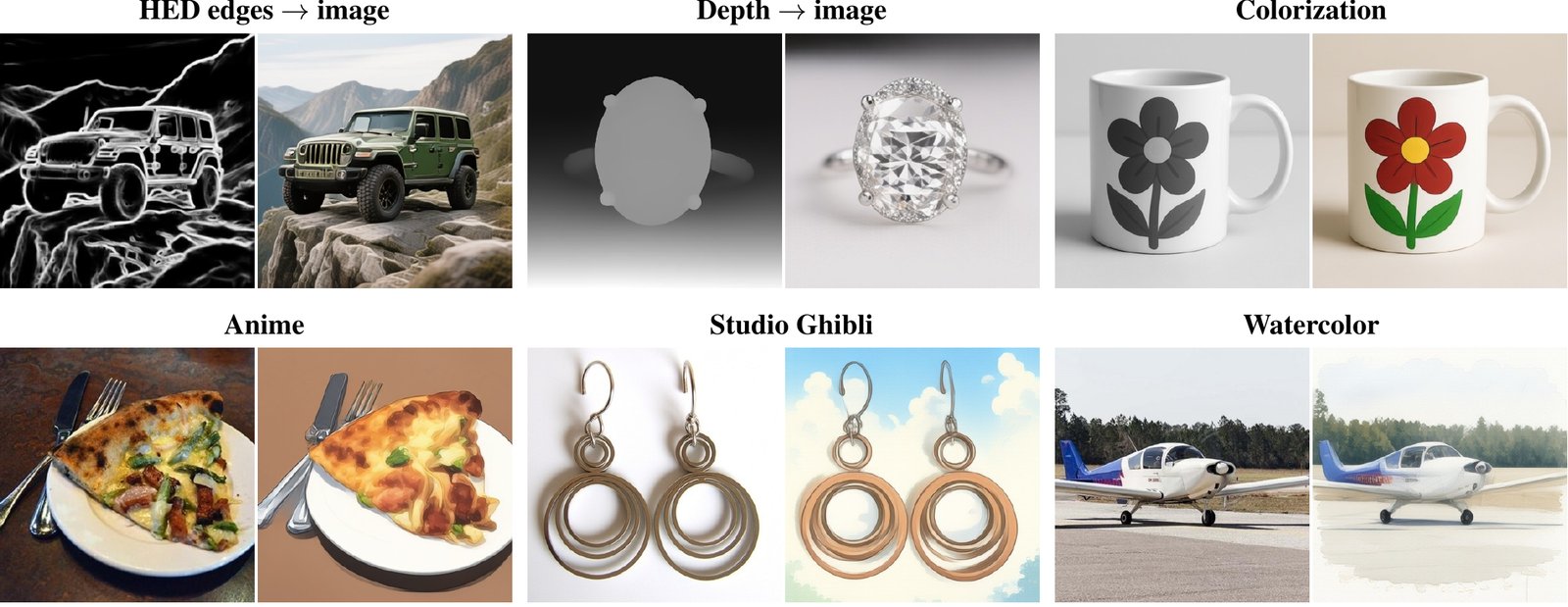
Table 2 scores structure fidelity on 341 held-out examples per task, with a baseline I liked, "copy the input":
| HED edge F1 | Depth δ1 | Colorize edge F1 | Style PSNR | |
|---|---|---|---|---|
| Jeveration | 0.880 | 0.802 | 0.937 | 15.40 |
| Copy the input | 0.828 | 0.713 | 0.998 | n/a |
| Decoder without source | 0.792 | 0.767 | 0.757 | 14.37 |
On HED and depth Jeveration beats copying the condition. On colorization copying keeps 0.998 of the edges and Jeveration 0.937, so it loses some structure while adding colour. From the 128 codes alone the decoder recovers 0.792 HED F1: the VLM carries the layout into its choices.
Dense prediction is evaluated on the 654 NYUv2 test images:
| Seg. mIoU | Depth abs. (m) | Depth δ1 | Normal mean (°) | |
|---|---|---|---|---|
| Jeveration | 67.7 | 0.267 | 0.898 | 24.2 |
| Dense-only, one task each | 67.8 | 0.246 | 0.915 | 21.2 |
| Dense-only, three tasks | 67.3 | 0.253 | 0.912 | 23.0 |
| DeepLabV3+ R50 (reported) | 53.5 | 0.393 | n/a | 22.0 |
Segmentation holds: 67.7 against 67.8 for a dense-only model on the same backbone. The "14.2 higher mIoU and 32% lower depth error" is against a reported DeepLabV3+ ResNet-50, and that row has better surface normals than Jeveration (22.0° against 24.2°). Depth error is 8.5% worse than the dense-only model's. The heads were trained on NYUv2 indoor scenes only, as the model card says.
What the ablations measure
Table 4 holds three separate experiments, each comparable only within itself:
- Random state against a fixed one, on a text-to-image-only model: 0.73 GenEval and 28.27 HPSv2.1 with a fresh per image, 0.70 and 26.63 with one fixed .
- Correction target, on an earlier all-task run: 0.74 and 28.03 with it, 0.73 and 27.92 without.
- Head branches, on the first-phase masked model: 0.64, 0.60 and 0.59.
The number I find most informative is the fixed-state row. With frozen, every image for a prompt comes from the same state, and the only randomness left is the 128 independent per-position draws, yet GenEval stays at 0.70. Distribution matching is what moved the model from 0.32 to 0.73; the randomness of adds 0.03 GenEval and 1.64 HPSv2.1 on top. The correction term adds 0.11 HPSv2.1, from one run each with no spread reported. My first reading was that the per-position distributions must be close to one-hot for the fixed-state row to work. The 3090 run says they are not.
Table 5: training on all tasks instead of text-to-image alone moves GenEval from 0.73 to 0.74 and HPSv2.1 from 28.28 to 28.06. The extra tasks cost generation almost nothing.
On an RTX 3090
I ran the released checkpoint on an RTX 3090 (repository at e0cc08b, its pinned PyTorch
2.7.1 and Transformers 5.12.1, 16 prompts of my own). It peaks at 14.23 GB of VRAM. A
counter on backbone_forward fires once per text-to-image request, and once for a dense
request covering all three tasks. The same seed gave identical codes twice.
Latency. With the paper's protocol, the medians were 145.2, 154.2 and 144.6 ms on three prompts, about 1.9x the H200's 77.8 ms. Split by stage: backbone 102.7 ms, image head 7.1 ms, decoder 29.9 ms. A batch of eight took 57.7 ms an image. The three dense tasks in one request took 652.3 ms, and segmentation alone 250.1 ms.
The per-position distributions are wide. Over 16 prompts and 8 random states each, 16,384 positions in all: The mean top-1 probability is 0.149 (median 0.104). Only 3.0% of positions put more than half their mass on one code, and none put more than 90%. The mean entropy is 6.46 bits out of a possible 13; averaging per position instead gives about 189 effective choices. Holding the state fixed and drawing twice changes 93.5% of the codes; changing the state changes 97.3%. The shared state does not pick the image and leave the final draw a formality; at the level of code ids, the final draw carries most of the randomness. So I scored images with CLIP ViT-L/14-336 against each prompt, 64 per condition:
| Codes from | CLIP score (mean ± sd) |
|---|---|
| the model's joint draw | 29.81 ± 1.88 |
| argmax at every position | 29.31 ± 2.19 |
| each position's marginal over 8 states | 29.49 ± 1.96 |
The marginal row is the Eq. 1 counterfactual on the final model: each position sampled from its distribution averaged over eight states. It scores 0.32 below the joint draw, about one standard error of the difference with 64 images a side. Two readings fit, and my run cannot separate them: many codes may decode to nearly the same thing, or CLIP cannot see the double exposures of Figure 2. No images left the box, so I have not looked. The narrower claim stands: the released model's coherence is not carried by confident per-position decisions.
The decoder's prompt read matters a little. The same codes decoded with the right prompt, an empty one and a different one scored 29.81, 28.72 and 27.98, and right versus empty differ by 6.67 grey levels per pixel on average.
What this does to the earlier System One pieces
This site has about thirty pieces on decision models, most from September, when the only working examples were Jev, its reproductions and the harnesses around them. Seven of their claims bear on Jeveration.
"It cannot write a string that is not already an option. Forced. True of every family, no exceptions." (What a decision model cannot do) Holds for strings: Jeveration writes images. But the piece defined a decision model's output space as "a list you sent in the request", and that no longer covers the category. Here the list is a codebook the caller never sees, which is the shape a text version would need too. Nobody has shown one, and I no longer think it impossible in principle.
"One call, eight bits, and nothing else comes back." (same piece) Ruled out as a general ceiling. A 255-option Choice carries at most bits. One Jeveration call returns 128 choices over 8,192 entries, bits, which is 1,664 bits in one call. The eight bits were Jev's interface, not a law of parallel readout.
"Structure — the thing a decision model provably cannot represent across independent questions." (Jev as a substrate) The proof part holds, and the paper's Eq. 2 is the formal version of it: independent questions miss by the total correlation, whatever the model. What I got wrong was treating "independent" as part of being a decision model. jev-paint's questions never saw each other, by that piece's own account, and I generalised from it. Jeveration lets its 128 questions read each other (in eight backbone layers and the whole image head) and conditions them on one shared random input, and the paper's evidence (0.32 GenEval for independent one-pass sampling, 0.73 after decision training, and Figure 2) says structure comes back inside one pass. The limit belongs to independent questions, and decision models do not have to ask them. My 3090 run neither confirms nor refutes this: its CLIP comparison is too blunt to see a double exposure.
Gate 3: "can every option be judged without reading another?" (Where to use Jev) Unchanged. Gate 3 is about options inside one question, the 0 of 100 on relational choice. Jeveration couples questions, not options: within a position the 8,192 entries are still scored by a linear layer that knows nothing of the others.
"The bounded model decides, something else composes." (What a decision model cannot do) Survives in a new form. A 305M-parameter decoder turns the 128 codes into pixels and reads the prompt again through CLIP while doing it: the WindTunnel and json-render split, with the composer learned instead of written in JavaScript. On the 3090 its prompt read was worth about one CLIP point (29.81 against 28.72 with no prompt).
"A decision model cannot emit a string, so somebody has to." (Five Jev harnesses) Holds. Jeveration emits codebook ids, and nothing in it writes text. The nearest thing that piece covered is djev, which seeds a DiffusionGemma canvas, pins the template and reads every label slot in one denoise step. Jeveration is the same canvas idea with nothing pinned, trained so that one step is enough.
"System One model" is "a serving discipline plus a training objective." (Any model can be Jev) Holds, and Jeveration is the clearest case for the second half. The readout is ordinary: logits at 128 positions, one pass. Everything that makes it work is the phase-2 objective, and no serving flag on an untrained Qwen3.5-4B would produce it. Its objective is coherent joint samples, though, where the piece meant calibration.
Two September themes do not transfer. The category was sold on calibrated probabilities you can branch on; Jeveration samples from its distributions and the paper measures no calibration. And the speed pattern repeats: Where to use Jev found that "the two headline multipliers measure 4.57x and 336x when somebody runs both arms on one task". Here the headline survives as arithmetic and shrinks with the choice of row.
Where I land
Jeveration is a good paper that is mostly named after the wrong ancestor. Its mechanism is masked generative modelling (MaskGIT) distilled into one step by distribution matching (Di[M]O), with a frozen VLM as the backbone and the outputs called Choices and Scores. What is new is that a frozen 4B VLM with adapters gets to 0.74 GenEval in one pass, and that one checkpoint does generation, editing and NYUv2-grade segmentation together.
The "System One" frame does earn one thing. It forces the question this site had been answering wrong: why parallel decisions cannot agree. The answer is not the architecture. It is the training objective, and the fix is a shared random input plus a teacher that knows the joint distribution. That is reusable well beyond pictures. WindTunnel's eight evidence slots, decided in parallel and deduplicated afterwards, are a small instance of the same factorisation problem.
The released model is also less decisive than the story suggests: its per-position answers average 6.46 bits of entropy, and sampling each position from its marginal cost little on my CLIP comparison. If you want fast images, compare it with SANA-Sprint before switching. If you build on decision models, read Section 3.1 and the ablation table, and stop telling people that a decision model cannot produce structure.
Read, counted, computed
Read: the paper and supplement (arXiv HTML v1), the repository at e0cc08b (inference
code only; there is no training code), the Hugging Face model card and config. Counted: the
trainable parameters and the decoder's from the .pt checkpoints' pickles over HTTP range
requests, and Qwen3.5-4B's from its safetensors headers; the run on the 3090 reproduced
both counts (1,001,840,000 trainable, 4,205,751,296 in the language model). Computed: every
speedup, ratio, rank and per-pixel rate above from Table 1, and the toy's entropies
exactly. Ran, on an RTX 3090: pass counts, latency, the per-position distributions, the
CLIP comparisons. Not run: GenEval, DPG, HPSv2.1, the image-to-image and NYUv2 scores, and
anything on an H200. Those are the paper's.