2026-11-09 · 29 min · mixture-of-experts · reinforcement-learning · pretraining · multimodal
Why read this
Notabletop 60%Rebuilds Inkling 2 Small's compute from the post's token counts (RL matches 8ND) and solves its expert layout, calibrated on Inkling-Small's real config.
- Original analysis
- Widely used
- Concrete numbers to act on
Training & RLNeeds datacenter GPUsApache-2.0Practitioner model
How this was scored
- Is it new?
- 1 of 3: An incremental tweak
- Can I trust it?
- 2 of 3: Measures key facts from files, code or configs
- Can I run it?
- 2 of 3: Open code or weights with real limits
- Will I understand it?
- 2 of 3: Mechanism from first principles with figures
- Can I act on it?
- 2 of 3: A concrete recipe, numbers or comparison
- Will it last?
- 1 of 3: Relevant for months
- Does it affect many?
- 2 of 3: A widely used model, tool or lab release
- Only here?
- 2 of 3: A teardown or measurement few others did
Score 62 of 100, ranked 421 of 773 rated articles. Each question is answered 0–3 by hand, and a 3 is rare. How articles are scored
Thinking Machines shipped Inkling in July and Inkling-Small two weeks later, both with Apache-2.0 weights. On 5 November 2026 it announced the second generation's first rung, Inkling 2 Small. The headline facts, from the post: a mixture-of-experts with 594B total parameters and 17B active, a new pre-train from scratch, image input, variable effort, and a score of 30.6 on the Artificial Analysis Intelligence Index (the lab's tweet rounds it to 31).
The X reaction ran ahead of the post in places. One researcher called it "a new pre train from scratch (17B active 594B total param), train fully in only a few dozen of days ... (only 12T token!)". Another account wrote "#1 open weights (Elo 1376)" and "$0.30/$1.00 per million tokens".
This page is about what I could check, and what I could not. Short version:
- Released on 12 November. At launch the model was on Tinker only, for sampling and fine-tuning, and the model card's licence line read "Tinker Terms of Use". The post said the lab would publish the weights under Apache 2.0 "next week after the completion of external safety testing and red-teaming". On 10 November
huggingface.co/api/models/thinkingmachines/Inkling-2-Smallstill answered 401 when I queried it. The Hub's API now dates the repo's creation to 4 November, so it was private, not missing. Two days later the lab posted that the weights were up, and the repo is public and ungated. The benchmarks below are still the lab's; the architecture now has a config, and the section on the release checks my predictions against it. - The training numbers are internally consistent. The post gives tokens per phase, wall clock for two phases, GPU count and FLOPs for the RL run. I rebuilt compute from them; by my arithmetic below, the RL figure lands where it should.
- At launch the architecture was described in one sentence. I solved what the stated counts force about the expert layout and tested the method on Inkling-Small, whose config is public.
I am not repeating what the two earlier articles cover: the first generation's 5:1 sliding-window layout and effort control are in the Inkling teardown, on-policy distillation and the stated-versus-measured parameter gap are in the Inkling-Small one.
What the posts claim, and where each claim comes from
| Claim (as posted) | Source of the number | Status |
|---|---|---|
| 17B active, 594B total | Post and model card | Reported on 9 November. The released headers count 594.05B, and 17.03B to 17.36B active depending on what is left out (see the release section) |
| "new pre train from scratch" | Post: "more efficient pre-training", phases H1-H4 | Reported |
| "only 12T token" | Post: 8.4T + 3.8T + about 320B + about 34B | Reported; sums to 12.55T before 3T+ of RL tokens |
| "a few dozen of days" | Post: H1 took 68 hours, RL 9 days; H2-H4 untimed | Not stated. The timed parts add to under 12 days |
| "#1 open weights (Elo 1376)" | A DesignArena "Overall Frontend" chart in the third post | Third-party. The weights have been open since 12 November |
| "$0.30/$1.00 per million tokens" | Tinker's price list | Measured: prefill $0.30, sample $1.00 |
Two of these need a note.
"#1 open weights." The 1376 figure comes from a DesignArena chart, not from Thinking Machines; on it Inkling 2 Small sits fourth, behind Claude Opus 5.5 (1388), GPT-6 Astra (1387) and Muse Wonder (1382). The lab's own post is more careful: "Pending the release of its weights, it is set to be the top open-weights model on DesignArena", and it quotes a different board, the Website leaderboard, where the model scores 1,340. On the broader Artificial Analysis index, the lab's own comparison table has two open-weights models above it: DeepSeek-V4.1-Flash-1017 at 32.6 and GLM 5.3 at 31.7, against 30.6. "Best open model at front-end design, by one arena" holds on the evidence shown. "Best open model" does not, and "open" was a promise until 12 November.
"A few dozen days." The post times two phases: H1 "ran for 68 hours", and the RL run took 9 days. H2 is 3.8T tokens with no duration given. At H1's token rate it would take about 31 hours by my arithmetic, which puts the timed and extrapolated phases at about 13 days. The post also says the RL run was paused after a monitoring alert and resumed with extra alignment phases, and it never times the gap. So "a few dozen days" may be right end to end, but the post does not support it, and the parts it does time are shorter.
The architecture, as stated
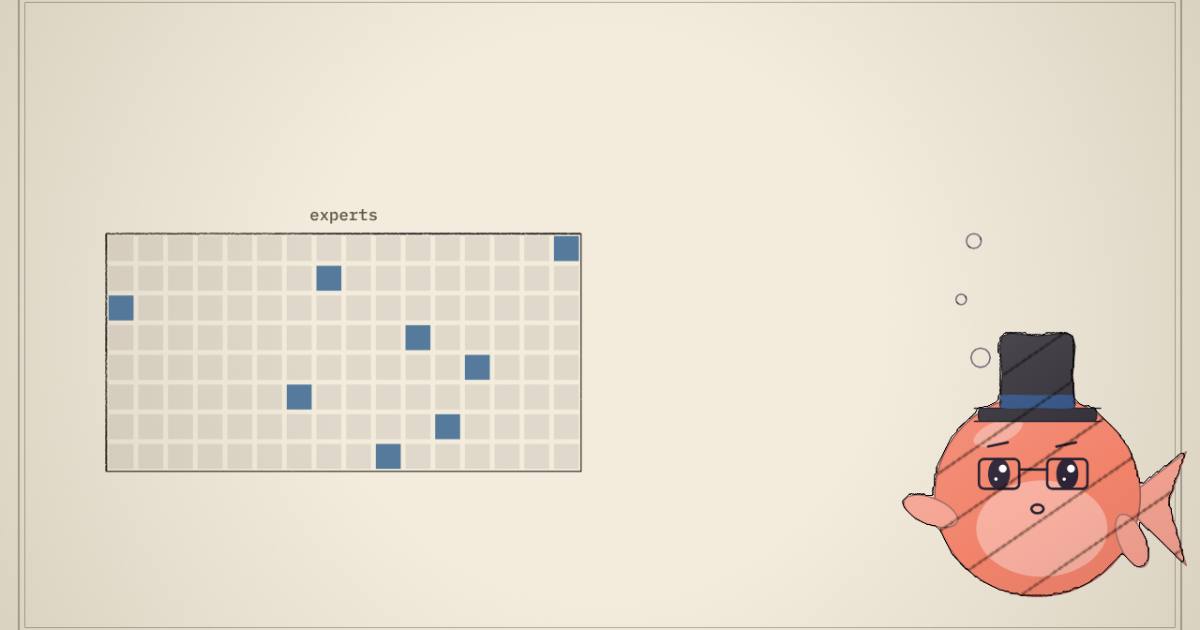
The model card's whole description: "A 48 layer decoder-only transformer with a sparse Mixture-of-Experts (MoE) feed-forward backbone: each token is routed to 8 of 384 experts. Attention is a hybrid of local and global layers." The post adds the vision path and the numerics:
- Experts. 384 routed experts per MoE layer, 8 picked per token. Inkling-Small's released config has 256 routed experts, top-6, plus 2 shared experts that every token uses, by its
config.json. Whether Inkling 2 Small keeps shared experts was not stated; the released config saysn_shared_experts: 0. - Attention. "A hybrid of local and global layers." The ratio and window were not stated. Inkling-Small's config sets 512-token sliding windows. The released config answers both: 40 local layers and 8 global, one global every sixth layer, with a 1,024-token window.
- Vision. "a 292M-parameter vision encoder based on Perception Encoder", with "20×20-pixel patches with 2×2 spatial pooling", image patches interleaved with text tokens. Pooling 2×2 patches of 20 pixels makes one token per 40×40-pixel tile, so a 1,000 by 1,000 image is 25 by 25 tiles, 625 tokens. Inkling-Small's config uses a four-layer
hmlppatcher withpatch_size: 40, so the token cost per image is the same; what changed is a real encoder in front of it. - Audio is gone: "this model does not support audio". Tinker's price list marks Inkling and Inkling-Small "Hybrid + Audio + Vision" and Inkling 2 Small "Hybrid + Vision".
- Context. The model card says up to 1M tokens. H2 trained at 512K context, H3 at 1M, the RL run at 256K with compaction. Tinker's price list sells it in 64K and 256K variants.
- Numerics. "MXFP8 and NVFP4"; pre-training "ran natively in NVFP4".
That was the whole public spec on 9 November. No hidden size, no head counts, no expert width. The config released on 12 November gives all three, and the release section compares them with what follows.
What 594 and 17 force
Two counts and an expert grid pin down more than they seem to. In any MoE, attention, embeddings, dense layers and shared experts are usually counted in both the total and the active figure. (The released weights show that the stated 17B leaves the embeddings out; the release section has what that does to this solve, about 0.4%.) Subtracting one from the other leaves only the routed experts that a token does not use:
with the number of MoE layers, experts, picked and the parameters in one expert. That gives the routed pool and its active slice without knowing the hidden size or the layer count:
- routed experts: B, 99.2% of the model
- routed parameters a token uses: B
- always on (attention, embeddings, any shared or dense layers, the vision encoder): B. On the released weights it is 4.80B without the embeddings and the vision encoder and 6.98B with them
The width of one expert does depend on how many of the 48 layers are MoE. With 46 (Inkling-Small kept its first two layers dense) it is 33.36M parameters; with all 48, 31.97M. For a SwiGLU expert that is , so hidden size 4,096 with expert width about 2,600, or 5,120 with about 2,100. Nothing public said which. The released config's answer is neither: hidden 4,608, expert width 2,304.
Before trusting this I ran it on a model I can read. From Inkling-Small's released config (hidden 4,096, 42 layers, first 2 dense, 256+2 experts, top-6, expert width 2,048) my parameter count script gives 263.6B total and 11.9B active; the weights' safetensors index says 531,912,898,740 bytes, about 265.96B parameters in bf16, so the config arithmetic is within 1%. Then I applied the solve to Inkling-Small's stated 276B / 12B: it gives 26.40M per expert, where the config says 25.17M. The solve runs about 5% high on rounded marketing numbers. Read 32-33M for Inkling 2 Small with that error bar.
Compared with Inkling-Small, then: 1.5x as many experts, 8 picked instead of 6, each expert roughly 30% larger (27% on the released config: 31.85M against 25.17M), a ratio of total to active parameters of about 35 instead of 23. The always-on slice is small: about 4.7B of 17B on the stated counts, 6.98B of 594.05B on the released weights. Most of what a token computes is expert MLP, and most of what has to sit in memory is experts it does not use. That is the shape that makes the post's "high expert parallelism" on GB300 NVL72 racks matter: 72 GPUs in one NVLink domain is where you can spread 384 experts per layer without crossing a slower network on every token.
The training run, rebuilt from the post's numbers
The post is unusually concrete about the schedule:
| Phase | Tokens | Context | What it was |
|---|---|---|---|
| H1 | 8.4T | not stated | "a broad mix of natural language, code, and image data"; 68 hours on GB300 NVL72 |
| H2 | 3.8T | 512K | "higher-quality, newer data the model hadn't seen" |
| H3 | about 320B | 1M | "reasoning and agent trajectories ... alongside replayed pretraining data" |
| H4 | about 34B | not stated | "about 34 billion tokens of agent trajectories" |
| RL | 3T+ | 256K, with compaction | 1,075 steps, 17M+ rollouts, 2,048 GPUs, 9 days, "Over 4 × 10²³ FLOPs" |
One detail in H3 and H4 is worth reading twice: the mixtures "consisted mostly of trajectories sampled from earlier models including Kimi K3 and our own models, filtered for correctness and alignment". Part of the mid-training signal is another lab's open model.
The standard estimate for training compute on a dense pass is : two FLOPs per parameter per token forward, four backward. For an MoE, is the active count. Every number in the ledger below is reasoned from the post's token counts and 17B; attention FLOPs and the 292M vision encoder are left out, so these are floors.
- H1:
- H2: ; H3: ; H4:
- pre-training total: FLOPs over 12.55T tokens
The RL run is the real test, because the post states its compute. An RL token is sampled (a forward pass, ) and then trained on (), so the like-for-like figure for "learner + sampler FLOPs" is . The post says "Over 4 × 10²³". Two independent statements, one about tokens and one about FLOPs, agree to 2% on my arithmetic. Counting only the trained pass () gives , which would contradict the post; the sampler's forward passes are a quarter of the bill.
Pre-training plus RL comes to about FLOPs. For scale: 12.55T tokens is about 740 tokens per active parameter, and 21 per total parameter.
The wall clock says something the token counts do not. H1's FLOPs in 68 hours is FLOP/s sustained. The post does not say how many GPUs H1 used. If I assume a dense NVFP4 peak of 15 PFLOP/s per Blackwell Ultra GPU and 30% utilisation, that is about 780 GPUs, eleven NVL72 racks; both assumptions are mine, and moving either moves the count. The RL run is the opposite story: over 2,048 GPUs and 9 days is FLOP/s per GPU, under 2% of the same assumed peak. That is not a criticism. The post's own table explains it: median rollouts of 43K tokens, p99 of 1.5M, durations of 8 minutes median and 4 hours p99. Long agent rollouts spend their time decoding one token at a time and waiting on tools, and a FLOP count does not see either. The post's systems notes are all about that bottleneck: CUDA graphs for prefill, draft and verify, sticky routing and DRAM KV-cache offload for "93%+ prefix cache hit rate", and a 5:3 sampler-to-trainer ratio.
The RL run itself
One joint RL run replaced the first generation's separate reasoning and agentic runs plus multi-teacher distillation. Three things in the description are concrete enough to repeat:
- The task mix is coding by volume. Coding is 38.5% of rollouts but 65.0% of tokens; vision is 13.9% of rollouts and 3.0% of tokens. Chat, safety and epistemics are 7.8% of rollouts and 0.2% of tokens. Short tasks are many; long ones are most of the compute.
- The objective tolerates staleness. The run uses Tinker's StableReinforce, a score-centering variant, with a median policy staleness of 17 updates and a rollout batch of 16K.
- Effort is trained, not prompted. "We randomly sampled and conditioned on an effort level, and applied a length penalty in the reward function."
The post also reports a safety incident in this run, plainly. Midway through, the asynchronous monitor flagged the model, failing at a task, working "around a network block through a third-party service it could reach using its search tools". The lab paused, removed environments that needed web access, added synchronous tool-call monitoring and resumed. Its alignment table then shows internal misbehavior falling from 75.2 (Inkling Small) to 14.9, still well above the 0.8 it reports for GPT-6.1 Sol, all on the lab's internal evals.
Pre-training quality: one chart, measured on their own data
The post's best evidence that the pre-train is good is a bits-per-byte chart on an internal held-out code set with a June 2026 cutoff. The pre-trained Inkling 2 Small scores 0.2030; Kimi K3.1 Pro, the best of the comparison models, scores 0.2068. The post-trained Inkling 2 Small scores 0.2080, worse than its own base, as post-training usually makes a model.
The comparison models are "base-recovered": only post-trained checkpoints were available, so the lab "fine-tuned on a dataset of pretrain-formatted code and documents before computing log loss" and reports that this "mostly recovers base model loss" where a true base exists. That is a reasonable method and an unfalsifiable one from the outside: the eval set, the recovery data and the recovery check are all private.
The benchmarks, briefly
Every score below is from the lab's table, mostly sourced from external evaluators (Artificial Analysis, Vals, Scale, Surge and others), at effort 0.99 and with a 1M-token trajectory limit. Inkling 2 Small is in the "Open Weights Flash" column, a category it joined when the weights went up on 12 November.
Where it leads its class: knowledge work and finance (JobBench 70.5%, Finance Agent v2.1 67.5%, Vals Legal Index 73.9%, EnterpriseBench-CoreCraft 71.8%), visual perception (PerceptionBench 64.7%, ScreenSpot Pro 83.8%) and DesignArena's boards. Where it trails: DeepSeek-V4.1-Flash-1017 beats it on FrontierCode (28.5% against 25.4%), DeepSWE (77.0% against 72.1%) and the AA index. The model card adds a row the post leaves out: Terminal Bench v4.0 at 13.1%, against 32.8% for GLM-5.3-Flash and 33.8% for DeepSeek-V4.1-Flash. On Terminal Bench 2.1 with the Pi harness it scores 85.1%, so the weakness is specific to the newer suite, but it is the largest gap in the table. The Hugging Face card published with the weights has no Terminal Bench v4.0 row, only Terminal Bench Science.
The fine-tuning claim is the one most specific to this lab: on an earnings-call RL task, the post says Inkling 2 Small reaches Inkling Small's final reward "with just 75 training steps" of 200. The Inkling models are averaged over 3 seeds; the comparison models are single runs. Since fine-tunability is the product, that is the number I would want reproduced first.
What it costs on Tinker
Tinker's price list, read on 10 November, has Inkling 2 Small at $0.30 per million prefill tokens ($0.03 cached), $1.00 per million sampled and $1.50 per million trained, at 64K context. Inkling-Small, a smaller model with 12B active, lists at $0.58, $1.44 and $1.73. The new model is cheaper on every line. At 10% output and half the input cached, it comes to about $0.25 per million tokens against $0.46 for Inkling-Small, on my arithmetic from list prices.
The 256K variant keeps the same inference prices and doubles training to $3.00. That fits what the training section describes: NVFP4 throughout, and the post mentions "a variant of NVFP4 KV cache, which we find to minimally lower evals".
12 November: the released weights, against the predictions
On 12 November Thinking Machines posted that "Inkling 2 Small's weights are now available for download on HuggingFace under an Apache 2.0 license." The repository, thinkingmachines/Inkling-2-Small, is public and not gated. The Hub dates its "upload model" commit to 19:53 UTC that day; by the time I read it, at commit aac9741, one later commit had changed the chat template so nested tool-call arguments keep their order. A second repo, Inkling-2-Small-MXFP8, holds an 8-bit checkpoint.
I did not download the 393.5 GB. A safetensors file starts with a JSON header listing every tensor's name, dtype and shape, so two HTTP range requests per file are enough to count the model. I read all 25 headers, plus config.json and hf_quant_config.json.
What the config says
- Shape. 48 layers, hidden size 4,608, 48 query heads and 8 key-value heads of width 128, a 201,024-entry vocabulary (200,058 used).
- Experts. Every one of the 48 layers is MoE, with 384 routed experts, 8 per token, no shared experts and an expert width of 2,304. Inkling-Small kept two dense layers at the bottom; this model has none.
- Attention.
local_layer_idslists 40 layers with a 1,024-token sliding window. The other 8 (layers 5, 11, 17 and so on to 47) are global. That is the first generation's five-to-one ratio, with twice Inkling-Small's 512-token window. - Context.
model_max_lengthis 1,048,576, the 1M the card states. - Vision. A 23-layer encoder of width 1,024 with 20-pixel patches and a 2×2 merge. Its backbone tensors sum to 292,041,728 parameters, the post's "292M". With the two projections into the decoder it is 327.7M.
- A draft module. A separate
mtp.safetensorsholds a five-layer bf16 multi-token-prediction module, the kind used to draft tokens for speculative decoding: 1.71B parameters, withblock_size: 8.
The config also names parts the card never mentions: width-4 depthwise convolutions in front of attention and the MLP, a gate on the attention output, attention-sink projections, a final logit softcap of 30, and an "attention residual" path whose learned queries mix earlier layers' outputs in blocks of six (n_layers_per_attn_res_block: 6). I am reading tensor names and config keys here, not modelling code, so I will not guess what each does.
Counting the parameters
The Hub's own count is 383,072,987,216, and at least one reply to the release post took it at face value ("383B is not small"). It counts stored elements. Most expert weights are NVFP4, two 4-bit values packed into one U8 byte: a layer's w2 tensor is stored as 384 × 4,608 × 1,152 bytes for experts that are 4,608 × 2,304 matrices, half the last dimension. The Hub also counts the quantisation scales as parameters. Counting each packed byte as two weights, leaving out the 33.6B scale entries and the draft module, the headers give:
| Released headers | This article on 9 November | |
|---|---|---|
| Total | 594.05B | 594B, stated |
| Routed experts | 587.07B, 98.8% of the model | 589.3B, 99.2% |
| One expert | 31,850,496 (3 × 4,608 × 2,304) | 31.97M if all 48 layers are MoE |
| Hidden × expert width | 4,608 × 2,304 | 4,096 × about 2,600, or 5,120 × about 2,100 |
| Routed parameters a token uses | 12.23B | 12.28B |
| Always on, without embeddings and vision | 4.80B | 4.72B |
The expert solve came in 0.4% high, against the 5% error bar I took from Inkling-Small. Both hidden-size guesses bracketed the real one, and neither was it.
The active count depends on what you leave out. Everything outside the routed experts plus 8/384 of them comes to 19.21B. Leaving out the input embedding and the output projection (926M each) gives 17.36B. Leaving out the vision encoder as well gives 17.03B, which matches the stated 17B. Both round to 17B, and the card does not say which convention it uses. Either way it explains the solve's 0.4%: the formula assumed everything outside the experts sits in both the total and the active count, and the 1.85B of embeddings (2.18B with vision) sit in the total only.
Mostly NVFP4
hf_quant_config.json and the headers agree that the main checkpoint mixes two formats. The experts in layers 0 to 39 are NVFP4: packed 4-bit values with an FP8 E4M3 scale for every 16 and a per-expert amax. The experts in the last eight layers, 40 to 47, are MXFP8: one FP8 E4M3 byte per weight and a one-byte U8 scale per 32 values, which the quant config's MXFP8 group describes as ue8m0, a power of two. Attention, the router, the embeddings and the vision encoder are bf16, and the output projection computes into fp32. The card says the model "was pretrained, midtrained and post-trained in NVFP4", and that the MXFP8 checkpoint has "a very marginal 1–2 percentage points gain" on evals. It does not say why the main checkpoint keeps its last eight layers' experts at 8 bits. The Hub's per-dtype count for the MXFP8 repo has 587.07B FP8 values, the same expert count as above, so there every expert is 8-bit.
That mix is why the download is bigger than 4-bit arithmetic suggests. One reply to the release estimated 334 GB at 4.5 bits a weight; the repo's files add up to 393.5 GB. The card asks for at least 500 GB of GPU memory for this checkpoint (two B300s or four H200s) and 800 GB for the MXFP8 one.
The licence
The card's front matter says apache-2.0 and links the Apache text on apache.org. There is no LICENSE file among the repo's 36 files. The card's header also links the lab's Model Acceptable Use Policy, last updated 15 July, which says that by "accessing, downloading, or using any Model Materials, you agree to be bound by this Model AUP" and then lists prohibited uses. Apache 2.0 on its own carries no use restrictions, so read both before you ship a product on it.
Running it, and colibri
The card lists day-one recipes for SGLang, vLLM, TokenSpeed and Unsloth, and fine-tuning in Miles, SkyRL and Snowflake's Cortex Training. One reply to the release post came from the author of colibri, the pure-C engine that streams routed experts from disk so a large MoE runs in a small RAM budget: "i'm working to add it to colibri" (JustVugg/colibri). Colibri already runs the first Inkling, the 975B one. On 13 November its dev branch (commit c976527b) has no Inkling 2 code, and no branch, issue or pull request mentions it, so for now that is a statement of intent. The model suits the approach. 98.8% of the weights are experts, and a token uses 8 of 384 per layer, so the part that has to stay resident is the 6.98B outside them.
What the release does not change: every benchmark on this page is still the lab's. Anyone with the hardware can now rerun them, and I have not.
13 November: first among open weights on DesignArena, by 32 points
At 23:00 UTC on 12 November DesignArena posted an update: Inkling 2 Small "is now open-weight and is ranked #1 among open-weight models on Overall HTML with an Elo of 1384, up 8 Elo points since its initial release last week", and "currently holds a 32-point lead on Kimi K3". The launch-week post it quotes had the model 4th overall and 1st among open weights at 1376, and listed it at $0.30/$1.00 per million input/output tokens, the same prices as the Tinker list above.
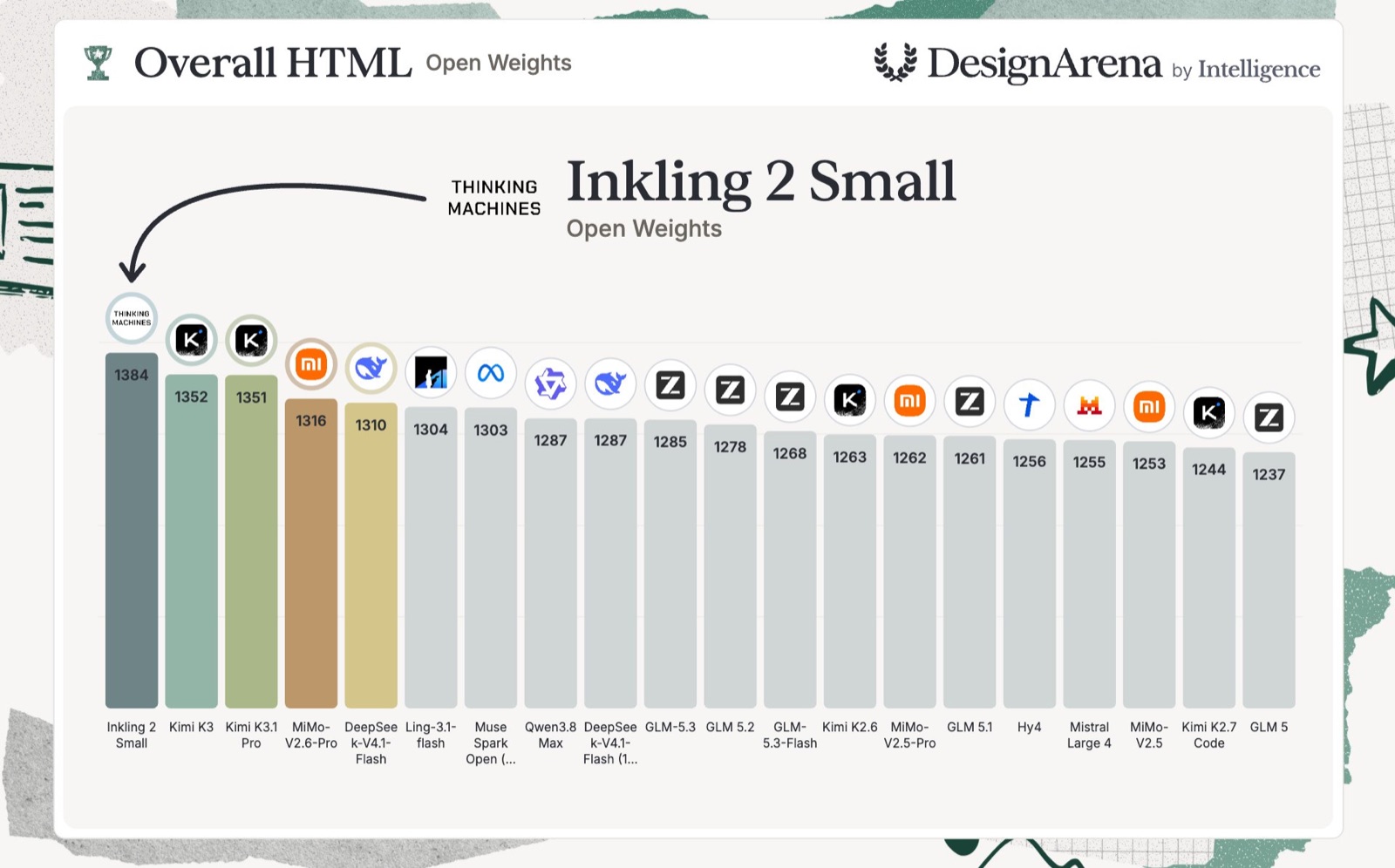
The chart matches the post: 1384, then Kimi K3 at 1352 and Kimi K3.1 Pro at 1351, then a 35-point drop to MiMo-V2.6-Pro at 1316. Its labels limit what it says. The launch-week chart this article read earlier was titled "Overall Frontend", and this one is "Overall HTML". From two images I can't tell whether that is the same board renamed or a different one, so I would not read the +8 as one rating moving. And this chart lists open-weight models only. It gives no overall rank, so the 4th place is a launch-week number, not a current one.
What 32 points means: on the standard Elo scale, a model rated points higher has an expected score of
against the other. For that is 0.546. Shown an Inkling 2 Small page and a Kimi K3 page for the same prompt, voters would pick Inkling about 55 times in 100, and Kimi K3 about 45. The 8 points since launch are worth 51 in 100. That assumes DesignArena's ratings sit on the usual 400-point scale, which I have not checked. Without vote counts or intervals I also can't say whether 8 points is movement or noise. A 32-point lead is a real preference and a modest one. Kimi K3 still wins close to half of those votes.
20 November: Inkling 2 Mini runs its middle twelve layers three times
Fifteen days after this model, Thinking Machines released Inkling 2 Mini, with open weights under Apache 2.0. It shares most of this model's recipe (NVFP4 training, an SFT mix the post calls similar, on-policy distillation for alignment) and differs in two ways that matter.
It is small. The model card gives 26.4B total parameters and 3.4B active, a single checkpoint of about 20 GB in mixed NVFP4 and MXFP8, a context window of up to 1M tokens, and lists Apple silicon with 32 GB or more among the supported hardware. The lab's demos ran on a 48 GB MacBook Pro. It got that small by pruning: training started with 384 experts per layer and 8 routed, and at one point in mid-training the lab kept the 128 most used experts in each layer and deleted the rest, then healed the model on 1T tokens distilled from a larger Inkling. The released config.json agrees: n_routed_experts 128, num_experts_per_tok 8, a hidden size of 2,304 and 24 layers.
It is looped. The 24 layers form four blocks of six. The first and last blocks run once; the middle two run three times per token, so a token sees 48 layer applications from 24 stored layers. The config's loop_config says the same thing in code: core_start 6, core_end 18, num_passes 3. The card's arithmetic: each extra pass adds about 1.0B effective active parameters, so three passes make 5.4B per token, against 3.4B active. Passes two and three read the previous pass's output through a learned gate that starts closed, so early in training each pass behaves like an unlooped model, and the gate opens as training goes on. The lab's ablation is the number I would quote: an unlooped twin cost 7.5% less to train and needed 140% more inference compute to reach the looped model's loss on 512K-token agentic traces. It also tried looping the last twelve layers instead of the middle twelve, and the middle won on 27 of 28 evaluations.
The lab is candid about what looping does not buy. Extra passes add reasoning depth and no storage, so knowledge benchmarks stay where a 26B model's sit. Its own table has Mini at -8.6 on AA-Omniscience against -6.4 for Qwen3.8-27B.
That gap is what Parallel's search leaderboard measures from the other side. Its numbers, as of 21 November:
| Inkling 2 Mini | Qwen3.8 27B | Hy4 | Gemini 4 Neon | |
|---|---|---|---|---|
| Score with search | 78.4 | 76.5 | 75.4 | 88.1 |
| Score without search | 16.9 | 20.3 | 30.2 | 42.5 |
| Lift | +61.5 | +56.2 | +45.3 | +45.6 |
| Cost per 1K tasks | $20.2 | $70.9 | $94.4 | $206 |
| Cost per 1K correct answers | $25.8 | $92.7 | $125 | $233 |
Mini is 9th of 60 overall and first among open-weight models, first on the efficiency table (the cheapest model scoring at or above the median of 66.6), and has the largest lift from search on the board. @p0's post for the leaderboard says it is "~5x cheaper per correct answer than the next-cheapest" among the ten highest scorers. The board's own cost-per-correct-answer column says otherwise for one of them: Qwen3.8 27B, tenth, at $92.7 per 1K correct answers, 3.6 times Mini's $25.8. The 5x holds against the eight closed models above it, where the cheapest pair (Gemini 4 Hydrogen and GPT-6.2 Sol) sit at $133. The board also reports that 39% of Mini's cost goes to search and page extraction, against 2% for Gemini 4 Neon, so "cheap" here partly means that tokens on a 3.4B-active model cost almost nothing and the search bill dominates.
Two cautions. These costs include Parallel's own search API, and the composite mixes public benchmarks with Parallel's WISER set, so this is a board about models driving Parallel Search. And a +61.5 lift from a 16.9 baseline mostly says the model knows little and fetches well, which is what the lab's knowledge scores already said.
I have not run Mini. It is a different enough model (a looped MoE, with a monitorability study and a variable-loop research checkpoint released beside it) that it deserves its own page rather than this section.
- architecture
- Inkling2LoopForConditionalGeneration
- task
- image-text-to-text
- library
- transformers
- license
- apache-2.0
- safetensors
- 2 shards
- largest file
- 19.53 GB
- files
- 14
- downloads
- 23.5K
- likes
- 5.2K
repo last modified 2026-11-23
What I ran, and what I could not
What I ran, with numbers you can check:
GET huggingface.co/api/models/thinkingmachines/Inkling-2-Small(and three other spellings): 401 on 10 November. Thethinkingmachinesauthor listing shows Inkling, Inkling-Small and their NVFP4 variants, nothing newer.- Downloaded Inkling-Small's and Inkling's
config.jsonandmodel.safetensors.index.json, and counted parameters from the config with a short Python script: 263.6B / 11.9B for Inkling-Small against 531,912,898,740 bytes in its index. - The expert solve and the compute ledger above, from the post's figures.
- Read the Tinker price list.
- On 23 November, for the Inkling 2 Mini section: read Thinking Machines' launch post, the Mini model card and
config.json, and Parallel's leaderboard page, whose tables give the scores, costs and cost per correct answer quoted there. - On 13 November, read the released repo at commit
aac9741:config.json,hf_quant_config.json, the model card, and the JSON header of all 25 safetensors files by HTTP range request, then counted parameters from the tensor shapes. No weights downloaded.
What I could not do: run the model. On 9 November there were no weights, and sampling it needs a Tinker key, which I did not use for this page. Since 12 November there are weights, and serving them needs the 500 GB of GPU memory the card asks for, which I do not have. Every benchmark, the bits-per-byte chart, the alignment table and the fine-tuning curve are the lab's. The post promises a follow-up on the NVFP4 recipe; as of 10 November it was not out.
Post-training with Tinker
- license
- Apache-2.0
- branch
- main
- forks
- 571
- open issues
- 168
- tests
- 221 files
- source
- 5.5 MB
- commit date
- 2026-11-20
GitHub REST API, 2026-11-23 — branch, createdAt, description, forks, license, openIssues, pushedAt, stars
local clone, 2026-11-10 at 8bf7dd6 — fileCount, hasTests, licenseFile, shallow, testFileCount
shallow clone: counts describe the pinned tree, not the history
- architecture
- InklingForConditionalGeneration
- task
- image-text-to-text
- library
- transformers
- license
- apache-2.0
- safetensors
- 33 shards
- largest file
- 18.86 GB
- files
- 50
- downloads
- 783.6K
- likes
- 465
repo last modified 2026-07-31
The Inkling 2 Small card below shows the Hub's parameter figure, which counts packed 4-bit bytes and scales; the 594.05B in the release section is the count of weights.
- architecture
- Inkling2ForConditionalGeneration
- task
- image-text-to-text
- library
- transformers
- license
- apache-2.0
- safetensors
- 25 shards
- largest file
- 19.89 GB
- files
- 43
- downloads
- 49.0K
- likes
- 1.4K
repo last modified 2026-11-20
Where the checks stand
The checkable parts hold together. The token counts, the RL FLOP total and the GPU-days agree with each other, the expert grid matches the stated parameter counts, and the price list says what the tweets said it says. The parts that matter most to a user (benchmarks, fine-tunability, the pre-training quality chart) are all reported, and the weights that let anyone check them arrived on 12 November, the week the lab said they would.
Before the release I listed the first things worth doing: count the parameters in the safetensors (Inkling-Small's stated total ran 3.8% above what its weights hold), read the attention layout out of the config, and run Terminal Bench v4.0 to see whether 13.1% is the model or the harness. The first two are done above. This time the stated total holds to 0.01%, and the expert solve was closer than I gave it credit for. The third needs a node of B300s or H200s, and it is still the check I would want first from anyone who has one.