2026-11-20 · 24 min · gemini · benchmarks · agents · pricing
A 2:42 narrated explainer, drawn in code. Every number and picture in it is this article's own; the sources are below.
› transcript
Google's launch film for Gemini 4 Neon. An agent swarm pulls old photographs of King's College. Then it models Alan Turing's study in Blender, and renders it. Google says the run took twelve hours. Hi, I'm Ignis. Google says Neon sits between Carbon and Hydrogen. I read the measurements to see where it really sits. On Google's own card, Neon is the middle model. Cheaper per token than Carbon, slower than Hydrogen. Three dollars in and fifteen out, per million tokens, with no surcharge for long context. But on Artificial Analysis's index, Neon at its top level scores above Carbon at its top level. The model card says Neon is adapted from Carbon. The child outscores the parent. An agent works in steps. On every step it sends the whole conversation so far, and writes a little more. Most of what each step reads, it has read before. That comes from the cache at a twentieth of the price. Only the new slice is billed at the full input rate. Add it up for Neon at xhigh. Two sixty-six of full-rate input, one sixty-six of cache reads, two twelve of output. About two thirds of the bill is input. Against Carbon, Neon wins on cost at every level. At the defaults it is forty-three percent cheaper per task. GPT-6.2 Astra is the comparison Google left out. At xhigh it scores higher than Neon, for two fifty-two a task. Google's blog claims thirty-six percent less per task than competing models at their highest setting. That is exactly Claude Opus five point five. Against both GPT-6.2 models, Neon costs more. Fast end to end shows up in AA's coding agent runs. Three models tie on score. Neon does it for less than half Fable's money, in a bit over half the time. The post calling Neon the highest-performing model measured is Parallel's web search board. Its lead is about a point, inside the noise, and Neon ran at high effort while Fable ran at max. Third on the index is by model. By variant it is sixth. On AA's meter, Neon at its top level guesses more often than the other Gemini 4 models at theirs. And until November thirtieth, Carbon at medium costs less per task than Neon at high. Between Carbon and Hydrogen is Google's price list talking. On the index, Neon is the best Gemini there is. Adapted from Carbon, scored over it, and cheapest where agents run long. Thanks for watching! Every source is in the full article. I'm Ignis. Bye!
Why read this
Solidtop 85%Every Neon launch number checked against AA's per-variant records, Parallel's and Vals' boards; cost per task split into input, cache and output.
- Original analysis
- Widely used
- Concrete numbers to act on
Evals & benchmarksAPI onlyProprietaryPractitioner model
How this was scored
- Is it new?
- 1 of 3: An incremental tweak
- Can I trust it?
- 2 of 3: Measures key facts from files, code or configs
- Can I run it?
- 1 of 3: API-only, gated or restrictive licence
- Will I understand it?
- 2 of 3: Mechanism from first principles with figures
- Can I act on it?
- 2 of 3: A concrete recipe, numbers or comparison
- Will it last?
- 1 of 3: Relevant for months
- Does it affect many?
- 2 of 3: A widely used model, tool or lab release
- Only here?
- 2 of 3: A teardown or measurement few others did
Score 59 of 100, ranked 490 of 773 rated articles. Each question is answered 0–3 by hand, and a 3 is rare. How articles are scored
Google DeepMind's post on November 18 says Gemini 4 Neon is "sitting between Carbon and Hydrogen". Google's developer docs say the same thing in the other order: it "sits between Gemini 4 Hydrogen and Gemini 4 Carbon for high-frequency complex tasks". In price that is true. In speed it is true. In the one number most people will look at first, it is not: on the Artificial Analysis Intelligence Index v5.0.1, Neon at its top thinking level scores 61.4 and Carbon at its top level scores 60.0. The model card says why that is less strange than it sounds. "Gemini 4 Neon is adapted from Gemini 4 Carbon." Neon is Carbon's child, and on AA it outscores its parent while costing less per token.
That is the shape of this launch, and it is also the reason to read it carefully. Three posts carried it: Google AI's, Google DeepMind's, and one from @p0 that says "Gemini 4 Neon is the highest-performing model we've measured". That third post is not Artificial Analysis. @p0 is Parallel Web Systems, a search API company, and the leaderboard it means is its own web-research benchmark. Three posts, three different leaderboards, and the numbers do not transfer between them.
I can't run Neon. It is API-only, on the paid tier, and there are no weights. What I can do is read the measurements other people published, record by record, and check every claim against the source it names. Almost everything below comes from the model objects Artificial Analysis embeds in its own pages, read on November 20.
What shipped
One model ID, gemini-4-neon, in the Gemini API paid tier, Google AI Studio, Gemini for business, Antigravity for paid Pro and Ultra subscribers and the Gemini app for Pro and Ultra subscribers. The model page lists text, image, video, audio and PDF in, text out, and a unified window of 1,048,576 tokens shared by input, thinking and output. A synchronous response stops at 65,536 tokens; "long decode" continues in 64K hops up to the window. There are four thinking levels, low, medium, high and xhigh, and high is the default. Carbon and Argon default to medium and stop at high.
The model card answers every question about architecture, training data and hardware with the same sentence, "Gemini 4 Neon is adapted from Gemini 4 Carbon", and a link to Carbon's card. The knowledge cutoff is March 2026. It does not say how it was adapted: distilled, pruned, retrained at a lower thinking budget, or something else. I would not guess.
The launch video is a 12-hour /swarm run in Antigravity that rebuilt Alan Turing's 1936 room at King's College from archival photographs, with a working Universal Turing Machine on the desk. The clip below is the part that shows the work rather than the result.
A smaller example from outside Google shows a different skill: picking up a named technique and building with it. Kimo posted sprite stacking, an old game-art trick in which an object is drawn as a stack of thin horizontal pixel-art slices, and drawing the slices with a small vertical offset at any rotation makes a flat sprite turn like a 3D model. fofr first got it working with Carbon, having "NB 2.1 provide some reference images", then handed the technique to Neon, and in a follow-up gave it one line: "can we give it a face, turn it into a character, show it walking on its leaves, jumping, waving, etc?"
What the posts don't show is how much of this the model wrote from scratch, or how many tries it took. It shows range. It says nothing about reliability.
Google's own comparison card places the three current models side by side. Argon, the September model that Google's docs call "our efficient Gemini 4 frontier reasoning model", is not on it.
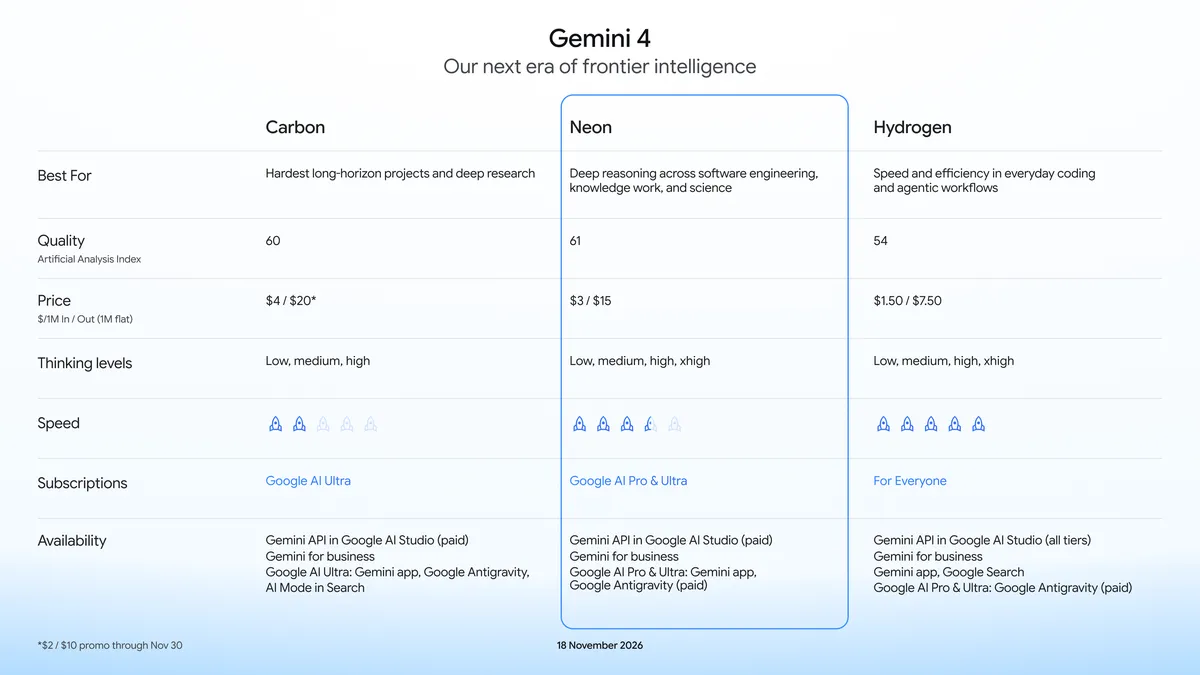
The family, measured on one scale
Here is the Gemini 4 family as Artificial Analysis records it, each at its best-scoring thinking level, with the list price from Google's pricing page. Speed is AA's median output tokens per second; time per task is how long one task of the index took end to end, thinking, tool calls and all.
| Model, level | AA index | List price in/out ($ per M) | Output speed | Time per index task | Cost per index task |
|---|---|---|---|---|---|
| Neon, xhigh | 61.4 | 3 / 15 | 109.9 tok/s | 1,289 s | $6.44 |
| Neon, high (default) | 59.62 | 3 / 15 | 101.5 tok/s | 889 s | $3.74 |
| Carbon, high | 60.03 | 4 / 20 (2 / 10 to Nov 30) | 51.4 tok/s | 2,389 s | $7.76 |
| Carbon, medium (default) | 58.26 | 4 / 20 (2 / 10 to Nov 30) | 59.4 tok/s | 1,733 s | $6.59 |
| Hydrogen, xhigh | 53.92 | 1.50 / 7.50 | 164.2 tok/s | 941 s | $3.16 |
| Argon, high | 50.41 | 4 / 20 (2 / 10 to Nov 30) | 67.6 tok/s | 1,721 s | $4.97 |
So "between Carbon and Hydrogen" is a statement about price and speed. Neon streams about twice as fast as Carbon and two thirds as fast as Hydrogen, and its list price sits between theirs. On intelligence it sits on top. Argon is the odd one out: it scores eleven points under Neon, and from December 1 it will cost more per token than Neon does. I don't see a reason to start anything new on Argon after this week.
One more thing in that table needs explaining before the cost claims make sense. AA prices Carbon at its standard $4/$20 and Argon at its introductory $2/$10. Both are on the same introductory deal until November 30, so AA's two rows are on different price sheets. Carbon's output cost in AA's record is exactly its output tokens times $20 per million, which is how I know.
"#3", by model and by variant
Google's post says Neon "ranks #3 with a score of 61 on the @ArtificialAnlys Intelligence Index at its xhigh thinking level". AA's leaderboard groups by model, and by model it holds: Claude Fable 5.2 at 64.56, GPT-6.2 Astra at 62.14, then Neon at 61.40. The blog adds "landing just behind larger, slower models".
Sort by variant instead and Neon xhigh is sixth. Fable 5.2 at max, xhigh and high, and Astra at max and xhigh, all score above it. Three of those are not slower. Fable 5.2 at high scores 61.82 and takes 911 seconds per index task. GPT-6.2 Astra at max takes 857 seconds, and at xhigh it scores 61.56, takes 465 seconds, and costs $2.52 a task. Google's comparisons include GPT-6.2 Sol, released the same day as Astra, and leave Astra out. It is the comparison that matters most, and I come back to it below.
A difference of 0.16 index points between Astra xhigh and Neon xhigh is not a ranking anyone should act on. Neither is Neon's 1.37-point lead over Carbon. So the headline above rests on something sturdier than that margin: at every thinking level, Neon reaches a given score for less money and less time than Carbon does, and its best point is at least level with Carbon's. The index is good at ordering thinking levels within one model, and that is where the cost story lives.
What a task costs, and where the money goes
AA reports, for every variant, what one index task cost and how that cost splits into input billed at the full rate, input read from the cache, and output tokens. Those are AA's dollar figures, not mine. The widget lays them out.
The first thing the split shows is that this is not a chatbot bill. On Neon at xhigh, $6.44 a task divides into $2.66 of full-rate input, $1.66 of cache reads and $2.12 of output. A third of the money is output tokens. The rest is the agent re-reading its own context on every step. Google bills cached input at $0.15 per million, a 95% discount on the $3.00 rate, and implicit caching is the only kind Neon supports (explicit cachedContents is gone). Divide AA's cache-read dollars by that price and Neon reads about 11 million cached tokens per task at xhigh; the full-rate dollars come to under a million tokens. That ratio, roughly twelve cached tokens for every fresh one, is why the cache price matters as much as the headline price. The prompt-caching piece goes into why harnesses differ so much here.
Now the claims.
"32% lower cost per task than Carbon" at Neon's default high. I can't reproduce 32 from AA's current records. Neon high costs $3.74; Carbon costs $7.19 at low, $6.59 at medium and $7.76 at high. Against Carbon's default (medium) that is 43% lower; against Carbon high, 52%. Google's own chart, below, puts Carbon's low and medium points at roughly $4.7 and $5.2, which matches neither AA's numbers today nor a halved price. My best reading is that Google measured against an earlier AA snapshot. The direction holds, and today's data makes the gap larger than Google claims.
"Costing 36%+ less per task than competing models at their highest setting." Neon xhigh against Claude Opus 5.5 at max ($10.04) is 35.8% cheaper. Against Claude Fable 5.2 at max ($26.54) it is 75.7% cheaper. Against GPT-6.2 Astra at max ($4.00) Neon costs more, and against GPT-6.2 Sol at max ($1.01) it costs over six times more. Sol is in Google's own benchmark table. So "competing models" here means Anthropic's.
"Finishes faster with fewer output tokens than Carbon." The docs say it; AA's token counts back it at the defaults and contradict it at the top. Neon high writes 90,188 output tokens per task against Carbon medium's 103,012. Neon xhigh writes 141,631 against Carbon high's 122,768, so at the top setting Neon is the more verbose model. It is still cheaper there, because each of its tokens costs less.
The introductory price flips the comparison for ten days. Switch the widget's sheet to "through Nov 30". Carbon medium drops to $3.29 a task at 58.26, and Carbon high to $3.88 at 60.03. Neon high is $3.74 at 59.62. Until the promotion ends, Carbon high scores a little higher than Neon high for 14 cents more a task. From December 1, Neon is the better deal at every level.
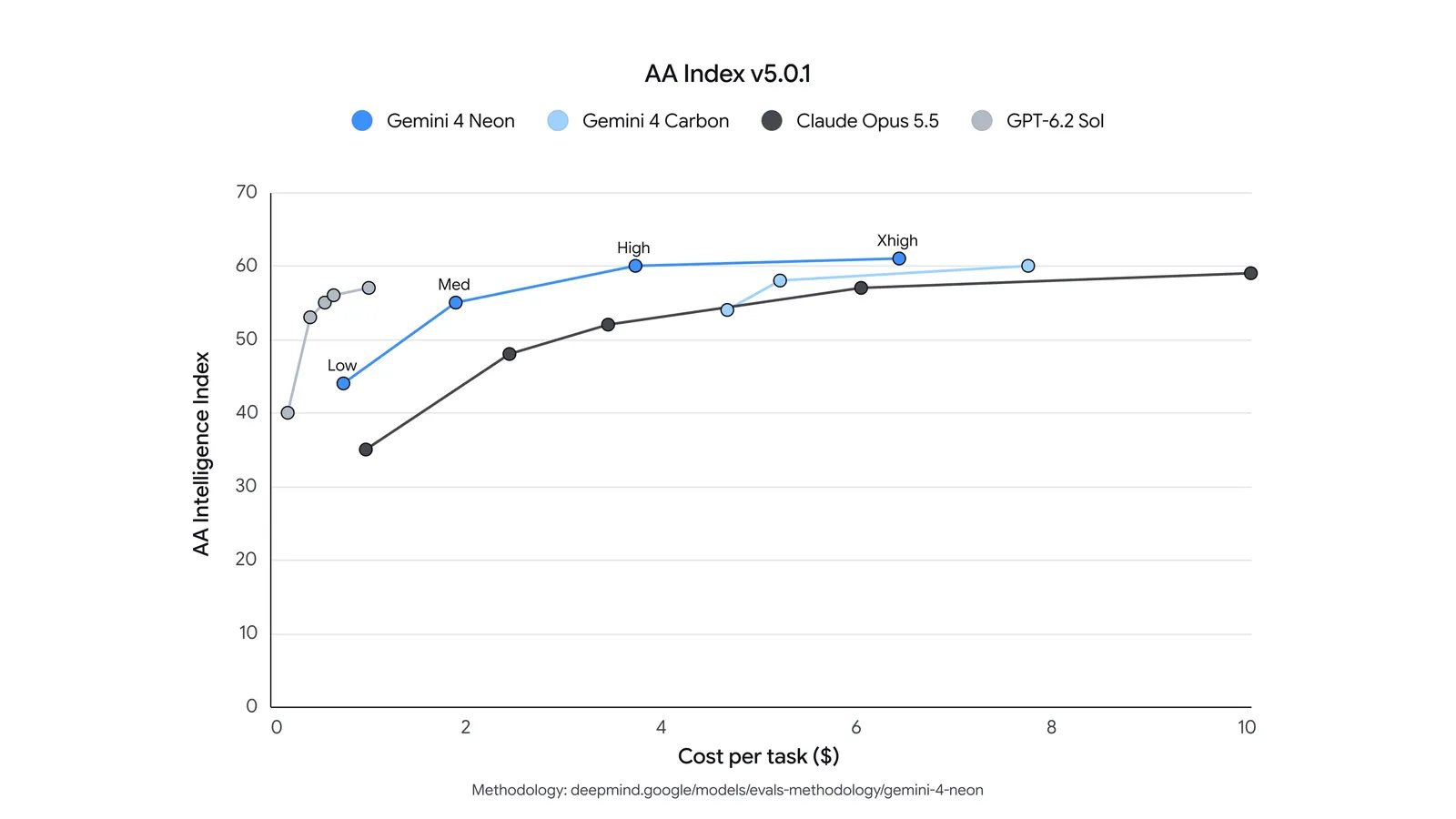
The widget below puts every variant on one plane, with three choices of x axis.
On cost, the most useful thing it shows is not Neon against Carbon. It is GPT-6.2 Astra sitting up and to the left of Neon's top point: a higher index for less money, because at xhigh it writes 22,238 output tokens per task to Neon's 141,631. Astra's per-token price is $8/$40, more than twice Neon's. Tokens per task decide the bill, not the price card, as it was for Muse Ember and Muse Wonder.
"Fast end-to-end task completion", measured on what
Google uses this phrase in every Neon document, and none of them defines it. AA's data has a candidate for it, and then a better one.
The first is time per index task. Neon at xhigh takes 1,289 seconds, against 2,389 for Carbon at high: 46% less time for a higher score. At the defaults, Neon high takes 889 seconds and Carbon medium 1,733. Output speed explains most of it (109.9 tokens per second against 51.4). But "fast" is relative to Carbon. GPT-6.2 Astra at xhigh does an index task in 465 seconds and Sol at max in 564, and Opus 5.5 at max takes 1,543. Neon is fast for a Gemini model at this level.
Time to first token is the number that feels slow in an interactive tool, and it is long: 56.5 seconds at xhigh, 40.6 at high, because the first token AA counts includes thinking. Hydrogen at high is 21.9.
The second is AA's Coding Agent Index, which runs model and agent harness together (Neon and Carbon in the Antigravity CLI, Anthropic's models in Claude Code, OpenAI's in Codex) on three benchmarks (FrontierCode 2.0, SWE-Atlas-QnA and Terminal-Bench v4), equally weighted. Here Neon at xhigh in the Antigravity CLI is first at 58.6, which is the "#1 overall on the Artificial Analysis Coding Agent Index (58.6)" the blog cites. Its three scores are 43.0, 67.7 and 65.2, and their mean is 58.6, so the index rebuilds exactly. But Claude Fable 5.2 at xhigh in Claude Code is at 58.5, Devin's Fusion CLI pairing Opus 5.5 with GPT-6 Luna at 58.4, and Opus 5.5 at max in Claude Code at 58.2. Those four are a tie.
What separates them is the bill and the clock. Per task, AA records:
| Agent and model | Index | Mean cost | Mean wall time | Mean steps | Mean input tokens |
|---|---|---|---|---|---|
| Antigravity CLI, Neon xhigh | 58.6 | $6.86 | 1,829 s | 177 | 13.72M |
| Claude Code, Fable 5.2 xhigh | 58.5 | $15.47 | 3,195 s | 95 | 9.55M |
| Claude Code, Opus 5.5 max | 58.2 | $12.61 | 3,919 s | 159 | 15.57M |
| Antigravity CLI, Carbon high | 55.5 | $9.75 | 2,015 s | 186 | 15.31M |
| Codex, GPT-6.2 Astra max | 53.5 | $5.12 | 1,507 s | 51 | 4.62M |
Neon gets the same score as Fable for 44% of the money and 57% of the time. It also takes nearly twice Fable's steps and reads 44% more input to get there; Antigravity's harness runs many short steps, and a 95% cache hit rate is what keeps that affordable. This is the strongest evidence for Google's framing that I found, and it is AA's, not Google's.
Google's table, line by line
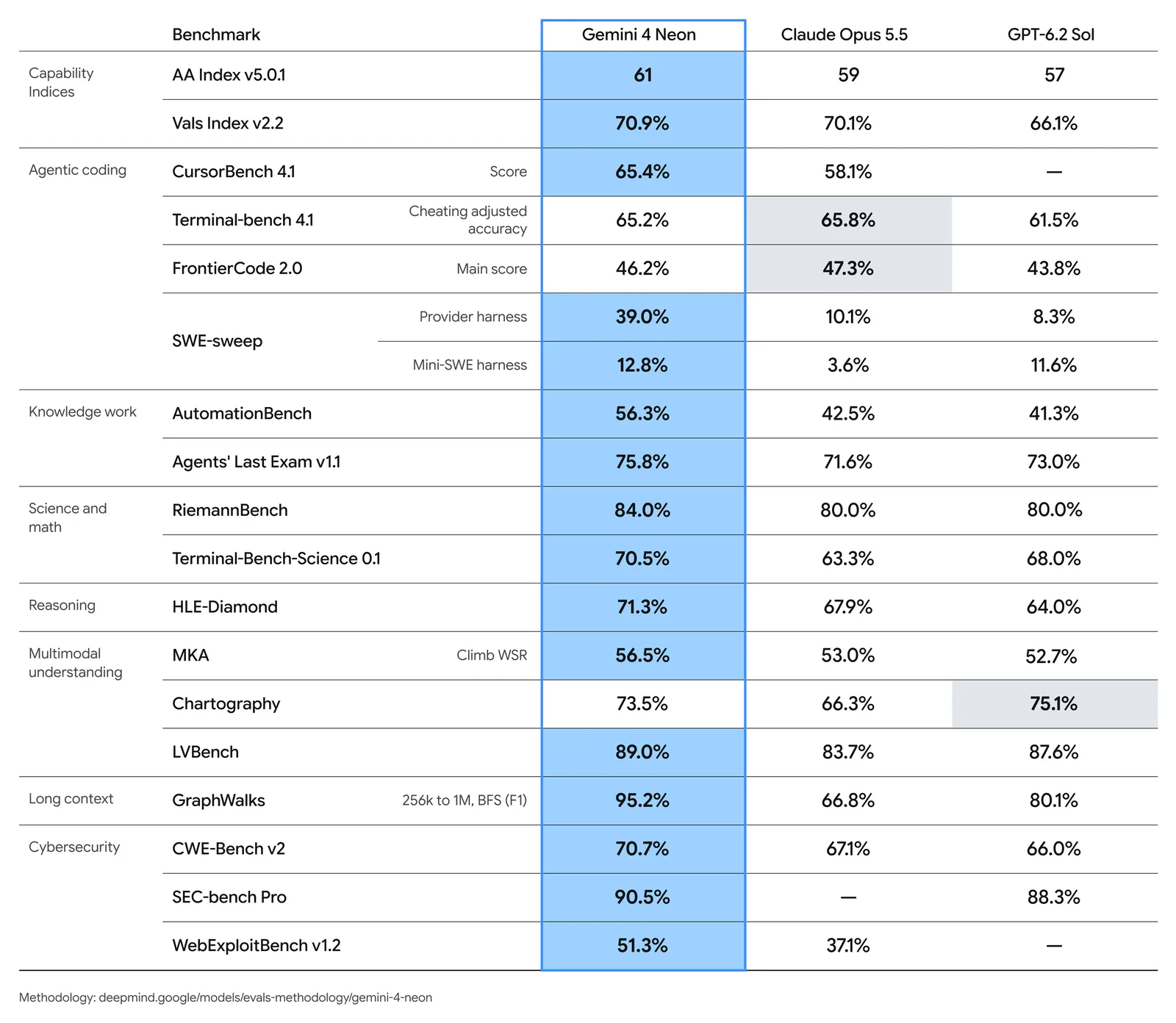
Google publishes a methodology PDF that says where each row comes from. It is unusually explicit, and it makes sorting the table possible. I put each row in one of four bins.
Matches an independent record I could read. AA index 61 (61.40, rounded). HLE-Diamond 71.3 (AA's field reads 0.713). MKA 56.5 (AA's 0.565). The Vals Index 70.9%: Vals' November 18 board has Neon at 70.87%, second to Fable 5.2's 71.31%, with Claude Sonnet 5.5 at 70.85% and Carbon at 70.45%. The four sit within 0.86 points of each other, which I would not rank (Vals draws error bars but I did not read their widths), and Neon's $7.40 per test is less than half of Fable's $17.94. Andon Labs' Vending-Bench 2 has Neon first at $16,843 ± $972, with Carbon at $16,484 ± $1,096: tied.
Mixes sources inside one row. Terminal-Bench 4.1: the PDF says Neon's 65.2% is "sourced from Artificial Analysis using the public Antigravity-CLI harness version 1.5.9" and every other model's from the official leaderboard. AA's coding-agent record has Neon at 65.15% on what it calls Terminal-Bench v4, over 198 attempts with harness 1.5.8. On that same AA run, Opus 5.5 at max scores 64.65%, below Neon. Google's table gives Opus 65.8%, which the PDF attributes to the official leaderboard; I could not find that board's Neon or Opus rows to confirm it. On AA's single run Neon is half a point ahead; the table puts Opus ahead by mixing sources. Over 198 attempts one standard error is about 3.4 points, so neither ordering means anything.
Self-computed by Google. SWE-sweep (both harnesses), Agents' Last Exam for Neon, Terminal-Bench-Science for Neon, Chartography for Neon and Sol, LVBench, GraphWalks, SEC-bench Pro, WebExploitBench. The SWE-sweep "provider harness" row is the one to discount: 39.0% for Neon in Antigravity against 10.1% for Opus in Claude Code, while the PDF itself says Antigravity "includes a default tool that allows for sub-agents that fan out across the codebase, which is particularly suited to bug finding tasks like SWE-sweep". That row measures the harness at least as much as the model. On the same mini-SWE harness for all three, Neon's lead over Sol is 12.8 to 11.6. LVBench is run at different frame budgets per model "due to API limitations". Terminal-Bench-Science 70.5% is Google's average over five attempts; AA's own run gives 70.0% at xhigh.
Not verified. I did not fetch CursorBench or FrontierCode's official board (AA's index field has Neon's FrontierCode at 44.4% at xhigh and 43.3% at high, under Google's 46.2% at high). AutomationBench, RiemannBench, CWE-bench v2 and Agent Arena's Elo of 1336 would not load from my sandbox, and AA stores a different AutomationBench metric from the one Google quotes.
Two rows I'd point at as real wins rather than noise: GraphWalks at 256K to 1M tokens (95.2 against 80.1 for Sol, self-computed but on a public set of 200 problems), and the cost columns everywhere. Google's table has no cost column at all, which is a choice, given that cost is the claim Google makes most often everywhere else.
The blog makes more claims than the table, and most of them can only be checked by Google or a partner. It says Neon is #1 on Vals' Legal Research Bench and Tax Agent Bench; Vals' page lists both benchmarks, but I could not map its per-benchmark table to models reliably enough to confirm a rank. It cites Surge AI rankings, a #2 on Agent Arena's steerability, a 76% hard-tier score on AutoBaxBench (the benchmark's authors' run, one LLM call per task) and WebExploitBench at 51.26% (Google's own run, validated by AgentCyberRange). ExploitGym gets no number at all, only "frontier-level performance using half the tokens of Carbon". The Gray Swan prompt-injection result, a 0.0% attack success rate "with real-time safeguards at its highest thinking level", comes from Gray Swan's runs. The safety figures (refusing 1.98% of Terminal-Bench 4.0 tasks, 0.0% cheating, shortcuts on 2.45% of tasks, a 0.09% misaligned action rate, 99.2% on an honesty evaluation) are all internal. I have no way to test any of them, and I'd treat them as Google's description of its own model.
The "highest-performing model" post is a search benchmark
Parallel's post reads "Not only is it the most intelligent model on our leaderboard, it's also up to 10x cheaper than the next best". The leaderboard is Parallel's Search Intelligence board: three suites (DSQA, HLE and WISER), about 100 tasks each, each model answering with Parallel's search API as its tool. Equal-weighted, Neon scores 88.13; without search it scores 42.51, so search adds 45.6 points, the largest lift on the board.
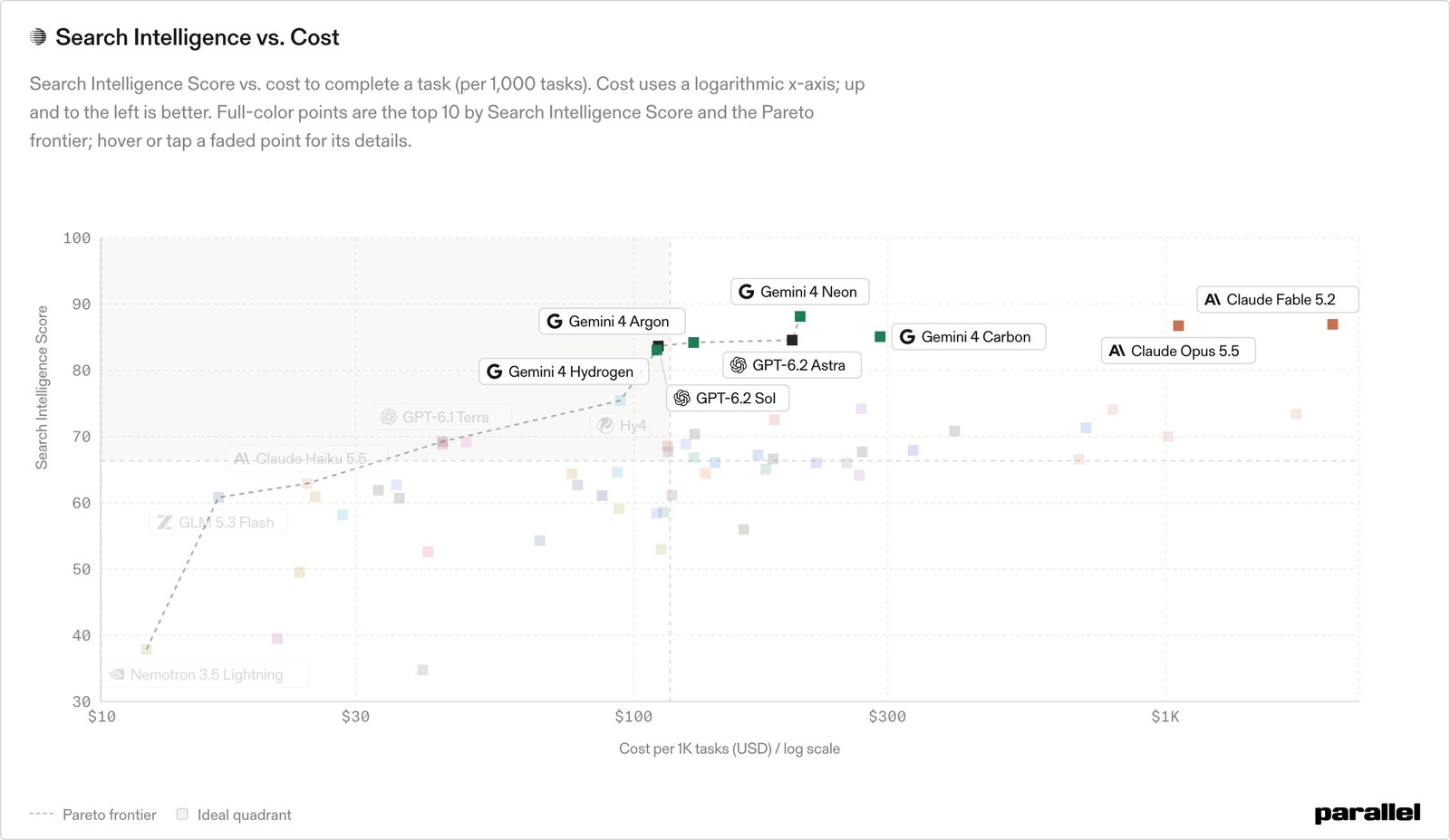
"Up to 10x cheaper than the next best" checks out exactly: Fable 5.2 is second at 86.94 and costs $2.063 per task to Neon's $0.2056, a ratio of 10.0. But Parallel's notes say the four Gemini runs were at high effort and Fable's at max. And the lead is 1.19 points. With about 100 tasks per suite, my rough binomial estimate of one standard error on each model's mean is about 1.9 points, so the gap is inside one standard error. Below Neon, GPT-6.2 Astra scores 84.55 at $0.1987 a task, slightly cheaper than Neon, and Gemini 4 Argon 84.2 at $0.1296.
Read it as: on web research with a search tool, Neon at high effort is as good as anything measured and far cheaper than Anthropic's models at max. It is not evidence that Neon is the most capable model overall, and Parallel does not say it is.
Fabrication, on two different meters
Google says Neon records "our lowest fabrication rate yet in internal Google Antigravity testing". I can't see that test. AA has a public meter that is close in spirit. On AA-Omniscience the hallucination rate counts how often a model answers wrongly instead of declining, out of the questions it doesn't get right (the definition the Muse Wonder piece worked through). On that meter Neon at xhigh is 14.4%. Carbon at high is 11.4%, Carbon at medium 4.2%, Argon 4.3% and Hydrogen at xhigh 8.5%; only Carbon at low (19.8%) is higher. So on AA's measure Neon at its top level guesses more often than the other Gemini 4 models at theirs. It also gets more right (60.5% accuracy, against 58.3% for Carbon high), and it is far below Opus 5.5 at max (50.3%), Fable 5.2 at max (59.3%) and GPT-6.2 Astra at max (59.1%).
These two claims don't contradict each other. They measure different things: Google's is fabricated results inside agent sessions, AA's is closed-book guessing. But "lowest fabrication rate yet" should not be read as "least likely to make something up when it doesn't know".
The safety card compares Neon with Argon
The model card's Frontier Safety section ran a "Material Capability Change" assessment against "the most recent model version subject to a critical capability assessment, which was Gemini 4 Argon", found an increase "below our MCC threshold", and carried Argon's determinations forward: CBRN biological and cybersecurity uplift critical capability levels "cannot be ruled out", the rest not reached. That reads oddly to me. Neon outscores Argon by eleven points on AA's index, which is a large step to call below a materiality threshold. The same section also says Carbon was also evaluated under the framework, with its own report, and Carbon came out after Argon. The full Neon safety report "will be available in the coming days". I'd wait for it before taking the MCC conclusion at face value.
Pricing, tiers and context
Neon is $3.00 per million input tokens and $15.00 per million output, thinking included, with cached input at $0.15. There is no long-context tier: Google's card says "1M flat", unlike models that triple the rate past 200K tokens. Batch and Flex halve everything to $1.50 and $7.50; Priority is $5.40 and $27.00. There is no free tier. Grounding with Google Search is 5,000 free requests a month shared across Gemini 3 and newer, then $14 per thousand. AA records the window as 1,000,000 tokens; Google's spec says 1,048,576.
One migration detail matters for anyone coming from Gemini 3: Neon does not support explicit caching (cachedContents, caches.create), and implicit caching only applies to prompts of at least 4,096 tokens. Carbon and Argon are implicit-only too, so from inside Gemini 4 nothing changes. From Gemini 3, the 95% discount stops being something you pin and becomes something the server decides for you.
What I'd do with it
If you run Carbon in an agent loop today, move to Neon at high on December 1, when Carbon's price doubles. On AA's numbers Neon high gets within half a point of Carbon high's index in a bit over a third of the time, and at 48% of its standard cost per task. Until then, Carbon at its introductory price is no worse a deal.
If you are choosing between labs rather than within Google's, Neon at xhigh is not the cheap option it looks like next to Opus. GPT-6.2 Astra at xhigh matches it for 39% of the cost per index task, and Sol at max is within about four points for a sixth of the cost. Where Neon earns its price is long agent runs inside Antigravity, where AA's Coding Agent Index has it level with Fable 5.2 at less than half the money. That is a harness-plus-model result, and it is the one I'd test first on my own tasks.
"Between Carbon and Hydrogen" is Google's price list talking. On the index, Neon is the best Gemini there is.
Sources, and what I ran
Everything was read on 2026-11-20. AA's per-variant records came from the JSON embedded in artificialanalysis.ai/models/gemini-4-neon (Neon's four variants plus a comparison set covering the rest of the Gemini 4 family, Opus 5.5, Fable 5.2 and GPT-6.2), its leaderboard page for the variant ranking, and artificialanalysis.ai/agents/coding-agents for the Coding Agent Index and its per-agent cost, time, steps and tokens. I checked that Carbon's output cost equals its output tokens times $20 per million to confirm which price AA applies. Dividing AA's index-run input dollars by Neon's prices ($3.00 for non-cached input and cache writes, $0.15 for cache reads) gives back AA's own count of 8,118,042,892 input tokens exactly, so AA bills cache writes at the full input rate; the same holds for Carbon at $4.00 and $0.20. Google's claims are from the launch blog, the model card, the methodology PDF (read in full), the API docs and pricing page. Parallel's numbers, effort settings and task counts are from the data embedded in its leaderboard page; Vals' and Andon Labs' from their public boards. The token counts per task from cache dollars, the percentages and the binomial noise estimate are my arithmetic on those figures. I ran no model. On 23 November I added the sprite-stacking example from fofr's three posts and Kimo's original, read through the fxtwitter mirror; the clip is cut from fofr's two videos.